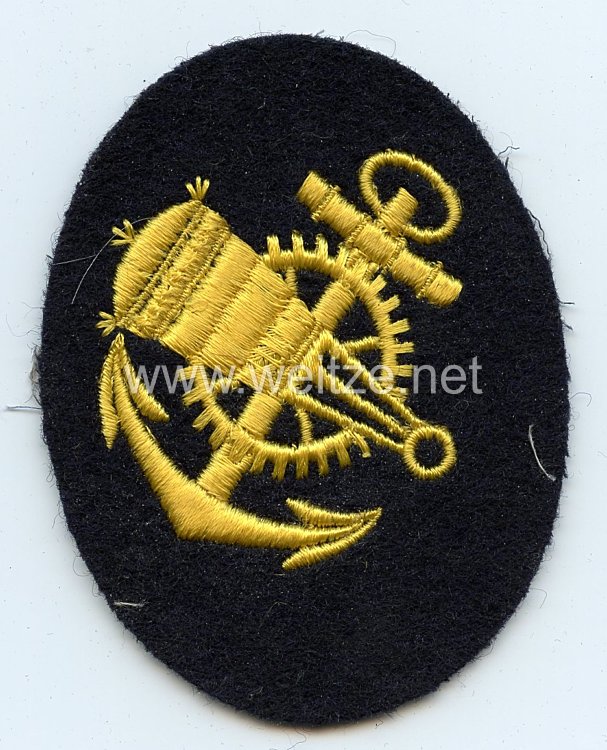
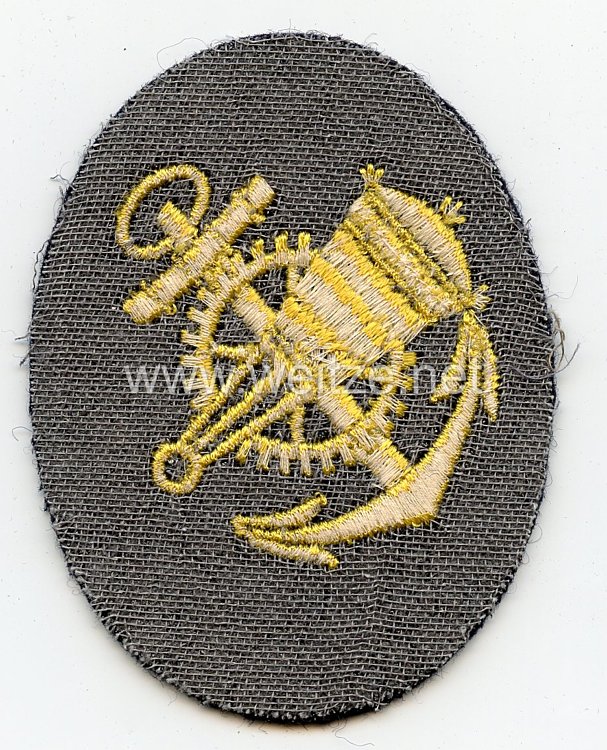
Kriegsmarine Sleeve Insignia Career Path Sperrwaffen (Barrier Weapons) - Mechanikermaat (Mechanic Petty Officer)

for the blue jumper, condition 2.
376587
12,00

Kriegsmarine Sleeve Insignia Career Path Sperrwaffen (Barrier Weapons) - Mechanikermaat (Mechanic Petty Officer)

The Kriegsmarine sleeve badge for the Sperrwaffen (Mine Warfare) career path - Mechanikermaat represents a specialized rank within the German Navy during World War II. These badges were worn on the blue work blouse and served for immediate identification of a naval serviceman's qualification and rank.

The Sperrwaffen formed a highly specialized and technically demanding branch within the Kriegsmarine. This division was responsible for the development, maintenance, and deployment of mine barriers, underwater obstacles, and other defensive installations designed to prevent enemy ships and submarines from entering strategically important waters. The significance of this weapon branch became particularly evident in coastal defense operations and in protecting German ports.

The rank of Mechanikermaat corresponded to a petty officer with specific technical training. The term “Maat” traditionally designated an experienced petty officer in the German Navy, while the additional designation “Mechaniker” (mechanic) indicated specialized technical qualification. These men were responsible for the maintenance, repair, and technical operation of complex mine warfare systems.

The Kriegsmarine sleeve badges followed a strictly regulated system established in various service regulations. The Anzugordnung für die Kriegsmarine (Uniform Regulations for the Navy) of 1937, with subsequent supplements and amendments, precisely regulated the appearance, placement, and wearing of all uniform insignia. Career path badges were typically worn on the left upper arm and combined rank stars or chevrons with a career badge indicating the specific specialty.

For the Sperrwaffen career path, the characteristic symbol was usually a stylized representation associated with mines or barrier systems. These badges were mounted on a dark blue background that harmonized with the blue work blouse. The blue blouse was part of the working and shipboard uniform and was worn during daily duty aboard ships and in naval bases.

The technical training to become a Mechanikermaat in the mine warfare career path was extensive and demanding. Candidates had to possess not only basic mechanical knowledge but also develop a deep understanding of complex firing systems, anchoring mechanisms, and the physical principles of various mine types. The Marineartillerieschule (Naval Artillery School) in Swinemünde and other specialized training facilities were responsible for training these specialists.

During the war, the mine warfare division played a crucial role in German defensive strategy. The mining of the Baltic Sea and other strategic waterways was intended to restrict the freedom of movement of Allied forces. Simultaneously, Mechanikermaten were also involved in clearing German waterways to ensure safe passages for German ships.

The production of these sleeve badges was carried out by various authorized manufacturers who had to meet the strict quality standards of the Kriegsmarine. The badges were typically produced in hand embroidery or machine embroidery on cloth backing. The materials used varied throughout the war, with later productions often resorting to simpler and more cost-effective manufacturing methods.

The collecting and study of such militaria objects today provides important insights into the organizational structure, hierarchy, and technical specialization of the Kriegsmarine. These sleeve badges are material evidence of a complex military organization and document the various specialized fields required for operating a modern 20th-century navy.

From a historical perspective, these objects enable a nuanced understanding of the Kriegsmarine beyond the well-known surface ships and submarines. The mine warfare career path and its specialized personnel were indispensable to the overall strategy of German naval operations between 1935 and 1945.

The condition classification “Zustand 2” (Condition 2) in militaria collecting terminology typically indicates a well-preserved item with minor signs of age and use, representing an authentic piece of naval history that has survived nearly eight decades.