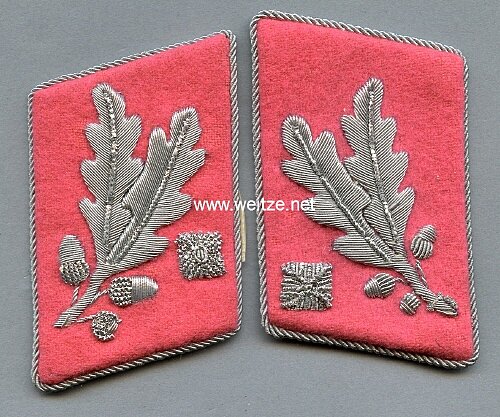
Collar Tab for an SA-Brigadeführer of SA-Gruppe Südmark

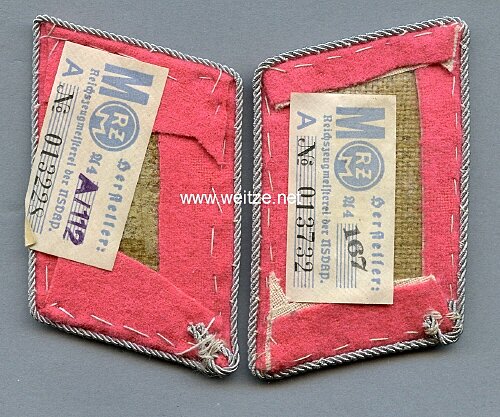
unpaired, hand-embroidered metal thread on pink wool, circa 1939. Unissued condition, with RZM paper label. Condition 1a.
216087
750,00

Collar Tab for an SA-Brigadeführer of SA-Gruppe Südmark

This collar tab for an SA-Brigadeführer of the SA-Gruppe Südmark represents a significant testimony to the uniform development and hierarchical structures within the Sturmabteilung (SA) during the National Socialist era. This single, unpaired collar tab dates from around 1939 and is distinguished by its hand-embroidered metal thread work on a pink background.

The SA-Gruppe Südmark was established in 1938 following the so-called “Anschluss” (annexation) of Austria to the German Reich. It encompassed the territory of the former Republic of Austria, with the exception of Tyrol and Vorarlberg. The Gruppe Südmark had its headquarters in Vienna and was one of the geographically defined organizational units of the SA that covered the entire Reich territory. The designation “Südmark” was intended to emphasize the historical connection to the German cultural sphere.

The rank of Brigadeführer corresponded roughly to a major general in the Wehrmacht within the SA hierarchy. This rank group belonged to the higher leadership positions within the organization. A Brigadeführer typically commanded a Brigade, which consisted of several Standarten and could comprise several thousand men. Holding this rank was associated with considerable responsibility and authority within the SA structure.

The collar tabs served as essential identification marks for rank and affiliation within the SA. The pink color of the background identified the specific assignment to the SA-Gruppe. Different SA-Gruppen used different collar tab colors for identification. The metal thread embroidery, executed by hand, was a quality feature for higher ranks. The execution in metal thread indicated the use of aluminum or silver-plated threads that produced a characteristic luster.

The present RZM paper label is of particular significance for the authenticity and historical classification of the object. The Reichszeugmeisterei (RZM) was founded in 1929 and was the central procurement and inspection office for uniforms, insignia, and equipment of the NSDAP and its formations. From 1935, the RZM system was systematized, and all official effects had to bear RZM approval. Manufacturers received specific RZM numbers that were noted on the labels. This was intended to ensure quality standards and control production.

The unworn condition of the collar tab with preserved paper label is remarkable, as such effects were usually attached to the uniform immediately after acquisition. This suggests that the piece was either procured as a reserve, never deployed, or that historical circumstances prevented its use. Toward the end of the 1930s and especially after the outbreak of war in 1939, the role of the SA changed fundamentally.

After the “Röhm Affair” of 1934, in which the SA leadership was largely eliminated, the organization increasingly lost political significance. The SA, which had functioned as the paramilitary combat force of the NSDAP in the 1920s and early 1930s, was degraded to a largely ceremonial organization. The SS took over the roles formerly assigned to the SA. Nevertheless, the SA formally maintained its structures and ranks, and uniform regulations continued to be observed.

In 1939, corresponding to the dating of this collar tab, Europe stood at the beginning of World War II. The SA played only a subordinate role in war preparations and during the war. Its members were frequently conscripted into the Wehrmacht, and the organization concentrated on home front tasks, pre-military training, and auxiliary services.

The craftsmanship quality of the metal thread embroidery on this collar tab reflects the high standards that applied to leadership ranks. While simple SA men and lower ranks often wore machine-made or simpler insignia, the effects of higher leaders were often crafted in elaborate handwork. This not only underscored the hierarchical difference but also the prestige character of these positions.

From today's perspective, such objects are important material witnesses to a dark epoch of German history. They document the organizational structures, visual self-representation, and hierarchical systems of the Nazi regime. For historical research and museums, such objects have significant documentary value, as they help to understand and preserve the structures and material culture of this period.