Kingdom of Westphalia Helmet for Enlisted Men of King Jerome's Gardes du Corps

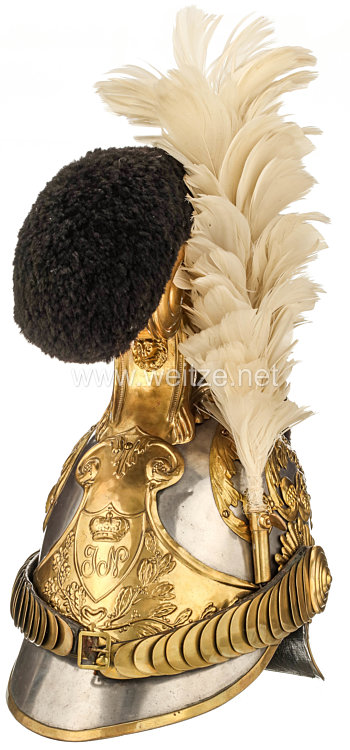
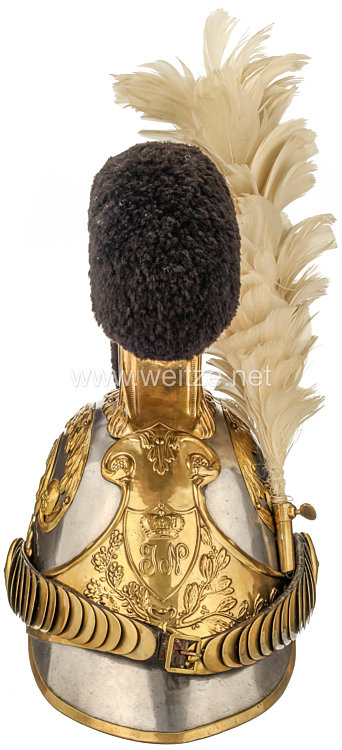
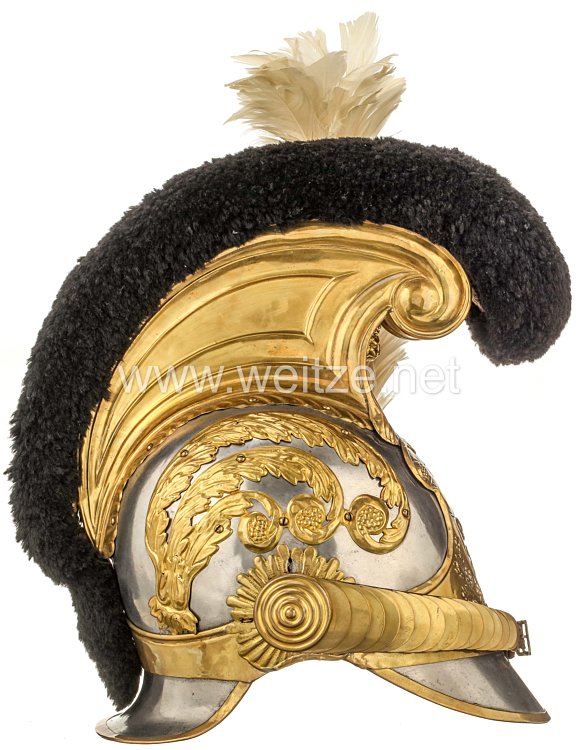
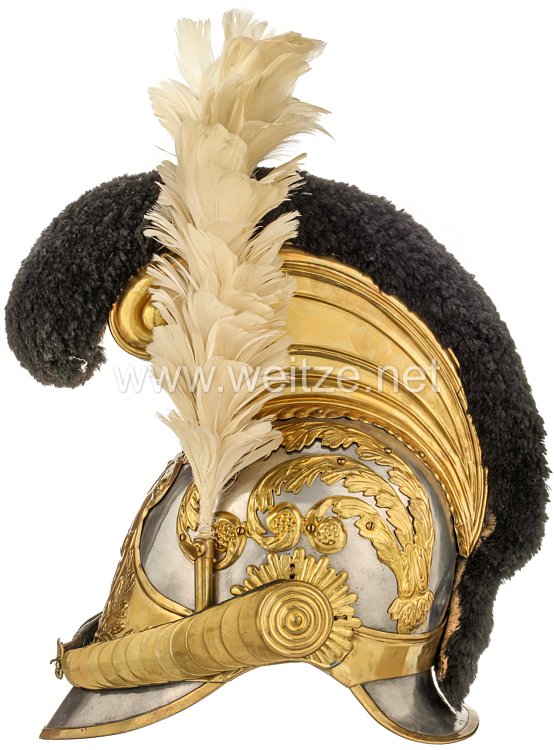
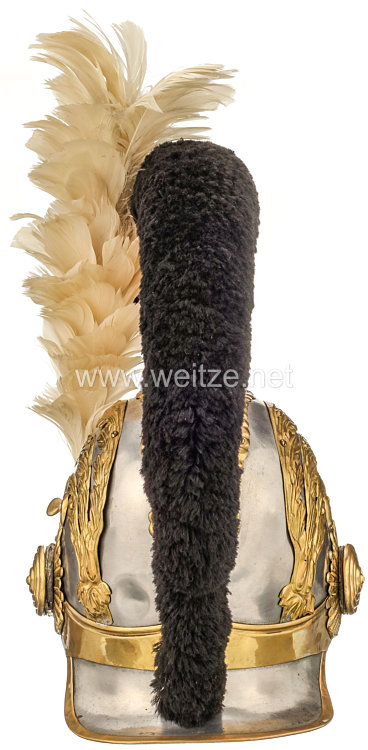
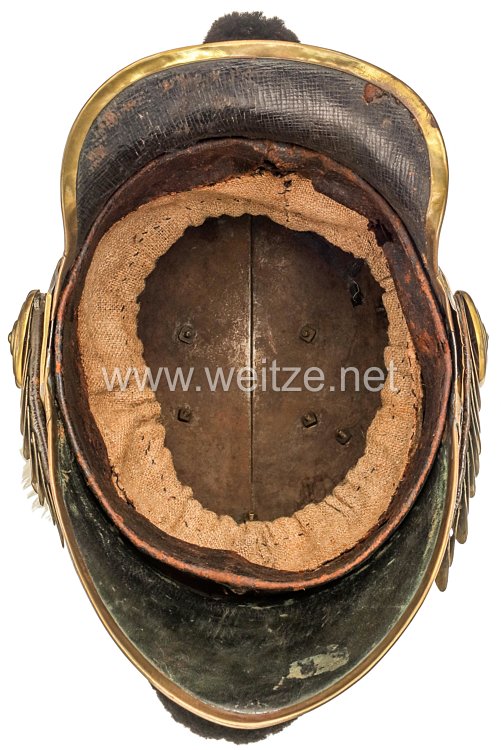
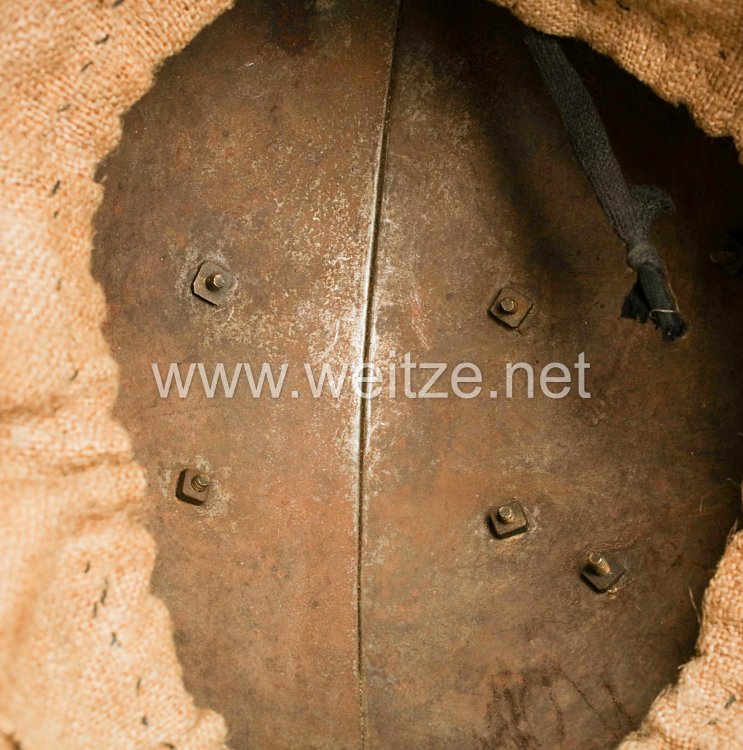
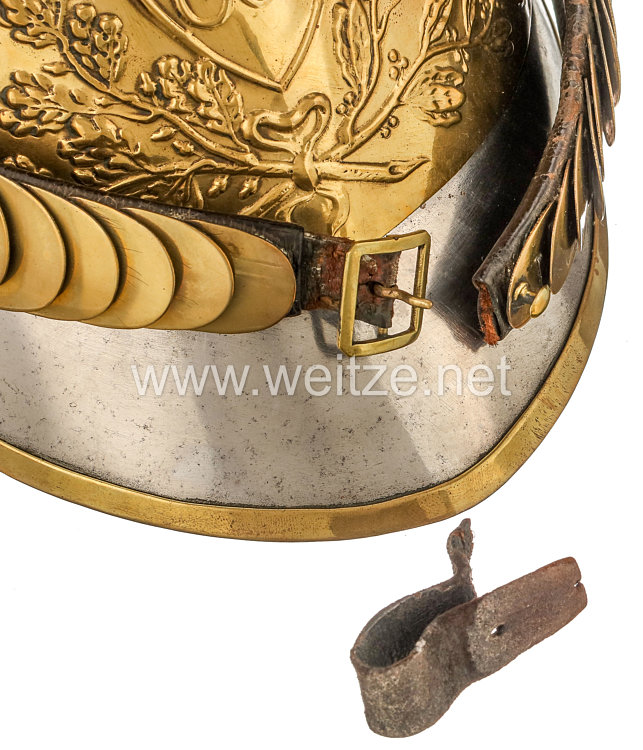
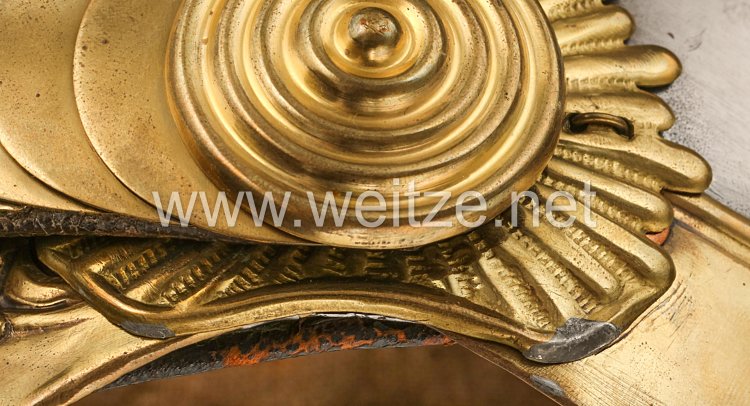
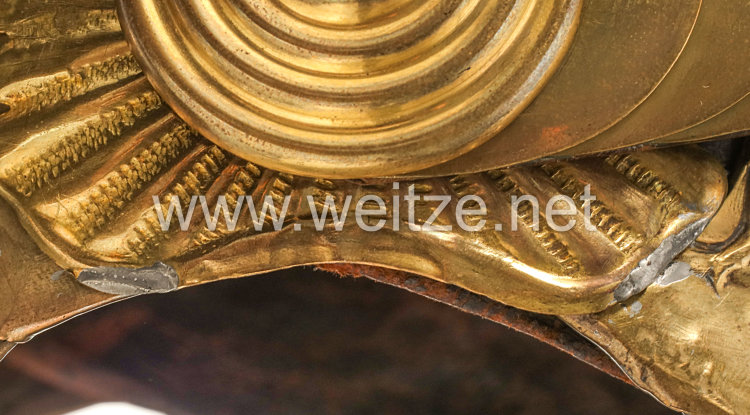
Circa 1812. The tall helmet skull constructed from two halves of bright steel. Large brass comb with replaced black wool caterpillar, the brass comb fronted with a relief lion head ornament, below which the large brass plate with the crowned cipher “JN” for Jérôme Napoleon, the large flat scale chin chains were replaced in old times, star-shaped ornaments beneath the rosettes, on the sides above them floral brass ornaments, on the left side in the socket with white replaced plume. The front and rear visors with brass edging, the rear visor lined with black leather, the front visor with green leather. Interior with the original leather sweatband and the original linen canvas lining.
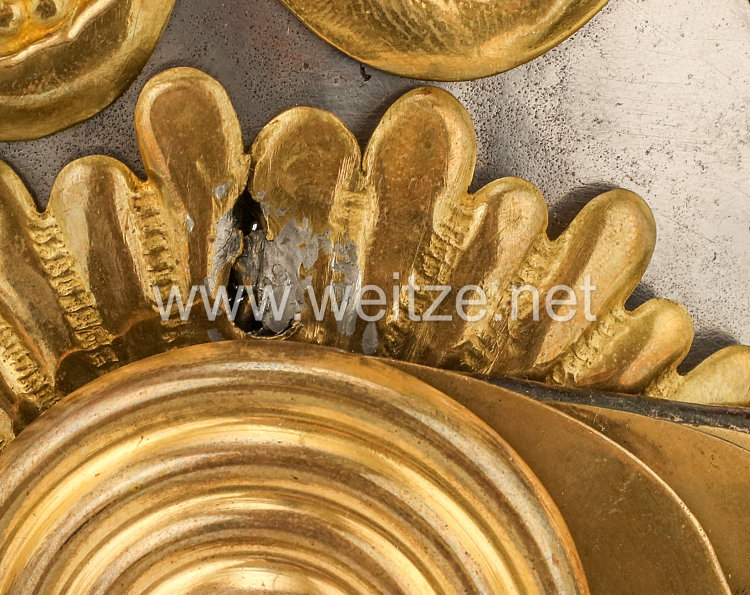
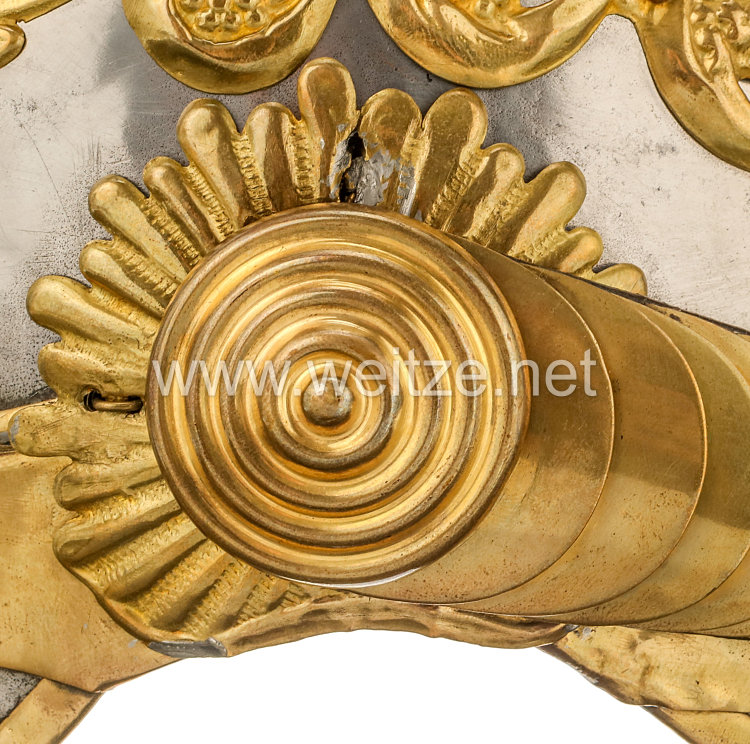
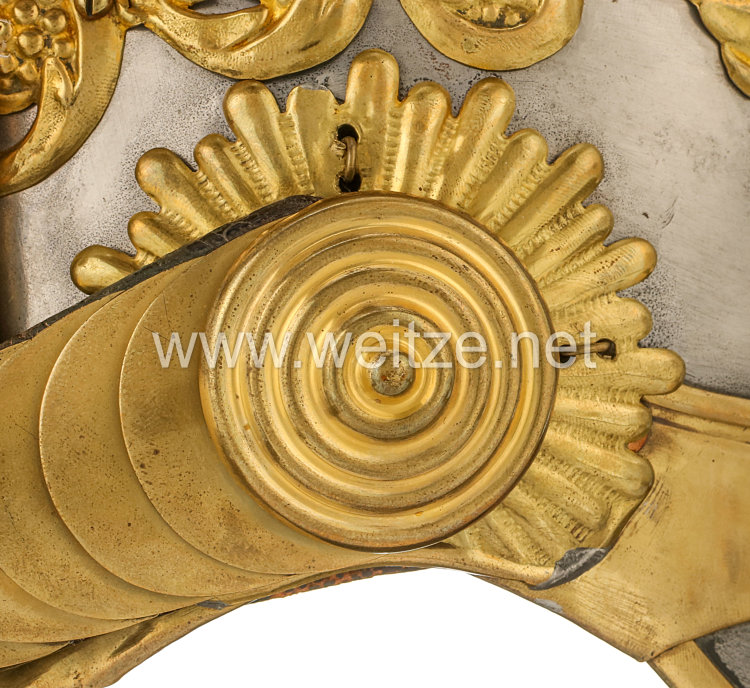
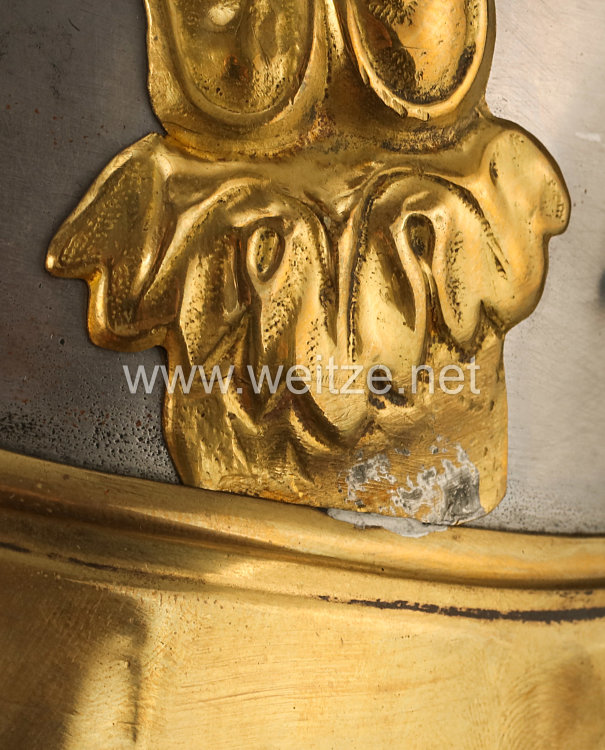
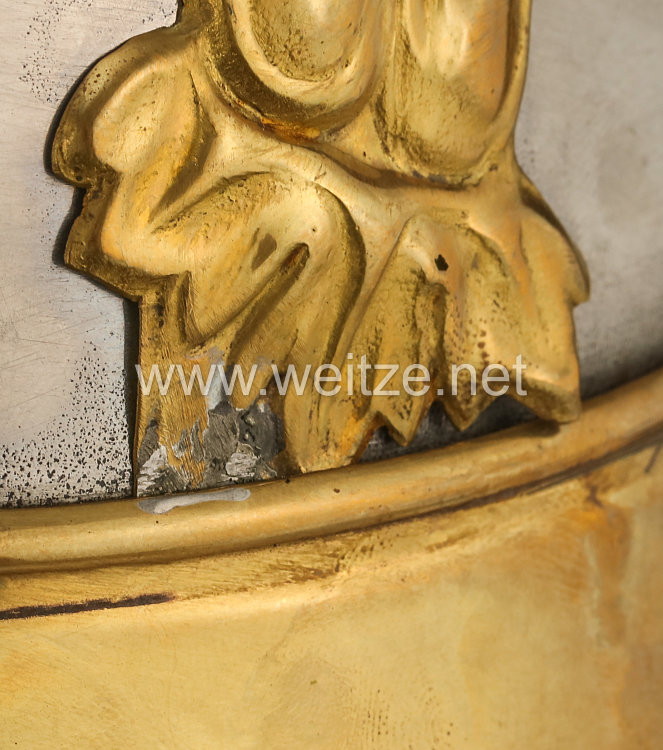
One of the two star-shaped ornaments beneath the rosettes with an old, small repair. The tongue of the leather strap under the scale chains torn off but present, thus complete. Despite the minor wear and aging signs as well as the replacements, a helmet in very fine condition. Condition 2.

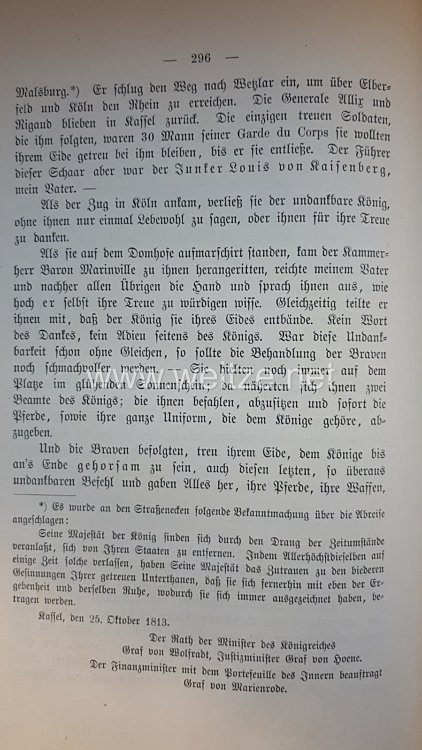
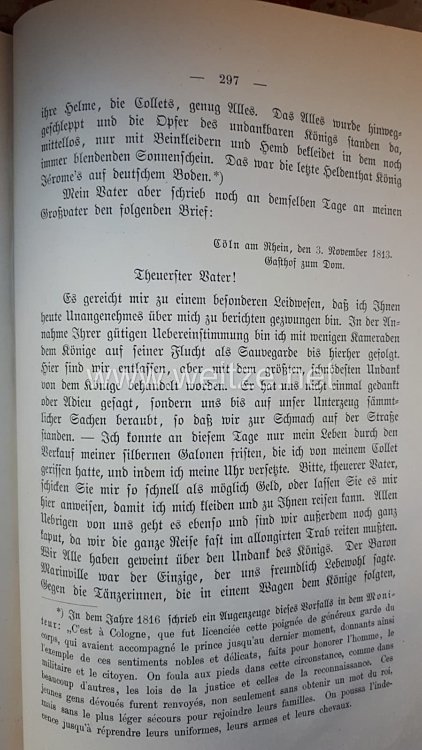
The Kingdom of Westphalia was established by Napoleon after the Peace of Tilsit (1807). His youngest brother Jérôme Bonaparte became king. The Gardes du Corps were established in 1808 with the strength of one squadron, approximately 100 men. Their duties included guarding the king. In 1812 the unit participated in the Russian campaign but escaped the catastrophe as they continued to accompany the king. The unit was known for its magnificent equipment. After the Battle of Leipzig, the troops of the Kingdom of Westphalia dissolved. The Gardes du Corps, however, accompanied their king as far as Köln, where the unit was then disbanded.

An extremely rare piece of historical significance! Fewer than 10 examples are known worldwide.

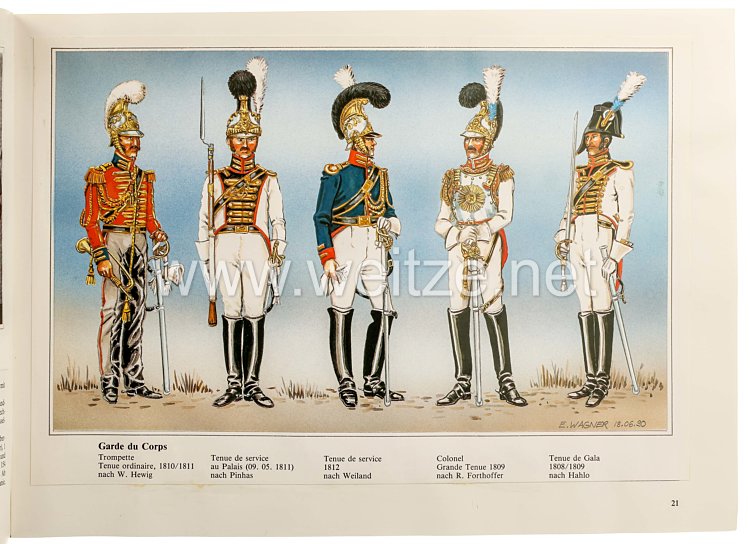
A depiction of the uniforms of the Gardes du Corps of the Kingdom of Westphalia can be found here:

https://www.dhm.de/datenbank/img.php?img=mgr04950&format=1

Included is a print showing a depiction of an officer of the Gardes du Corps and a text about the dissolution of the unit in Köln 1813.


344187

Helmet for Enlisted Men of the Gardes du Corps of King Jérôme – Kingdom of Westphalia

Among the rarest surviving artifacts from the Napoleonic era, objects from the Kingdom of Westphalia occupy a unique place in military collecting. This enlisted man's helmet from the Gardes du Corps of King Jérôme Bonaparte represents an extraordinary survival from a short-lived but historically significant satellite state of Napoleonic France.

The Kingdom of Westphalia – Napoleon's Client State

The Kingdom of Westphalia was created by Napoleon in 1807 by merging territories ceded by the Kingdom of Prussia in the Peace of Tilsit. This client state of France in present-day Germany existed from 1807 to 1813. While formally independent, it was ruled by Napoleon's youngest brother, Jérôme Bonaparte. Napoleon sought to model the Westphalian army on the French system, creating a military establishment that mirrored French organizational principles while developing its own distinctive character.

The Gardes du Corps – A Royal Bodyguard

In 1808, the Westphalian Guard was established, comprising a Grenadier infantry battalion, a Jäger infantry battalion, a Chevau-léger cavalry regiment, and a Garde du Corps cavalry squadron. The Guard cavalry consisted of a single squadron of approximately 100 men, whose primary role was the protection of the King.

It is noteworthy that Napoleon himself objected to the establishment of the Gardes du Corps, as he did not consider such a unit appropriate for his family. Despite his objections, the unit was maintained and became emblematic of the Westphalian court's aspirations to royal grandeur.

The Gardes du Corps wore uniforms similar to those of the French cuirassiers, but with significant differences: they were equipped with half-cuirasses — wearing only a front breastplate without a back plate — and Raupenhelm (caterpillar helmets). This distinctive combination gave the unit a unique and imposing appearance that set them apart from their French counterparts.

The Helmet – A Raupenhelm of Distinction

This helmet is a Raupenhelm, the characteristic headgear of the Gardes du Corps. Its high helmet bell is constructed from two halves of polished steel. A large brass comb surmounted by a black wool caterpillar crowns the helmet, with the comb's front featuring a sculpted lion head decoration. Below this sits the large brass shield bearing the crowned cipher “JN” for Jérôme Napoleon — the defining insignia that unmistakably identifies this helmet with the Westphalian king. Large flat scale chains, star-shaped decorations beneath the rosettes, and floral brass ornaments on the sides complete the elaborate decoration. A plume holder on the left side accommodates a white plume. The front and neck visors are edged with brass rails, with the neck visor lined in black leather and the front visor in green leather. The interior retains the original leather sweatband and original sackcloth lining.

Sources confirm that officers of the Garde du Corps had distinct helmets, with an officer's helmet from the period 1809–1813 documented separately. The present example is explicitly an enlisted man's (Mannschaften) helmet.

The 1812 Campaign and the Fate of Westphalia

In 1812, the Kingdom of Westphalia committed a substantial military force to Napoleon's Russian campaign. Together with the V Corps (Poles), VII Corps (Saxons), and IV Cavalry Corps, the Westphalian VIII Corps was assigned to the 2nd Support Army under the command of Jérôme Bonaparte. On 24 June 1812, the corps comprised 15,885 infantry in 18 battalions, 2,050 cavalry in 12 squadrons, and 34 artillery pieces.

Nevertheless, after being harshly criticized in a letter by his brother Napoleon, Jérôme resigned his command on 14 July and returned home. King Jérôme left the army in mid-July and took the Garde du Corps back to Kassel with him. The consequences for the rest of the Westphalian contingent were catastrophic: by the end of the campaign, out of the initial 25,000 soldiers and 800 officers of the Kingdom of Westphalia, only 600 men and 18 officers returned, with a further 600 defecting to Russia.

The final chapter came with the Battle of Leipzig on 19 October 1813. Prussian troops occupied Westphalia on 26 October, and the kingdom was dissolved, restoring the status quo of 1806, except for the counties of Rietberg and Stolberg-Wernigerode, which were annexed by Prussia. When the Kingdom of Westphalia came to its end in September 1813, the Garde du Corps squadron was disbanded.

The Afterlife of the Gardes du Corps

A remarkable footnote in the survival history of these objects is the documented fact that in the nineteenth-century Cologne Carnival, Gardes du Corps helmets and cuirasses were for a time used as costume accessories. This secondary use as carnival props may help explain both how certain pieces survived and the condition in which they have come down to us.

A visual record of the unit survives in a painting by François Josèphe Kinson, dating to 1809/10, which depicts King Jérôme wearing the uniform of his Garde du Corps in the park of Schloss Napoleonshöhe.

This helmet stands as a tangible witness to Napoleon's ambitious project of remaking Europe — a project that, in the case of Westphalia, produced a kingdom that lasted barely six years but left behind artifacts of remarkable military splendor, of which this Raupenhelm is among the most significant surviving examples.