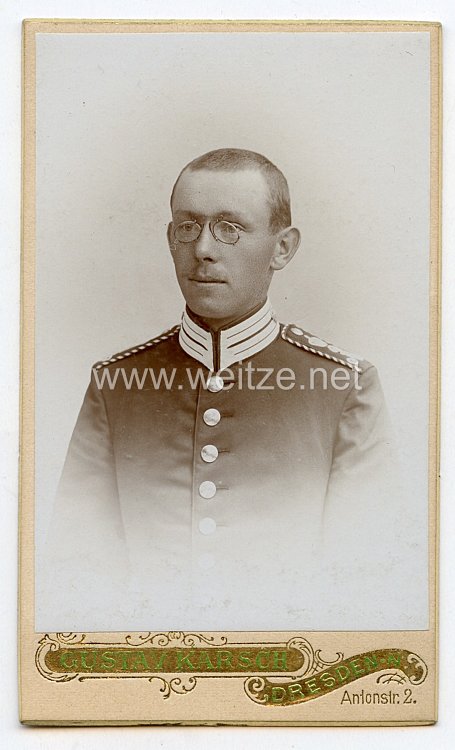
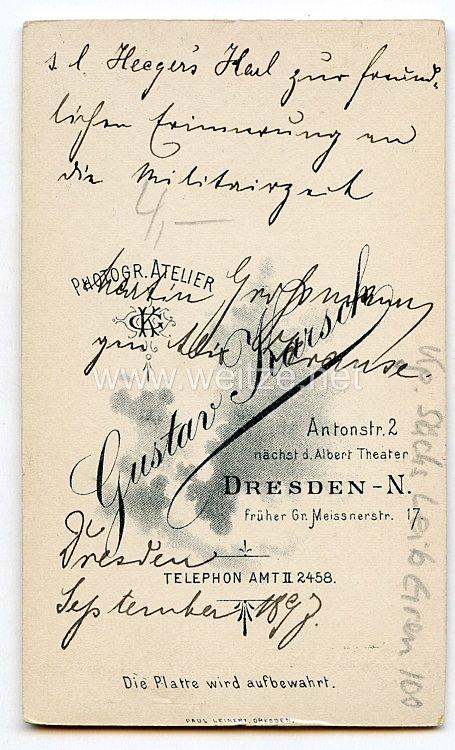
Saxony Cabinet Photo One-Year Volunteer in the 1st (Leib) Grenadier Regiment No. 100
This cabinet photograph depicts a One-Year Volunteer (Einjährig-Freiwilliger) of the 1st (Royal) Grenadier Regiment No. 100 in Dresden around 1900, documenting a significant aspect of Wilhelmine military life in the Kingdom of Saxony.
The 1st (Royal) Grenadier Regiment No. 100 was one of the most prestigious units in the Saxon Army. As a royal bodyguard regiment, it enjoyed special royal patronage and possessed a long tradition. The regiment was stationed in Dresden, the capital of the Kingdom of Saxony, and played a central role in the city's social and military life. The designation “Leib-” (Royal) referred to the special connection with the Saxon royal house and bestowed considerable prestige upon the unit.
The status of One-Year Volunteer was a distinctive institution in the German military system of the Imperial era. This institution was introduced through the Military Order of 1814 in Prussia and later adopted by other German states. It allowed young men with higher education, particularly those with an Abitur (university entrance qualification) or equivalent certificate, to reduce their military service to one year instead of the regular two or three years.
However, One-Year Volunteers had to meet substantial requirements. They had to finance their entire equipment, uniform, and provisions themselves, which made this status effectively a privilege of the wealthy middle class. The costs could amount to several thousand marks, a considerable sum for that time. After successfully completing their one-year service, these volunteers had the opportunity to train as Reserve Officers, which carried considerable social prestige.
The cabinet card format was the standard format for portrait photography around 1900. Measuring approximately 10 x 15 cm (the present example at 6.1 x 10.2 cm represents a smaller variant), cabinet cards were larger than the earlier carte-de-visite photographs and allowed for more detailed representations. The photographs were mounted on thick cardboard, with the photographer's studio usually noted on the back or bottom of the front.
Dresden had numerous renowned photographic studios around 1900 that specialized in military portraits. Soldiers had themselves photographed in full uniform to leave these memories of their service time with their families or to keep as personal mementos. For One-Year Volunteers, such a photograph was particularly important as it documented their social status and education.
The uniform of the 1st (Royal) Grenadier Regiment No. 100 followed Saxon military regulations and displayed characteristic features. Saxon infantry regiments wore dark blue tunics with specific distinction colors. The Royal Grenadier Regiment had special insignia and decorations as particular distinctions marking its position as a royal bodyguard regiment.
The period around 1900 was a time of intense militarization of German society. Military service was considered an honorable duty, and the status of reserve officer opened doors in administration, business, and society. The institution of One-Year Volunteers created a bridge between the educated middle class and the military, contributing to the permeation of society with military values.
The Saxon Army maintained its independent organization within the German army until 1918. It had its own traditions, uniforms, and structures, but was subordinated to the German Kaiser in time of war. The XII (Royal Saxon) Army Corps formed the organizational framework for Saxon troops.
Such photographic documents are important sources for military and social history today. They document not only uniforms and equipment but also the social structures and values of the Wilhelmine era. This cabinet photograph is an authentic testimony of that time, showing the close connection between education, social status, and military service in the German Empire.