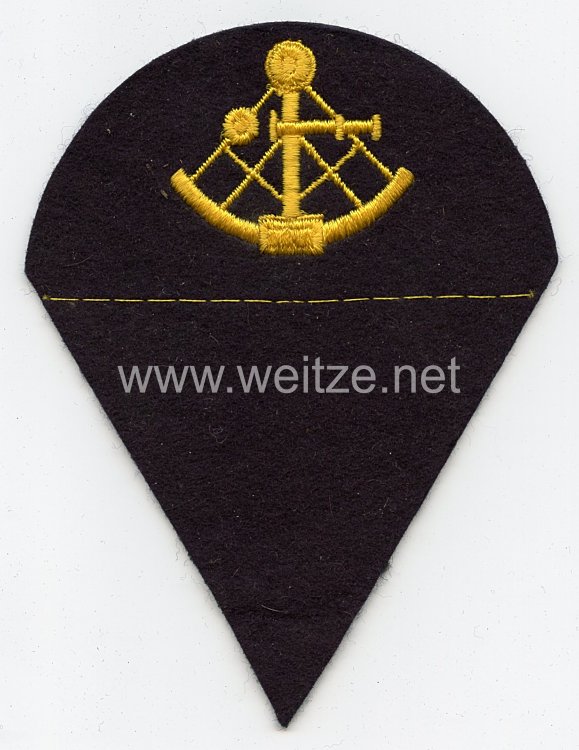
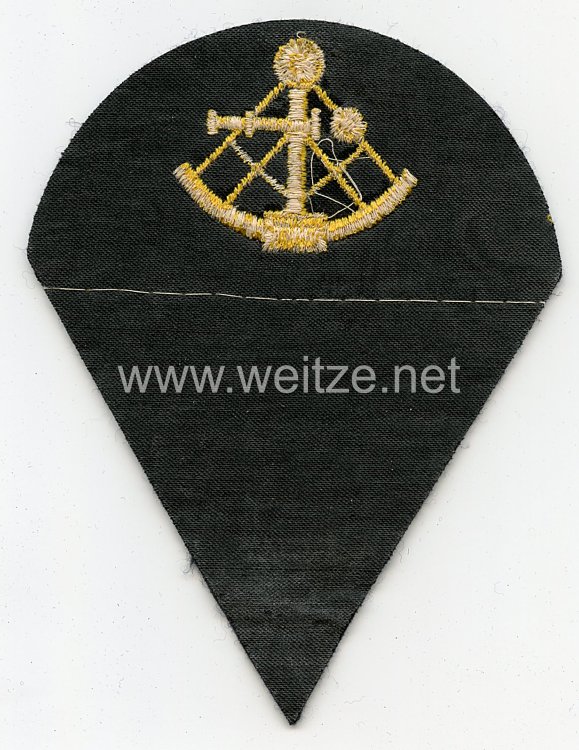
Kriegsmarine Enlisted Ranks Sleeve Insignia for Survey Career Path
The Kriegsmarine enlisted personnel sleeve insignia for the Survey Career Path (Vermessungslaufbahn) represents a fascinating example of the complex specialization systems within the German Navy during World War II. These badges served not only to identify specialized personnel but also reflected the high importance placed on technical and scientific disciplines in maritime warfare.
The Kriegsmarine, officially established on June 1, 1935, developed a comprehensive system of career path insignia to identify various specializations within its enlisted ranks. The Survey Career Path belonged to the technical-scientific branches and included personnel entrusted with hydrographic surveys, cartography, and nautical measurements. These activities were crucial for navigation, the creation of nautical charts, and strategic planning of maritime operations.
According to the uniform regulations for the Kriegsmarine, the insignia was worn on the left upper sleeve of the uniform. The version for the Kolani (colonial uniform) designates the tropical-suitable variant of the naval uniform, designed for deployment in warm climates. The Kolani typically consisted of light, breathable fabric and was worn by naval units deployed in southern waters, the Mediterranean, or overseas territories.
The design of sleeve insignia followed strict guidelines of naval service regulations. For the Survey Career Path, the badges displayed characteristic symbols representing the nautical-scientific nature of the work. These were typically applied in dark blue or black on the uniform fabric, with different versions existing for various uniform types.
The hydrographic services of the Kriegsmarine had a long tradition dating back to the Imperial Navy. The Naval High Command maintained specialized survey ships and units that continuously collected data on ocean depths, currents, coastal formations, and other navigation-critical information. Particularly during World War II, this activity was of strategic importance for U-boat operations, mine-laying, and amphibious landing operations.
Enlisted personnel in the Survey Career Path underwent specialized training requiring mathematical, physical, and nautical knowledge. They worked with precise measuring instruments such as sextants, echo sounders, and geodetic devices. Their work contributed significantly to updating and improving nautical charts that were vital for the entire German Navy.
The present insignia shows typical signs of aging in the form of foxing stains, which is common with textiles from this era. These discolorations result from moisture and microbial growth and are characteristic of uniform items stored over decades. The condition provides insight into storage conditions and the age of the object.
The manufacture of such insignia was carried out by authorized producers who had to meet the quality standards of the Kriegsmarine. After 1945, these insignia became important study objects for military history and are now part of museum collections as well as private militaria collections. They document the organizational structure and specialization within the German naval forces during one of the most significant military conflicts of the 20th century.
The scientific study of such insignia contributes to understanding the daily reality of naval personnel and illustrates how technical expertise and military organization were intertwined. The Survey Career Path represented an often-overlooked but essential aspect of maritime warfare that extended far beyond pure combat capability.