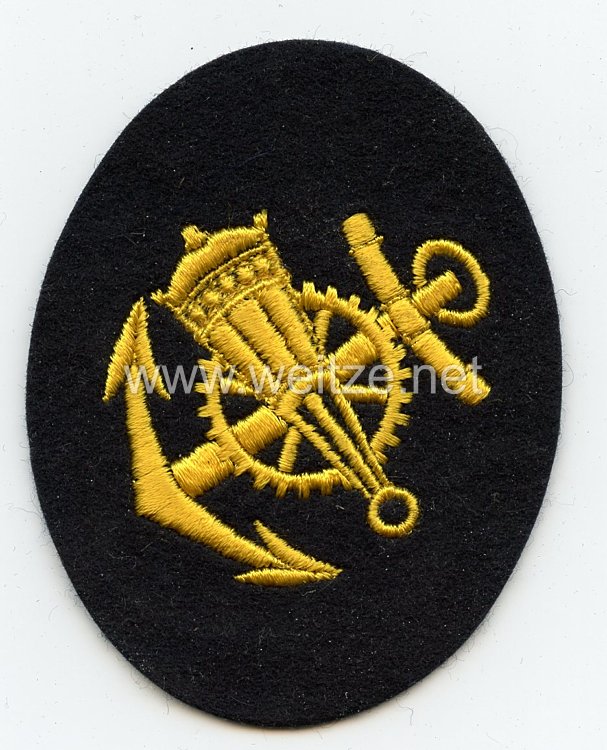
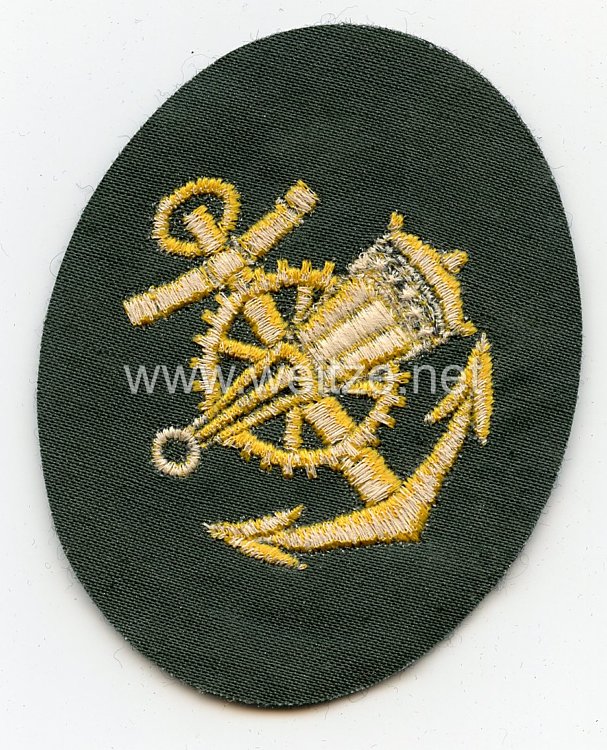
Kriegsmarine Sleeve Insignia Career Path Barrage Weapons - Mechanic Petty Officer

for the blue blouse, condition 2.
376586
12,00

Kriegsmarine Sleeve Insignia Career Path Barrage Weapons - Mechanic Petty Officer

The Kriegsmarine sleeve insignia for Career Track Mine Warfare - Mechanikermaat represents a significant element of the rank and service designation system within the German Kriegsmarine during World War II. This particular version for the blue work blouse identified petty officers of the mine warfare career track holding the rank of Mechanikermaat (technical petty officer).

The Kriegsmarine established a differentiated system of career track insignia after its founding in 1935, which identified the various technical and nautical specializations within the fleet. The mine warfare career track (Sperrwaffenlaufbahn) was one of these highly specialized branches, dealing with naval mines, mine barriers, net barriers, and other maritime obstruction devices. This branch played a crucial role in maritime warfare, both in offensive and defensive operations.

Career track insignia were worn according to the Dress Regulations for the Kriegsmarine and were affixed to both upper sleeves of the uniform. For the blue blouse, which was part of the daily service dress, the insignia were manufactured in a special version - typically as an embroidered or woven emblem on a dark background. The insignia for the mine warfare career track displayed characteristic symbols that referenced mine warfare.

The rank of Mechanikermaat corresponded to a petty officer with technical specialization. The term “Maat” traditionally designated a petty officer rank in the German Navy, while the prefix “Mechaniker-” indicated technical qualification. Mechanikermaten were responsible for the maintenance, upkeep, and operation of complex technical systems - in the case of the mine warfare track, particularly for mine mechanisms, firing devices, and laying apparatus.

The mine warfare branch gained considerable importance during World War II. The Kriegsmarine laid extensive mine barriers in the North Sea, the Baltic Sea, and off enemy ports to block Allied shipping routes. Simultaneously, German waters had to be protected against Allied mining operations. Personnel in the mine warfare career track therefore required highly specialized knowledge in hydrography, ballistics, mechanics, and electrical engineering.

Training to become a Mechanikermaat in the mine warfare career track took place at specialized naval schools and included both theoretical and practical components. Candidates had to acquire extensive knowledge about various mine types, their functioning, safety mechanisms, and laying procedures. Practical training frequently occurred aboard minesweepers, minelayers, and in specialized depots.

The blue blouse on which this sleeve insignia was worn was part of the regular service dress of the Kriegsmarine. It differed from the dress uniform and was worn during daily shipboard work and duties. The sleeve insignia on this uniform enabled quick identification of a sailor's career track and rank, which was essential for organization and service operations aboard ship.

The manufacture of these insignia was carried out by various authorized manufacturers who had to meet the strict quality standards of the Kriegsmarine. The insignia were typically produced with machine embroidery on wool felt or similar materials and displayed the characteristic symbols in metallic thread or corresponding threads in yellow or white.

After the end of the war in 1945, the Kriegsmarine was dissolved, and its uniforms and insignia became historical artifacts. Today, such sleeve insignia are important witnesses to naval history and are preserved by museums, archives, and private collectors. They document the complex organization and technical specialization within the German naval forces of this era.

The condition of preservation of such insignia varies considerably. The classification “Condition 2” according to common collector categories indicates a well-preserved specimen with minor signs of use. Factors such as light exposure, moisture, and mechanical stress over decades significantly affect the preservation of these textile militaria.

For military-historical research, such insignia provide important insights into personnel structure, technical specializations, and the organizational form of the Kriegsmarine. They complement archival sources and help to draw a more complete picture of maritime warfare during World War II.