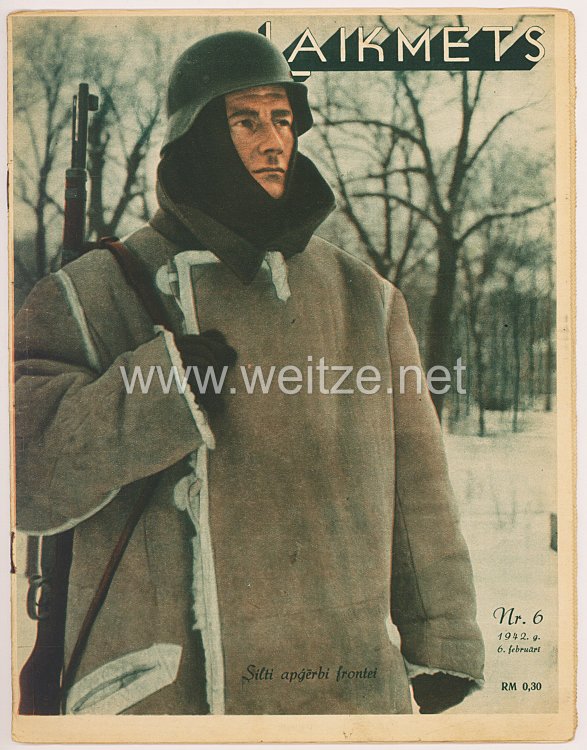
Third Reich / Estonia - Magazine “Laikmets” - Volume 1942 No. 6
The Magazine “Laikmets” and German Occupation Press in the Baltic 1941-1944
This 1942 issue of the magazine “Laikmets” (Latvian for “Era” or “Zeitgeist”), published by the Deutsche Verlags- und Druckerei-Gesellschaft im Ostland m.b.H. (German Publishing and Printing Company in the Ostland) in Riga, represents a significant historical document from the period of German occupation in the Baltic region during World War II.
Following the launch of Operation Barbarossa on June 22, 1941, the Wehrmacht conquered the Baltic states of Estonia, Latvia, and Lithuania within weeks. These territories had been under Soviet control since 1940. On July 25, 1941, the Reichskommissariat Ostland was established under Reich Commissioner Hinrich Lohse, assuming civil administration of the occupied territories. The capital of this Reich Commissariat became Riga, the Latvian metropolis.
The Deutsche Verlags- und Druckerei-Gesellschaft im Ostland m.b.H. was one of the most important propaganda institutions of the German occupation administration. It was specifically founded to control the media landscape in the occupied Baltic territories and shape it according to National Socialist ideology. The company ultimately reported to the Reich Ministry for Public Enlightenment and Propaganda under Joseph Goebbels and worked closely with the press office of the Reich Commissariat.
The magazine “Laikmets” was primarily aimed at the Latvian and possibly Estonian population and appeared in Latvian language. It was part of a comprehensive strategy to win over the local population for German rule and mobilize them against the Soviet threat. The National Socialists skillfully exploited the anti-communist and anti-Soviet sentiment that prevailed among large parts of the Baltic population following the Soviet occupation of 1940-1941 and the associated deportations and repressions.
In 1942, when this issue No. 6 appeared, the German occupation was in a phase of relative stability. The Wehrmacht stood deep inside the Soviet Union, and the occupation administration began to build long-term structures. Cultural and publishing institutions played a central role in this. Magazines like “Laikmets” were intended to fulfill various functions: they served ideological indoctrination, cultural integration of the population, dissemination of news from a German perspective, and legitimization of the occupation rule.
The content of such publications typically included reports on the course of the war from a German perspective, anti-Soviet and antisemitic propaganda, cultural contributions, articles about the “new European order” under German leadership, as well as practical information for the population. Attempts were often made to establish continuity with Baltic national traditions and present German rule as liberation from Soviet oppression.
The Deutsche Verlags- und Druckerei-Gesellschaft im Ostland published several newspapers and magazines in various languages. Besides Latvian publications, there were also Estonian, Lithuanian, and German-language periodicals. This media landscape was strictly controlled and censored. All publications had to comply with the guidelines of National Socialist press policy.
The technical production of such magazines involved considerable difficulties during wartime. Paper shortages, lack of printing capacity, and the general war situation complicated regular publication. Nevertheless, German authorities assigned the highest priority to maintaining propaganda activities, as they considered this essential for control of the occupied territories.
As the war progressed, and particularly after the defeat at Stalingrad in February 1943, the tone of the occupation press changed. Themes such as the “defense of Europe against Bolshevism” and recruitment for German military units were increasingly emphasized. The Baltic states, especially Estonia, became important recruitment areas for the Waffen-SS.
The magazine “Laikmets” and similar publications ceased publication in autumn 1944 when the Red Army reconquered the Baltic region. Many copies were destroyed, making surviving issues rare historical documents today. For historical research, such magazines offer important insights into the propaganda strategies of the German occupation power, the collaboration structures in the Baltic, and the complex history of this region during World War II.
Today, such objects are preserved in archives, museums, and collections, serving the scientific study of National Socialist rule in the Baltic and education about the mechanisms of totalitarian propaganda.