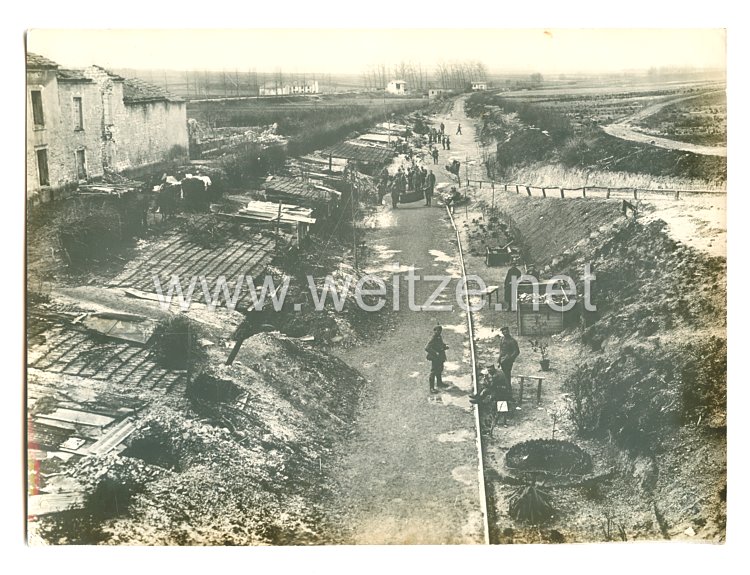
World War I German Army Press Photograph: A Colony of German Dugouts
This press photograph from World War I documents a colony of German dugouts and represents a significant contemporary historical testimony to military infrastructure and propaganda work during the Great War of 1914 to 1918.
Press photographs during World War I played a central role in war reporting and public relations. The German Army recognized early on the importance of visual documentation and propaganda. As early as 1915, the Bild- und Filmamt (BUFA) was established, later transformed into the Bild- und Film-Amt GmbH. This institution coordinated official war photography and film production and provided visual material for domestic and international press.
German dugouts were an essential component of trench warfare, which particularly dominated the Western Front. These underground or semi-underground protective structures served to protect soldiers from artillery fire, weather conditions, and enemy fire. The term “colony” suggests a larger collection or group of such dugouts, typical of well-developed position sectors.
German military architecture in trench warfare developed various types of dugouts. Simple dugouts consisted of earth holes reinforced with wood or corrugated iron. More elaborate constructions, especially in long-held positions, included concrete bunkers with several meters of earth cover. German engineer units were known for their systematic and thorough construction methods. In the Somme region and at Verdun, German troops sometimes erected underground facilities at depths of up to 12 meters that could withstand even heavy artillery bombardment.
The standardization of dugout construction was regulated in military regulations. The “Regulations on Field Fortifications” and later supplements from the war years defined construction methods, material requirements, and tactical considerations. A typical dugout for a squad (8-12 men) had dimensions of approximately 3 x 4 meters and a ceiling thickness of at least 1.5 meters of earth over wooden planks or corrugated iron.
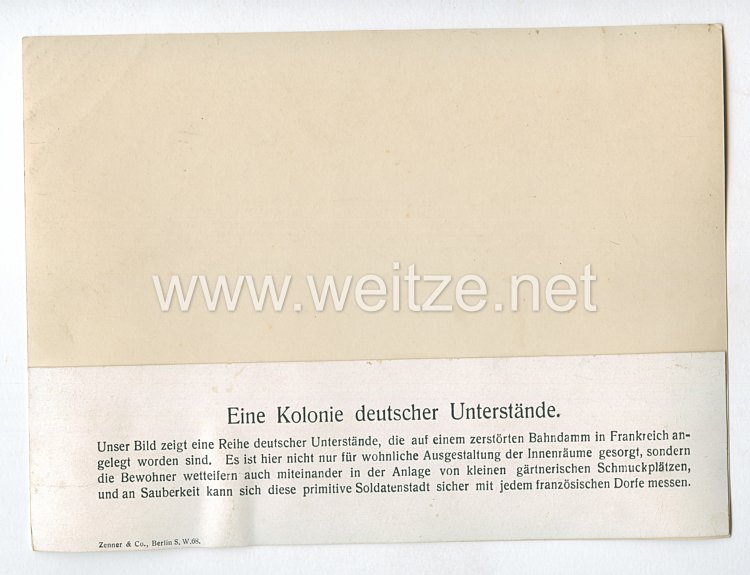
The present photograph with its dimensions of approximately 17.5 x 23.5 cm corresponds to the standard format of contemporary press photos. The inscription on the back was common practice and typically contained information about location, date, photographer or issuing authority, as well as a caption for press distribution. Such inscriptions were often made by stamp or handwriting by the press offices of army corps or the Great General Headquarters.
War photography was subject to strict military control and censorship. Photographers required special permits and were often members of Army Photo Departments or accredited civilian photographers. The images were intended to demonstrate military strength and organization on one hand, while strengthening morale on the home front on the other. Depictions of dugouts served to emphasize the good supply and protection of one's own troops.
The used condition of the photograph testifies to its actual use, possibly in editorial offices, archives, or collections. Many press photos were copied multiple times and distributed to various newspapers and magazines. The Scherl publishing house, Ullstein publishing house, and other major press houses regularly received such visual material.
From today's perspective, such press photographs are important historical sources. They document not only military reality but also how the war was presented to the public. The difference between the often idealized portrayal in official press photos and the brutal reality of trench warfare is an important research topic in modern military and media history.
Such photographs are preserved today in various archives, including the Federal Archives in Koblenz and Berlin, the Bavarian Main State Archives, as well as international collections such as the Imperial War Museum in London. They serve historians, museums, and researchers as invaluable resources for understanding World War I and its visual culture.