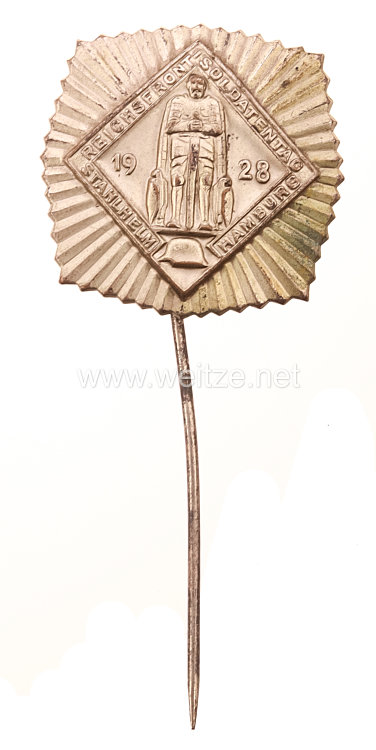
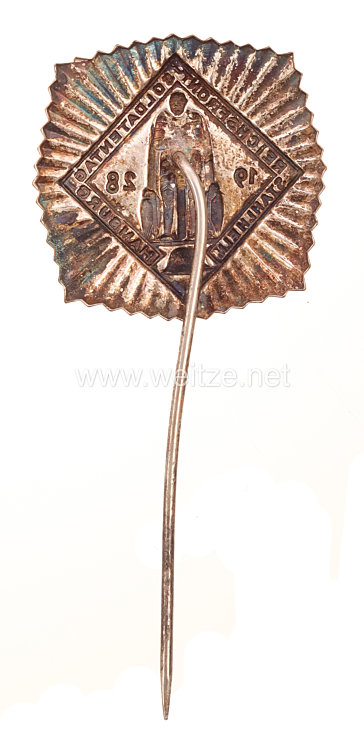
Stahlhelmbund - Meeting Badge - Reichsfrontsoldatentag 1928 Hamburg
The Meeting Badge of the Reichsfrontsoldatentag 1928 in Hamburg represents a significant chapter in German post-war history during the Weimar Republic. These tin badges were issued on the occasion of the major gathering of the Stahlhelmbund – League of Front Soldiers in May 1928 in Hamburg and served as identification and proof of participation for the assembled veterans.
The Stahlhelm, Bund der Frontsoldaten (Steel Helmet, League of Front Soldiers) was founded on December 25, 1918, in Magdeburg by front-line soldiers from World War I. Under the leadership of Franz Seldte, the organization developed into the largest veterans' association of the Weimar Republic, at times boasting over one million members. The League understood itself as a non-partisan organization, though it represented monarchist and national-conservative positions and was critical of Weimar democracy.
The Reichsfrontsoldatentag 1928 in Hamburg represented one of the largest mass gatherings of the Stahlhelmbund in the second half of the 1920s. From May 5 to 8, 1928, tens of thousands of former front soldiers assembled in the Hanseatic city to commemorate their comradeship and articulate political demands. The event comprised marches, rallies, wreath-laying ceremonies, and social gatherings.
The meeting badges were an essential component of the Stahlhelmbund's organizational culture. They were typically manufactured from stamped and embossed tin, often enameled or painted, and attached to a long pin that enabled wearing on clothing. These badges fulfilled several functions: they served as admission credentials to events, as recognition symbols among participants, and later as mementos of the days spent together.
The design of such badges followed typical iconographic patterns of the veterans' movement. Steel helmets, oak leaves, imperial eagles, Iron Crosses, or local landmarks of the host cities were frequently depicted. For the Hamburg meeting of 1928, maritime elements or Hamburg city symbols were presumably integrated. The color scheme typically oriented itself toward the black-white-red colors of the German Empire, to which the Stahlhelmbund pledged allegiance.
The context of 1928 is important for understanding the significance of this gathering. Germany found itself in the so-called “Golden Twenties,” a phase of relative economic and political stabilization after the crisis years of the early Weimar Republic. Simultaneously, political divisions remained deep. The Stahlhelmbund positioned itself as guardian of front comradeship and as a counterpoint to republican veterans' organizations such as the Reichsbanner Schwarz-Rot-Gold.
Organizing such large-scale events required considerable logistical efforts. Special trains brought participants from all parts of the Reich to Hamburg. Local restaurants, clubs, and private quarters provided accommodation and meals. The badges were produced in advance and distributed through the Stahlhelmbund's local organizational structures or issued upon arrival.
From a collector-historical perspective, Stahlhelm meeting badges today represent important testimonies to the veterans' culture of the interwar period. They document the organization's mobilization capacity and self-conception. The condition “Grade 2” indicates a well-preserved specimen with slight signs of use, which is considered very good for objects over 95 years old.
The historical assessment of the Stahlhelmbund and its activities remains complex. On one hand, the organization expressed legitimate veterans' interests and offered many former soldiers social community. On the other hand, the League contributed to the destabilization of the Weimar Republic through its anti-democratic stance and its proximity to right-conservative and later National Socialist circles. In 1933, the Stahlhelmbund was incorporated into the SA and lost its independence.
Such badges are today important sources for researching the political culture, memory politics, and veterans' movements of the Weimar Republic. They illustrate how material objects were employed in the construction of collective identities and for political mobilization.