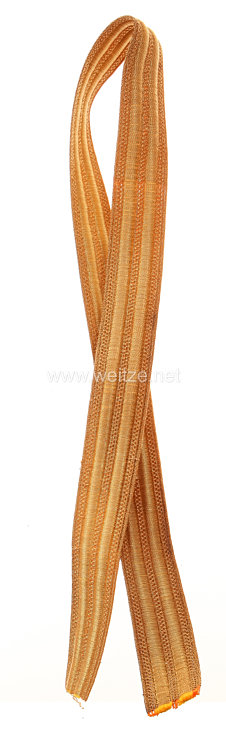
Kriegsmarine Sleeve Braid for a Lieutenant

Metal thread, Width: approx. 140 mm, Length: approx. 40 cm, unissued, Condition 2-


Price Per Piece:

440285
30,00

Kriegsmarine Sleeve Braid for a Lieutenant

The Kriegsmarine sleeve braid for a Lieutenant represents a characteristic distinction badge of the German Navy during World War II. These special sleeve braids served to identify officer ranks and were an essential component of the uniform regulations of the German Navy between 1935 and 1945.

The Kriegsmarine was officially founded on May 21, 1935, when National Socialist Germany regained military sovereignty and officially rejected the restrictions of the Treaty of Versailles. Under the supreme command of Grand Admiral Erich Raeder and later Karl Dönitz, the Kriegsmarine developed into a significant naval power. Uniform regulations and rank insignia were carefully elaborated to establish a clear hierarchy within the Navy.

The rank of Leutnant zur See (Lieutenant at Sea) represented the lowest officer rank in the Kriegsmarine, comparable to the Lieutenant in the Wehrmacht. After successfully completing naval officer training at the Marineschule Mürwik (Naval Academy) in Flensburg-Mürwik, young officers were promoted to this rank. The training was demanding and included both theoretical and practical elements of naval warfare, navigation, and leadership.

The sleeve braid described here is made of metal thread, indicating a higher-quality execution. In the Kriegsmarine, there were various quality levels for insignia: metal wire braids were typically used for service uniforms, while embroidered versions were also employed for certain uniform variants. The width of approximately 140 millimeters and length of about 40 centimeters correspond to the standardized dimensions for Kriegsmarine sleeve braids.

For a Leutnant zur See, the sleeve braid consisted of a medium gold stripe, which achieved a special optical effect through the characteristic braiding of the metal yarn. The exact execution was detailed in the Dress Regulations for the Kriegsmarine. These regulations not only governed the number and width of stripes for each rank, but also the exact placement on the sleeves of various uniform types.

The braids were worn on the service uniform, the dress uniform, and other uniform variants. They were attached to both sleeves, typically about 10 centimeters from the end of the sleeve. The attachment was done by sewing, with careful attention paid to ensuring the braid lay straight and evenly.

The unworn condition of the present object is remarkable, as most surviving Kriegsmarine uniform effects show signs of use. This can have various reasons: it may be a depot find, a never-used replacement braid, or a piece that was no longer issued towards the end of the war. The production of uniform effects was carried out by various manufacturers throughout the Reich, with strict quality standards maintained.

In the context of naval history, officer ranks and their external insignia played an important role in discipline and order aboard ship. Clear recognition of rank was essential on a warship, especially in critical combat situations. The tradition of sleeve braids in the German Navy dates back to the Imperial Navy, with the system being modernized and simplified after 1935.

After the end of World War II and the capitulation of the Wehrmacht in May 1945, the Kriegsmarine was dissolved. Many uniform pieces and effects were destroyed, confiscated, or lost. Preserved pieces like the described sleeve braid are today important witnesses to naval history and are treated by collectors and museums as historical documents.

The Bundesmarine, founded in 1956, and today's German Navy continued the tradition of sleeve braids, maintaining the basic system of rank identification while removing National Socialist symbols. Even today, officers of the German Navy wear sleeve braids that, in their fundamental design, recall the historical models.

From a military-historical perspective, such objects are valuable for understanding uniform studies, the organizational structure of the Kriegsmarine, and the material culture of World War II. They provide insights into manufacturing techniques, material usage, and the significance of military traditions in this era.