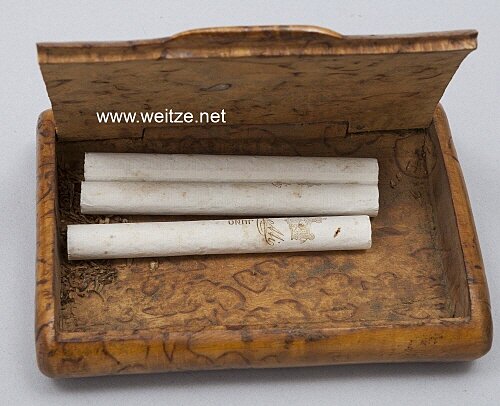
Wooden Cigarette Case with Silver Overlay, Russia circa 1910
This cigarette case made of Karelian birch wood with silver overlay represents a fascinating testimony to Russian artisanal tradition and the social culture of the late Tsarist Empire around 1910. Such cases were not merely practical objects but also status symbols and expressions of personal identity during a time of profound social transformation.
Historical Context of the Era
The years around 1910 mark a particularly tense phase in Russian history. The Tsarist Empire under Nicholas II found itself in a period between the failed Revolution of 1905 and the approaching First World War. Russian society was deeply divided between the conservative nobility defending their centuries-old privileges and ascending reform-oriented forces. In this context, material cultural goods such as ornate cigarette cases played an important role as signs of social belonging.
Karelian Birch as Prestigious Material
The use of Karelian birch (Betula pendula var. carelica) is particularly noteworthy. This rare wood, found mainly in the Karelia region between Finland and Russia, is distinguished by its characteristic marbled grain pattern. Since the 18th century, Karelian birch wood had been regarded as a precious material, preferentially used for luxury items and furniture for the imperial family. The Tsarist workshops in St. Petersburg processed this wood into exquisite art objects. Around 1900, the use of Karelian birch experienced a renaissance, especially in the production of personal accessories for high society.
Symbolism of the Prince's Crown and Rider
The silver overlay with prince's crown and rider references the deep roots in Russian aristocratic tradition. The prince's crown was a heraldic symbol indicating the rank and lineage of its bearer. In the Russian system of noble hierarchy, formalized through Peter the Great's Table of Ranks from 1722, such visual rank insignia played a central role.
The rider motif could have various layers of meaning. It might allude to Saint George, the dragon-slayer and patron saint of Russia, who also appears in Moscow's coat of arms. Alternatively, it could symbolize the connection to military or noble cavalry units that enjoyed high prestige in Tsarist Russia. Many members of the Russian nobility served in prestigious cavalry regiments such as the Guard Cuirassiers or the Chevalier Guards.
Cigarette Culture in the Late Tsarist Empire
Cigarette smoking only became established in Russia during the second half of the 19th century. While pipes and cigars had previously dominated, cigarettes were increasingly viewed as modern and cosmopolitan. The Russian tobacco industry, particularly factories in St. Petersburg and Moscow, produced high-quality cigarettes for domestic and international markets. Cigarette cases became indispensable accessories for every gentleman and lady of society. They were crafted from the most diverse materials – from simple leather to precious metals and exotic woods.
Craftsmanship and Silver Work
The silver overlay of the case testifies to the high artistry of Russian silversmiths of this era. St. Petersburg and Moscow were centers of silver processing, with workshops such as those of Fabergé, Khlebnikov, or Ovchinnikov becoming world-famous. Smaller workshops also produced high-quality work for wealthy clientele. The combination of noble metals with precious woods was characteristic of Russian Art Nouveau and the so-called Neo-Russian movement, which revived traditional Russian art forms.
Military and Social Context
Such personal luxury items were particularly popular among officers of the Russian Army. In the hierarchically structured military society of the Tsarist Empire, personal accessories were important markers of distinction. Officers of the Guard and cavalry regiments, who often came from the high nobility, carried such cases as signs of their status. The years before World War I were characterized by military reforms and modernization efforts following the lessons of the Russo-Japanese War (1904-1905).
Significance and Legacy
Objects like this cigarette case are today important cultural-historical testimonies of a vanished world. The October Revolution of 1917 ended not only the Tsarist Empire but also the aristocratic culture that produced such art objects. Many of these objects were destroyed, melted down, or lost in the chaos of revolution and civil war. Preserved pieces document the material culture and aesthetic concepts of an era on the eve of tremendous historical upheavals.