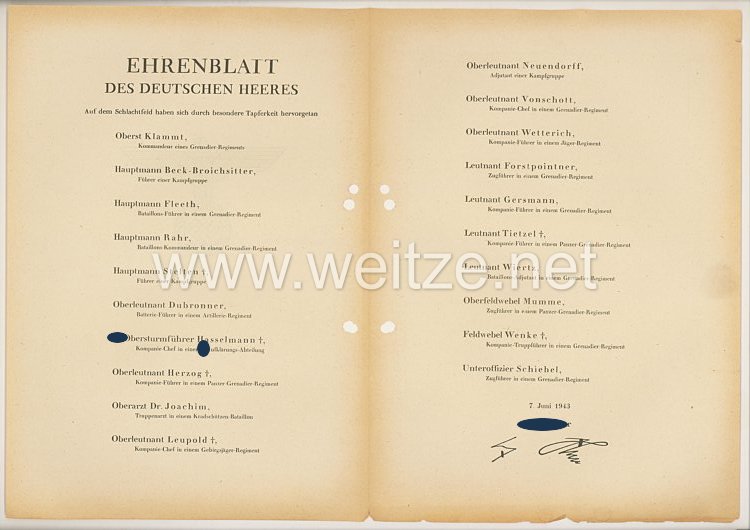
Honor Roll of the German Army - Issue of June 7, 1943

DinA4 double sheet in used condition.
348185
100,00

Honor Roll of the German Army - Issue of June 7, 1943

The Ehrenblatt des Deutschen Heeres (Honor Roll of the German Army) represents one of the most significant military recognition documents of the Wehrmacht during World War II. This edition from June 7, 1943 originates from a critical phase of the war, shortly after the devastating defeat at Stalingrad and during intense fighting on the Eastern Front.

The Honor Roll was officially instituted by decree on January 30, 1944, although honors in this form had been published since 1941. It served to publicly recognize soldiers who had distinguished themselves through extraordinary bravery and military achievements. Mention in the Honor Roll was considered a high honor and ranked in the hierarchy of military recognition immediately after the highest orders such as the Knight's Cross.

The document typically appeared as a DIN A4 double sheet, printed on high-quality paper bearing the national emblem of the German Reich. The design followed strict official guidelines and generally contained the names of honored soldiers, their ranks, units, and a brief description of their outstanding deeds. Each edition was published by the Oberkommando des Heeres (OKH) (Army High Command) and bore the signature of high-ranking military leaders.

June 1943 marked a transitional phase in the course of the war. After the loss of the 6th Army at Stalingrad in February 1943, the Wehrmacht found itself in an increasingly defensive position. At the same time, German leadership was preparing Operation Citadel, the major summer offensive at Kursk that would begin in July 1943. In this context, the Honor Roll served not only for individual recognition but also for maintaining troop morale and fighting spirit.

Soldiers named in the Honor Roll received material benefits in addition to public recognition. They received a special Honor Roll clasp worn on the ribbon of the Iron Cross, as well as frequently a promotion or additional decorations. The families of those honored were also notified, giving the award a special social dimension.

The criteria for inclusion in the Honor Roll were strictly defined. Extraordinary individual achievements beyond normal duty had to be demonstrated. Typical reasons included the destruction of enemy tanks under particularly dangerous circumstances, the rescue of wounded comrades under enemy fire, successful leadership of units in hopeless situations, or special achievements in reconnaissance.

The historical significance of such documents today lies less in military honor than in their value as contemporary historical sources. They document the propaganda and motivation strategies of the Nazi regime, the structure and organization of the Wehrmacht, and individual fates of soldiers. For military historical research, they offer insights into battles on various fronts and the nature of warfare.

The used condition of this example is typical for this type of document. They were often kept by soldiers, sent in field post letters, or stored in military archives. The state of preservation can vary from well-preserved to heavily damaged, depending on the circumstances of storage over nearly eight decades.

From a collector's perspective, Honor Rolls are sought-after military historical documents. Their value depends on various factors: the date of issue, condition, any special features of the named persons or units, and the completeness of the document. Editions from special periods such as major battles or from the early war years are particularly desirable.

It is important to emphasize that historical examination of such objects serves scientific analysis and understanding of history. Wehrmacht decorations are inseparably connected with the criminal Nazi regime and its war crimes. A critical and contextualized consideration is therefore essential.

The June 7, 1943 edition falls into a period when the Wehrmacht was transitioning from offensive to defensive operations on multiple fronts. The names and deeds recorded in this Honor Roll represent individual stories within the larger narrative of World War II, providing researchers with valuable primary source material for understanding both military operations and the human experience of the conflict.