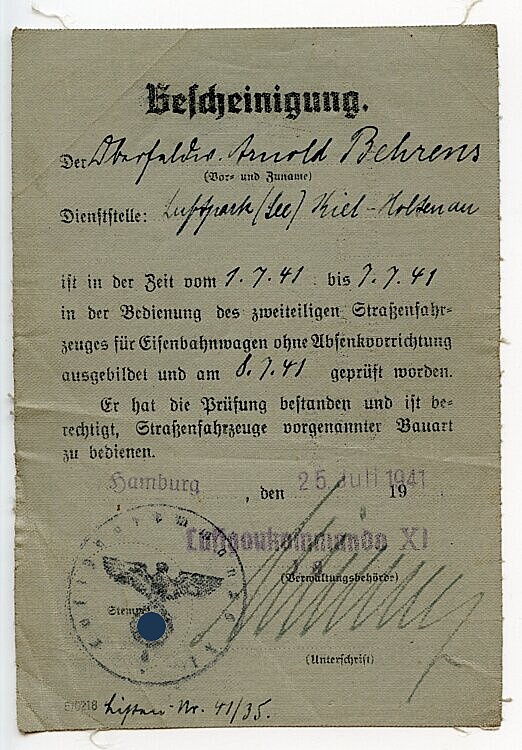
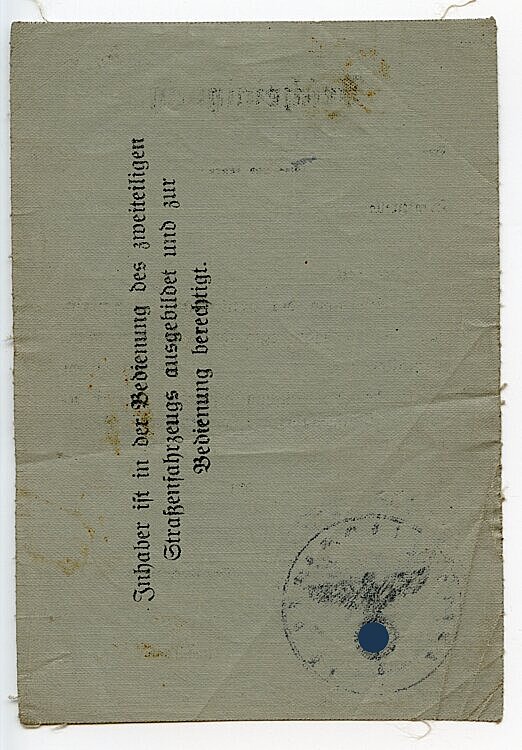
Certificate from Luftpark (See) Kiel-Holtenau Service Office for a Master Sergeant
This document is a certificate from 1941, issued by the Luftpark (See) Kiel-Holtenau service office and the Luftgaukommando XI in Hamburg. It documents the training and examination of an Oberfeldwebel (senior sergeant) in operating specialized transport equipment of the German Luftwaffe during World War II.
The Luftparks of the German Luftwaffe were central logistical facilities during World War II, responsible for the maintenance, repair, and supply of aircraft. The Luftpark (See) Kiel-Holtenau was a specialized facility on the Baltic Sea coast that dealt with maritime aviation. Kiel-Holtenau was a strategically important location, as it was situated on the Kiel Canal, connecting the North Sea and Baltic Sea.
The document certifies training in operating a two-part road vehicle for railway wagons without deflection device. This specialized equipment was part of the Luftwaffe's complex transport logistics. The training took place from July 1 to 7, 1941, the examination on July 8, 1941, and the official certificate was issued on July 25, 1941 in Hamburg.
The timing of this certificate is historically significant: In July 1941, just weeks after the beginning of Operation Barbarossa (the German attack on the Soviet Union on June 22, 1941), the German Wehrmacht was in a phase of massive expansion and logistical challenges. Training personnel in specialized transport procedures was essential for maintaining military operations.
Luftgaukommando XI was one of the regional administrative units of the Luftwaffe headquartered in Hamburg. The Luftgaukommandos were responsible for territorial administration, training, and logistical support within their jurisdiction. Luftgaukommando XI covered the northern German region, including important coastal areas and naval bases.
The rank of Oberfeldwebel was a senior non-commissioned officer rank in the Wehrmacht. Oberfeldwebels were experienced NCOs often employed as technical specialists or in leadership positions at platoon level. The fact that an Oberfeldwebel was selected for this special training underscores the technical complexity and importance of the task.
The mentioned equipment – a two-part road vehicle for railway wagons – was part of the Wehrmacht's complex multimodal transport system. Such devices enabled railway wagons to be moved on roads when no continuous rail connection was available or when goods needed to be transferred between different modes of transport. This was particularly important for transporting large and heavy components such as aircraft parts, engines, or other military equipment.
The specification “without deflection device” indicates a particular technical configuration. Deflection devices were mechanisms that improved steering or maneuverability in some transport vehicles. A vehicle without such devices required special skills and knowledge to operate.
Such training certificates were an integral part of the military administrative system. They not only documented personnel qualifications but also served as proof of authorization to operate special equipment. This was important for accident prevention, assignment of responsibility, and general military order.
From a documentary perspective, such certificates provide valuable insights into the military training structure and logistical challenges of the German armed forces during World War II. They demonstrate the precision of military administration and the diversity of specialized tasks beyond direct combat operations.
For collectors and historians, such documents are important primary sources documenting the everyday reality of military service. They complement the historical picture beyond major battles and strategic decisions, showing the practical aspects of warfare.