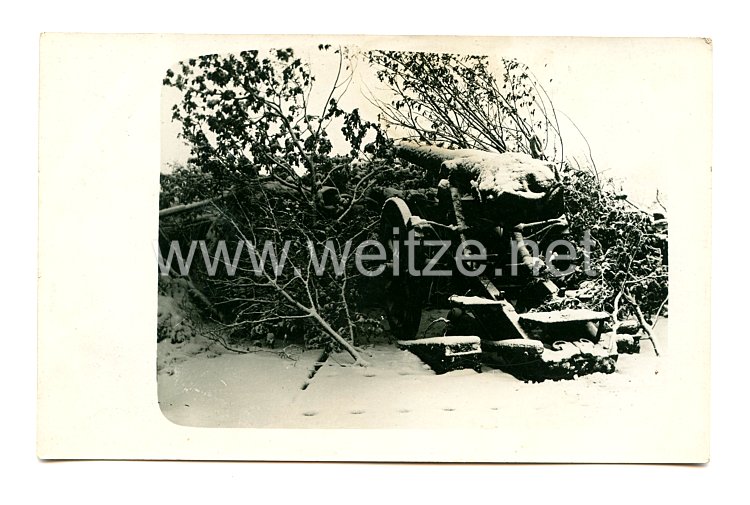
World War I German Army Photograph, Field Gun in Position

Postcard size. Used condition.
332885
8,00

World War I German Army Photograph, Field Gun in Position

Historical Context: Field Artillery of the German Army in World War I

This postcard-sized photograph documenting a field gun in position during World War I (1914-1918) represents an important aspect of German military photography from this era. Such photographs served both military documentation purposes and propaganda, frequently being distributed as field postcards in millions of copies.

The Field Artillery of the German Army

The backbone of German artillery was the 7.7 cm Feldkanone 96 neuer Art (FK 96 n.A.), introduced from 1896 and further developed into the Feldkanone 16 by 1916. These guns featured a recoil mechanism that allowed the weapon to remain in position after each shot without requiring complete realignment. With a range of approximately 8,500 meters and a rate of fire of up to 15 rounds per minute, this weapon represented considerable firepower.

Additionally, light field howitzers such as the 10.5 cm Feldhaubitze 98/09 and heavy guns played crucial roles. German artillery was considered among the most modern and powerful in the world at the war's beginning.

Trench Warfare and Artillery Tactics

After the mobile warfare of 1914, the Western Front became frozen in trench warfare that would last until 1918. In this context, artillery gained unprecedented importance. Field guns were positioned in carefully prepared firing positions, often camouflaged and protected to shield them from enemy counter-battery fire.

Gun crews, typically six to eight soldiers per piece, had to work under extreme conditions. Ammunition supply presented a constant logistical challenge, especially during major offensives when hundreds of thousands of shells were fired.

Military Photography and Field Postcards

The postcard-sized photograph reflects the important role of visual propaganda in World War I. The German Army maintained its own Picture and Film Offices (Bild- und Filmämter), which from 1916/17 systematically documented warfare. Photographs of artillery positions were meant to demonstrate the technical superiority and striking power of German forces.

Field postcards were produced in enormous quantities and served multiple purposes: they were communication tools for soldiers at the front, propaganda instruments to maintain morale at home, and historical documents. Many of these cards show standardized motifs: guns in position, batteries firing, or artillerymen at work.

Technical Details and Organization

German field artillery was organized into artillery regiments, typically consisting of two battalions of three batteries each. Each battery had six guns. The command structure was strictly hierarchical, with battery commanders, usually holding the rank of captain, responsible for tactical leadership.

Fire direction was conducted by observers in forward positions or on observation towers, who communicated with batteries via telephone or optical signals. The development of indirect fire, where targets beyond line of sight were engaged, revolutionized artillery tactics.

Course of War and Battles of Materiel

In the great battles of World War I – Verdun (1916), the Somme (1916), Passchendaele (1917) – artillery played the dominant role. At the Battle of Verdun, German artillery fired over two million shells on the first day. The term “drumfire” (Trommelfeuer) describes the intense, hours-long bombardment of enemy positions before infantry attacks.

The battle of materiel led to enormous wear on guns and a constant need for replacement and ammunition. German arms industry produced approximately 64,000 guns and billions of shells during the war.

Artillery's Impact and Innovation

The war drove rapid technological advancement. Sound ranging and flash spotting techniques were developed to locate enemy batteries. Creeping barrages were perfected to provide moving curtains of fire ahead of advancing infantry. Gas shells added a new dimension of terror to artillery bombardment.

The psychological impact of artillery was immense. The term “shell shock” entered the lexicon to describe the psychological trauma caused by sustained bombardment. Artillery fire reshaped the landscape itself, creating the cratered, devastated moonscapes that characterized the Western Front.

Collector Value and Historical Significance

Photographs like this one are today important historical documents. They provide historians and collectors with insights into the material culture of World War I, the organization of artillery, and the lived reality of soldiers. The “used condition” of the object – possibly with creases, discoloration, or inscriptions – testifies to its authentic use during or shortly after the war.

Such militaria are not merely collectibles but also educational tools that help understand the devastating effects of industrialized warfare and keep alive the memory of the millions of victims of World War I.