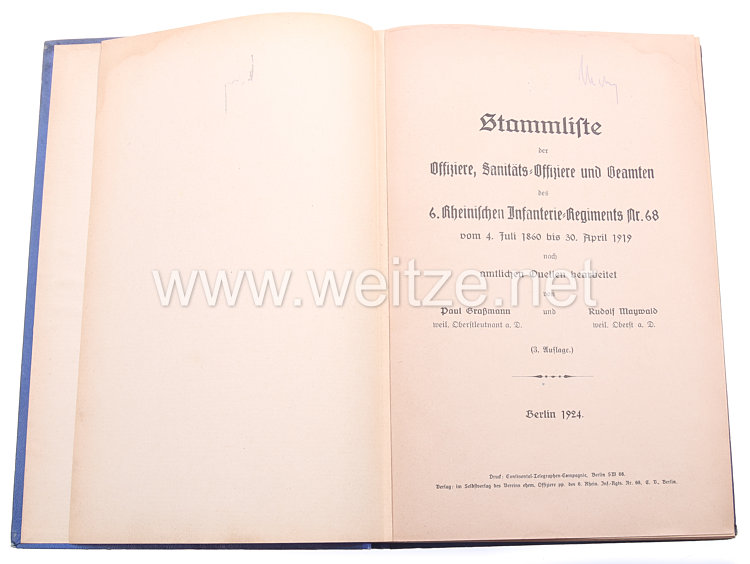
Regimental Roll of Officers, Medical Officers and Officials of the 6th Rhenish Infantry Regiment No. 68, from July 1, 1860 - April 0, 1919
The Stammliste (Officers' Roll) of the 6th Rhenish Infantry Regiment No. 68 represents a significant military-historical document that chronicles the personnel history of one of the most traditional units of the Prussian Army. Published in 1924 by the association of former officers in a self-published edition, this roll covers the period from July 1, 1860 to April 30, 1919, providing a comprehensive overview of nearly six decades of German military history.
The 6th Rhenish Infantry Regiment No. 68 belonged to the Royal Prussian Army and was stationed in the Rhine Province. The unit lived through significant historical epochs: the period of army reforms after 1860, the Austro-Prussian War of 1866, the Franco-Prussian War of 1870-71, the long peace period of the German Empire, and finally World War I from 1914-1918. The roll's end date in April 1919 marks the dissolution of the old Prussian army structures following the Treaty of Versailles.
Officers' rolls of this type were a characteristic product of German military tradition in the late 19th and early 20th centuries. They served multiple purposes: First, they functioned as memorial books preserving the memory of fallen and deceased comrades. Second, they served as genealogical and biographical reference works documenting individual officers' career paths. Finally, they expressed the esprit de corps and regimental tradition that were of paramount importance in Prussian-German military culture.
The publication in 1924 occurred during a time of profound upheaval. Following Germany's defeat in World War I and Kaiser Wilhelm II's abdication, the old army had been dissolved. The Reichswehr of the Weimar Republic was limited to 100,000 men, and the traditional regiments no longer existed. In this situation, veterans' associations became the custodians of military tradition. The Association of Former Officers of the 6th Rhenish Infantry Regiment No. 68 published this roll to preserve the unit's history for posterity.
The scope of 342 pages indicates a very detailed documentation. Typically, such rolls contained biographical information on each officer: date and place of birth, entry into the army, promotions, transfers, decorations, participation in campaigns, and if applicable, date and circumstances of death. Medical officers and officials were also listed, reflecting comprehensive documentation of the regiment's entire leadership personnel.
The period from 1860 to 1919 was of enormous significance for the Prussian Army. In the 1860s, the Prussian military was modernized under War Minister Albrecht von Roon and Chief of the General Staff Helmuth von Moltke. Infantry Regiment No. 68 was part of this reformed army that defeated Austria in 1866 and contributed significantly to the founding of the German Empire in 1870-71. Many of the officers listed in the roll likely participated in these historic events.
The long peace period from 1871 to 1914 was characterized by routine garrison duty, maneuvers, and gradual modernization of equipment and tactics. The roll documents the careers of numerous officers who served during this time. World War I then brought dramatic changes: massive casualties, rapid promotions to meet personnel needs, and finally the defeat of 1918.
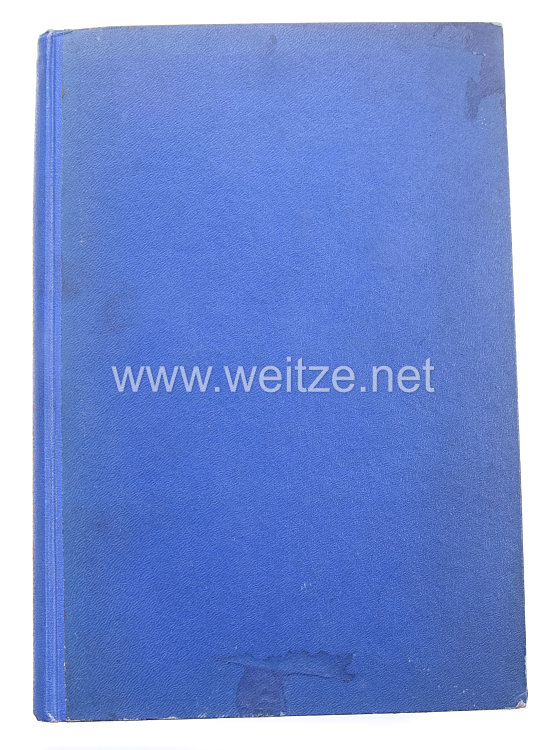
The cloth binding with spine lettering was a typical binding form for official and semi-official publications of this era. It offered durability and a dignified appearance befitting the importance of the content. The indicated condition grade 2 suggests a well-preserved copy according to standard classification, which is remarkable for a 100-year-old book.
Such officers' rolls are today important sources for military-historical research, genealogy, and regional history. They enable researchers to trace individual career trajectories, analyze the social composition of the officer corps, and compile casualty statistics. For family historians, they can provide invaluable information about ancestors who served in the Prussian Army.
Self-publication was characteristic of such regimental documentations. Veterans' associations often financed production through subscription among their members. This ensured that the regiment's memory was preserved, even when no commercial publisher had interest in such a specialized publication. Publication in Berlin, the capital of the former German Empire, underscores the national significance attributed to this documentation.
The document represents more than just a list of names and dates; it embodies the values and traditions of the Prussian officer corps: honor, duty, loyalty, and comradeship. In the context of 1924, amidst the turmoil of the Weimar Republic, such publications served to maintain continuity with a vanished world and to keep alive the memory of those who had served and sacrificed for their country.