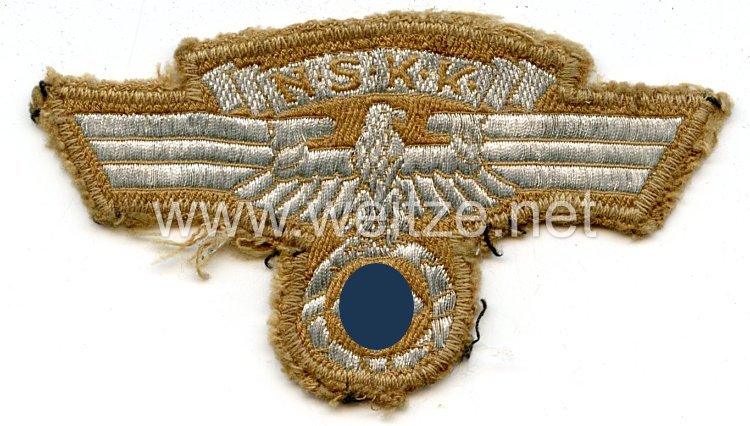
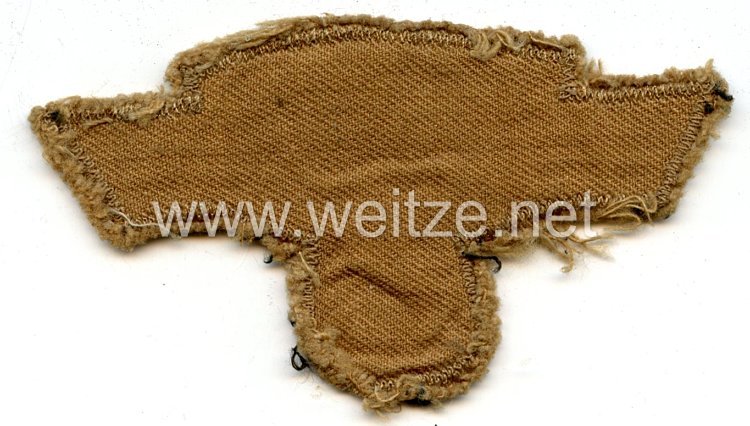
National Socialist Motor Corps (NSKK) Sleeve Eagle for the Brown Shirt

Bullion woven version, RZM paper label missing. Condition 2.
440484
100,00

National Socialist Motor Corps (NSKK) Sleeve Eagle for the Brown Shirt

The sleeve eagle of the National Socialist Motor Corps (NSKK) for the brown shirt represents a characteristic insignia of one of the most significant paramilitary organizations of the Third Reich. The NSKK, initially founded on April 1, 1930 as a sub-organization of the SA, developed into an independent formation under the leadership of Adolf Hühnlein, who served as Corps Leader from 1931 until his death in 1942.

The primary mission of the NSKK consisted of motor vehicle technical training and promoting motorization in Germany. After the seizure of power in 1933, the organization expanded considerably and assumed important functions in traffic education, driving instruction, and pre-military motor vehicle training. During World War II, the NSKK played a significant role in transporting material and personnel, particularly in occupied territories.

The metal thread sleeve eagle described here represents the superior quality level of NSKK insignia. Unlike simple cloth versions, these badges were woven with aluminum or silver threads on a backing material, giving them a characteristic metallic luster. The production of such insignia required specialized weaving machines and craftsmanship, making them significantly more expensive than embroidered or printed variants.

The RZM system (Reichszeugmeisterei - Reich Equipment Office) was introduced in 1929 and controlled the production and distribution of all NSDAP-related uniforms and insignia from 1934 onward. Each authorized manufacturer received an RZM number, which was affixed on a paper label on the back of the insignia. The absence of this label on the described piece is not unusual, as these paper labels were frequently lost through wearing, cleaning, or storage over the decades. The RZM marking served quality control purposes and was intended to ensure that only authorized manufacturers produced official insignia.

The eagle itself followed standardized design guidelines for NSKK insignia. It was worn on the left upper arm of the brown shirt, which represented the characteristic service uniform of the organization. The brown color of the shirt deliberately referenced the SA tradition, with which the NSKK was historically connected. The eagle's design showed the national emblem with outstretched wings, clutching a swastika in its talons – a motif used in various variants across all NS organizations.

The metal thread version was particularly popular among NSKK leaders and officers, as it offered higher quality and better visual impact than standard cloth versions. The weaving technique enabled fine details and precise representation of eagle feathers and other design elements. The reflective properties of the metal threads ensured that the insignia appeared particularly impressive during parades and official occasions.

After 1945, the NSKK was banned and dissolved along with all other NS organizations. The manufacture, distribution, and public display of such insignia are prohibited in Germany under § 86a StGB, with exceptions for historical, scientific, and educational purposes. Original insignia like the described sleeve eagle are today exclusively objects of military-historical collections and research.

The stated Condition 2 indicates, according to common collector evaluation standards, a good to very good state of preservation, where the insignia was worn but shows no significant damage. Typical signs of aging such as slight oxidation of the metal threads or minimal wear are acceptable in this condition category. The fact that the piece has survived the past decades makes it an authentic witness to a dark period of German history, which today serves exclusively historical documentation and education.

The metal thread construction technique employed in this eagle exemplifies the sophisticated manufacturing capabilities of authorized RZM contractors during the Third Reich period. These workshops combined traditional textile craftsmanship with industrial-scale production methods to supply the vast demand for insignia across multiple NS organizations. The NSKK, at its peak in 1944, counted approximately 500,000 members, all requiring proper uniforming and insignia according to strict regulations.