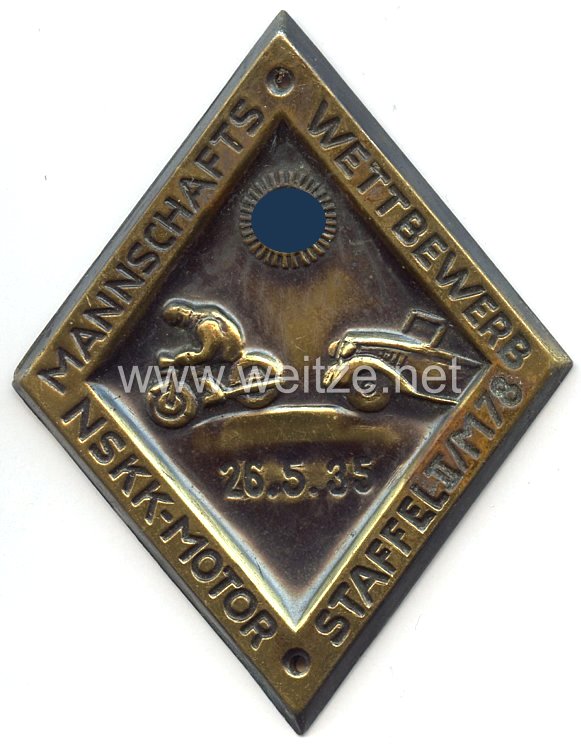
NSKK - Non-Portable Participant Plaque - "NSKK-Motorstaffel II/M73 Mannschaftswettbewerb 26.5.1935"
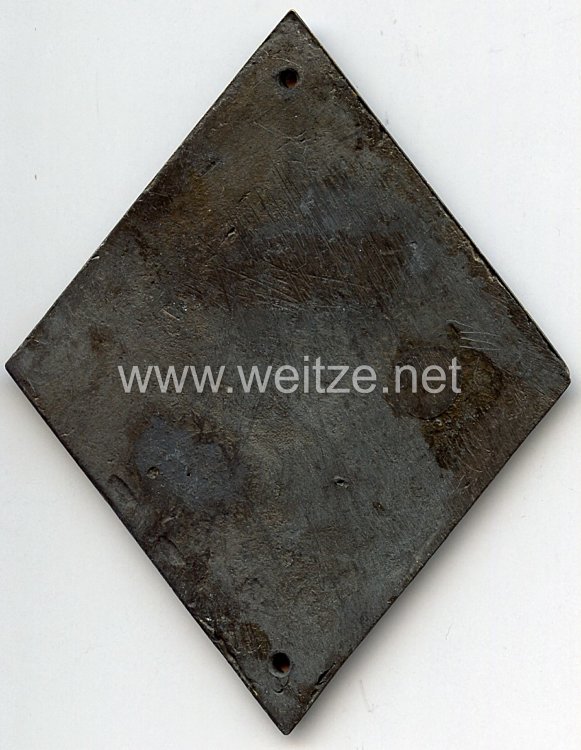
This non-wearable participant plaque of the National Socialist Motor Corps (NSKK) documents participation in the team competition of NSKK-Motorstaffel II/M73 on May 26, 1935. This plaque made of gold-plated fine zinc, measuring 63 x 81 mm with two mounting holes, represents a typical example of the numerous competition awards distributed within the NSKK during the National Socialist era.
The NSKK was founded on May 1, 1931, as a formation of the NSDAP and was initially subordinated to the SA. After the seizure of power in 1933, the NSKK developed into an independent organization with the primary goal of promoting motorized training of the German population and creating a reserve of trained drivers for military purposes. Under the leadership of Corps Leader Adolf Hühnlein, the NSKK grew to approximately 500,000 members by 1939.
The organizational structure of the NSKK was hierarchically arranged and divided into various levels. The Motorstaffeln (motor squadrons) formed the lowest units and were organized according to geographical considerations. The designation “Motorstaffel II/M73” refers to a specific local unit within Motorstandarte 73 (Motor Regiment 73), with the Roman numeral II indicating the second squadron of this regiment. The motor regiments were combined into motor brigades, which in turn were subordinate to the various NSKK groups.
The team competitions played a central role in the NSKK's training system. These competitions served multiple purposes: they promoted members' technical skills in handling motor vehicles, strengthened esprit de corps and camaraderie within the units, and created a competitive character intended to increase performance readiness. The competitions typically included various disciplines such as precision driving, technical knowledge, orientation drives, and the maintenance and care of motor vehicles.
The year 1935, when this competition took place, was a phase of intensive expansion and consolidation of the NSKK. After the reintroduction of general conscription in March 1935, the paramilitary training provided by the NSKK gained additional significance. The organization worked closely with the newly established Wehrmacht and represented an important resource for training drivers and technical personnel.
Non-wearable plaques like this example differ fundamentally from wearable badges and insignia. While the latter could be worn on uniforms and were often documented by official award certificates, non-wearable plaques were commemorative items intended for private keeping. They were frequently stored in special collecting folders or display cases and served as personal documentation of the owner's sporting and organizational activities.
The craftsmanship of such plaques varied depending on the importance of the event and available resources. The use of gold-plated fine zinc was a common and cost-effective manufacturing method that nevertheless allowed for an attractive appearance. The two holes at the top of the plaque served for mounting, either for wall mounting or for attachment in collecting albums.
The design of such NSKK plaques typically followed certain iconographic elements: representations of motor vehicles, NSKK symbols such as the winged wheel, swastikas as sovereign symbols, as well as information about location, date, and type of event were common. The aesthetic design reflected the contemporary taste of the 1930s, with clear, geometric forms and an emphasis on dynamism and technical progress.
From a historical perspective, such objects are today important testimonies to the everyday culture of National Socialism. They document the penetration of all areas of life by NS organizations and illustrate how ideological commitment and organizational loyalty were created through sports, competitions, and community events. The systematic honoring and awarding even at local events was part of a comprehensive system of social control and integration.
For collectors and historians, NSKK plaques provide insights into the regional organization and activities of this NS formation. The specific unit designations often enable assignment to certain geographical regions and the reconstruction of local NSKK structures. The condition grade 2 indicates a well-preserved example, which is particularly noteworthy for objects made of gold-plated zinc, which is susceptible to corrosion and wear.
The NSKK was dissolved in 1945 following Germany's defeat, and its activities were prohibited by the Allied occupation authorities. Today, objects like this plaque serve as historical artifacts that help researchers understand the organizational structure, activities, and cultural practices of this National Socialist organization. They represent material evidence of the regime's effort to militarize and mobilize German society through seemingly innocuous sporting and technical competitions.