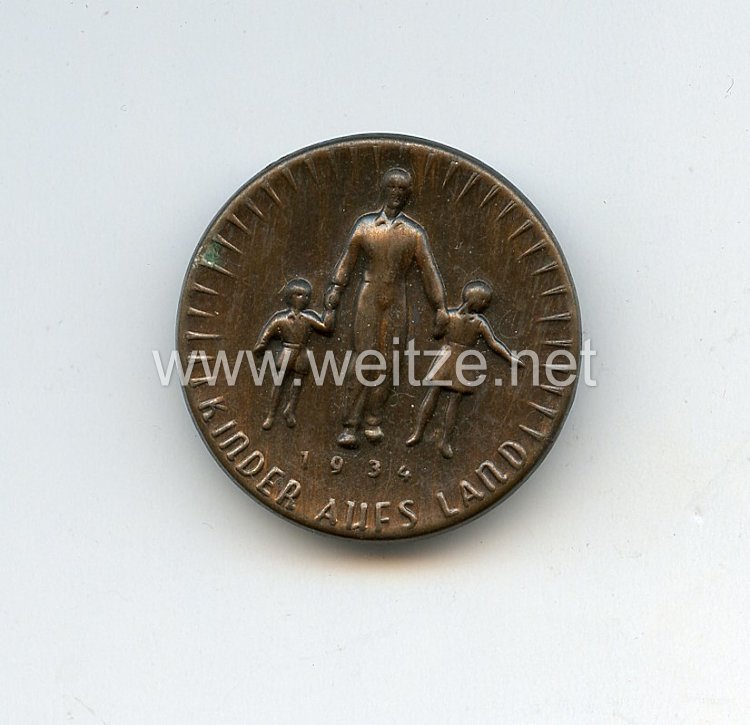
Third Reich - Children to the Countryside 1934

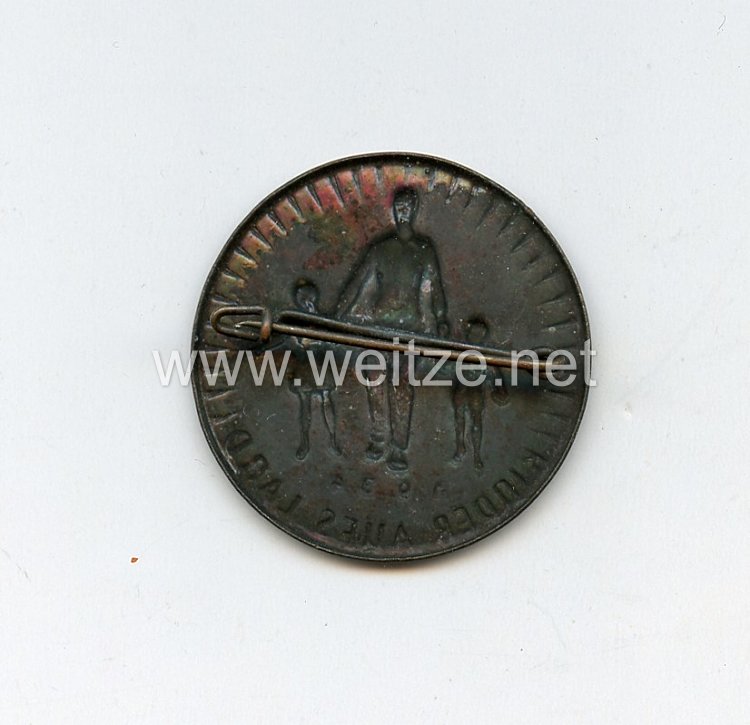
Tinplate badge, with pin fastener, condition 2.
418284
20,00

Third Reich - Children to the Countryside 1934

The “Kinder aufs Land” (Children to the Countryside) badge from 1934 represents a fascinating chapter in early Nazi welfare policy and the propagandistic staging of social programs in the Third Reich. This tin-plate badge, worn on a pin, documents one of the numerous collection campaigns conducted in the 1930s to finance various social and paramilitary initiatives.

The “Kinder aufs Land” campaign was part of the early efforts of the National Socialist regime to present itself as a people-oriented and socially caring movement. After the seizure of power in 1933, the regime developed a comprehensive system of welfare organizations, with the National Socialist People's Welfare (NSV) playing a central role. It was officially established as an independent organization on May 3, 1933, and rapidly developed into one of the largest mass organizations of the Third Reich.

The year 1934, when this badge was issued, marked an important phase in the consolidation of Nazi rule. After the Röhm Putsch in June 1934 and Hindenburg's death in August, Hitler solidified his absolute power. In this context, welfare campaigns served not only social purposes but also legitimized the regime and mobilized the population for National Socialist goals.

Sending children to the countryside had various dimensions. On one hand, city children from poorer backgrounds were to be strengthened healthwise through stays in rural areas. The National Socialists drew upon youth welfare traditions that had already existed during the Weimar Republic and the Imperial era. On the other hand, such programs were connected with the NS ideology of “Blood and Soil” romanticism, which glorified rural life as authentic and racially valuable.

The financing of such programs was substantially achieved through donation collections, in which badges like the present one played a central role. The system of badge collections was perfected in the Third Reich and served several purposes simultaneously: it generated financial resources, created a sense of Volksgemeinschaft (people's community), and functioned as a visible sign of participation in National Socialist activities. Whoever wore such a badge publicly demonstrated their willingness to contribute to the supposed common good.

The material tin plate is typical for collection badges of the 1930s. In a time of economic uncertainty following the 1929 Wall Street Crash and the years of depression, inexpensive materials were necessary to enable mass production. Tin plate could be stamped and embossed cheaply, allowing large quantities to be manufactured. The pin fastening enabled easy attachment to clothing, typically on the lapel or jacket.

The design of such badges followed certain propagandistic patterns. Idyllic scenes, playing children, or rural motifs were frequently used to suggest a perfect world and evoke positive emotions. The inscription with the year and purpose of the collection served documentation purposes and was intended to feign transparency.

In the broader context of Nazi youth policy, the “Kinder aufs Land” campaign fit into a comprehensive system of capturing and indoctrinating youth. 1934 was also the year when Baldur von Schirach was appointed “Youth Leader of the German Reich” and the coordination of youth associations was largely completed. The Hitler Youth developed into the dominant youth organization, and programs like countryside evacuations were increasingly integrated into its activities.

Such badges are important contemporary historical documents today. They testify to the omnipresence of National Socialist propaganda in everyday life and the mechanisms of social control. Wearing a badge was often less an expression of voluntary support than the result of social pressure. Anyone not wearing a badge could quickly fall under suspicion of lacking loyalty to the Volksgemeinschaft.

The condition grade 2 indicates a well-preserved specimen with possibly slight signs of use but no significant damage. This is remarkable for an over 90-year-old object made from a relatively fragile material.

From today's perspective, such objects provide insight into the mechanisms of totalitarian rule and the permeation of everyday life with political propaganda. They remind us how the NS regime instrumentalized seemingly harmless social programs for its ideological purposes and how even charity became an instrument of power consolidation and indoctrination.

r