Army - Award Document Iron Cross 2nd Class
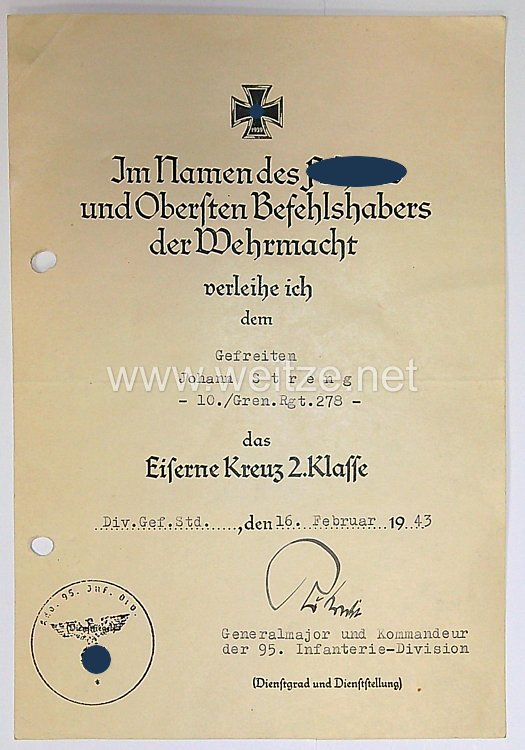
This award certificate for the Iron Cross Second Class represents a significant document from German military history during World War II. This particular certificate was issued on February 16, 1943, and documents the award of this valor decoration to a lance corporal (Gefreiter) of the 10th Company, Grenadier Regiment 278, a unit of the 95th Infantry Division.
The Iron Cross was originally established in 1813 during the Wars of Liberation by King Friedrich Wilhelm III of Prussia and was reinstituted by Adolf Hitler in 1939 for World War II. The decoration existed in several grades, with the Iron Cross Second Class being the basic level for bravery in the face of the enemy. The award criteria were strict and required demonstrable acts of personal courage or outstanding leadership performance in combat.
The certificate bears the signature of Major General Edgar Röhricht, the divisional commander of the 95th Infantry Division at that time. Röhricht was an experienced officer who himself was decorated with high honors. He received the Knight's Cross of the Iron Cross on May 15, 1944, the German Cross in Gold on April 9, 1943 (only a few weeks after issuing this certificate), as well as the Austrian Military Merit Cross Third Class with War Decoration. These awards demonstrate his military competence and combat experience.
Grenadier Regiment 278 belonged to the core formation of the 95th Infantry Division, which was primarily deployed on the Eastern Front. In February 1943, the Wehrmacht found itself in a critical phase of the war. The Battle of Stalingrad had just ended in a devastating defeat, and German troops were engaged in heavy defensive battles along the entire Eastern Front. The award of the Iron Cross during this period reflects the intensity of combat operations.
The formal design of such award certificates followed military regulations and standards. They were printed on special paper, often bearing the national emblem of the German Reich, and carried the handwritten signature of the awarding commander. The bureaucratic process of awarding began with a recommendation by the immediate superior, which was passed up through the chain of command. Final approval occurred at division level, as in this case by Major General Röhricht.
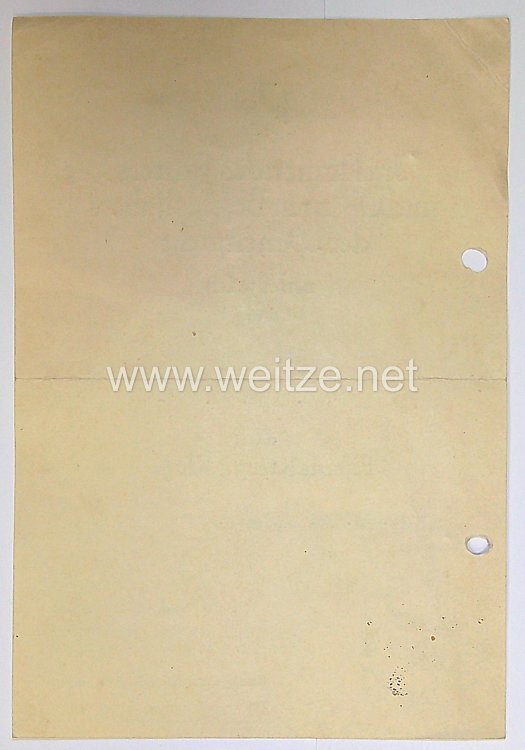
The physical condition of this certificate shows typical signs of use: it was hole-punched, presumably for storage in a personnel file, and folded in the middle, indicating transport or personal custody by the recipient. These details lend authenticity to the document and tell of its actual use during the war.
The 95th Infantry Division had an eventful history. It was established in 1939 and fought in various campaigns before being transferred to the Eastern Front. The division experienced the heavy fighting of 1942 and 1943, including the Red Army's winter offensives. The soldiers of this division, like the lance corporal honored here, stood at the focal point of some of the war's fiercest battles.
Such award certificates are important historical documents today. They enable researchers to trace military careers, reconstruct combat operations, and understand the Wehrmacht's decoration system. For collectors and military historians, they provide a direct connection to individual fates within the larger historical events.
The condition rating of “2-” according to standard collector classification indicates good to very good preservation, despite the mentioned hole-punching and folding. This is remarkable for a document over 80 years old that has survived the turmoil of war and the post-war period.
Documents like this serve as tangible links to the experiences of individual soldiers during one of history's most devastating conflicts. They remind us that behind the massive military operations and strategic maneuvers were individual human beings who served, fought, and in many cases, sacrificed their lives. The certificate thus functions both as a military record and as a personal testament to one soldier's service during a pivotal moment in world history.