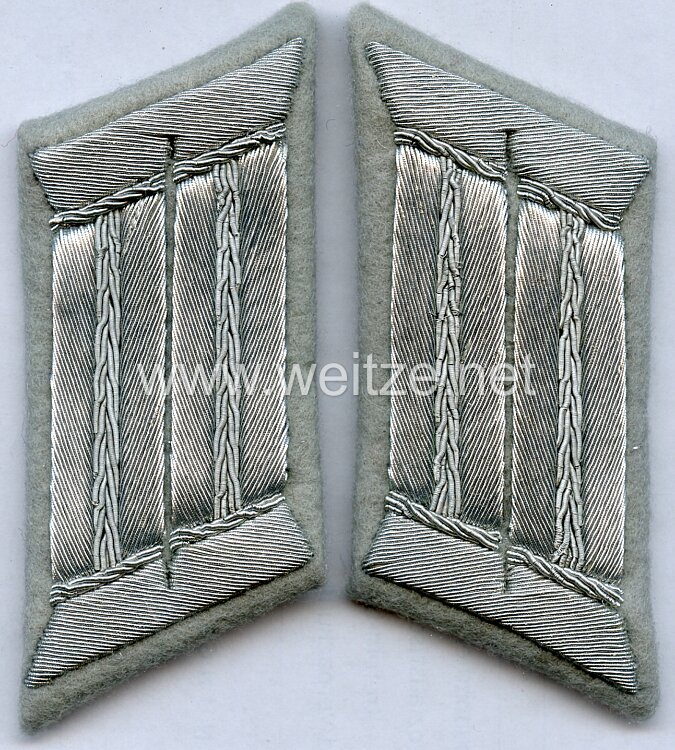
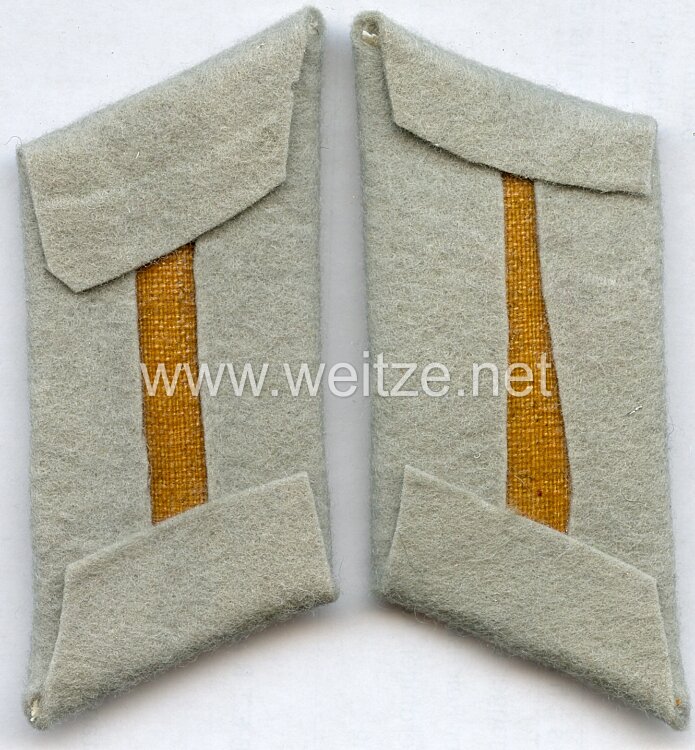
Wehrmacht Heer Pair of Collar Tabs for Propaganda Troops

Bright finish for the dress tunic, branch color light gray, condition 2.
285383
200,00

Wehrmacht Heer Pair of Collar Tabs for Propaganda Troops

The collar tabs of the Wehrmacht Propaganda Troops represent a fascinating testimony to the military organizational structure of the Third Reich. These special insignia served to identify members of the propaganda companies, a highly specialized unit within the Wehrmacht responsible for documenting and propagandistically portraying military operations.

The Propaganda Troops were officially established in 1938, following earlier attempts to professionalize military reporting. With the formation of these units, the Wehrmacht leadership recognized the strategic importance of media warfare. The Propaganda Companies (PK - Propagandakompanien) consisted of war correspondents, photographers, cameramen, and radio technicians who documented military operations at the front lines.

The collar tabs described here in bright, shiny execution were intended for the Waffenrock, the Wehrmacht's walking-out uniform. The bright gray branch color (Waffenfarbe) was characteristic of the Propaganda Troops and distinguished them from other branches of the Army. In the complex system of Wehrmacht uniforms, branch colors played a central role in quickly identifying troop affiliation. While, for example, the infantry wore white, artillery red, and armored troops pink as their branch colors, the Propaganda Troops received the distinctive light gray identification.

Collar tabs were worn in pairs, one on each side of the uniform collar. The shiny execution with metal threads or aluminum bullion was typical for walking-out uniforms and parade dress, while matte, embroidered versions were preferred for field use. The production of these insignia was carried out by specialized manufacturers who worked according to strict military specifications. The Army Service Regulations (H.Dv. - Heeres-Dienstvorschrift) precisely regulated the shape, size, and attachment of these uniform parts.

The significance of the Propaganda Companies in World War II can hardly be overestimated. They created the visual material used both for domestic propaganda and for newsreels. Their footage fundamentally shaped public perception of the war. PK members were often highly qualified professionals, including well-known pre-war photographers and filmmakers. They operated under dangerous conditions and, despite their non-combatant role, were frequently present at the front lines.

The organizational integration of the Propaganda Troops was complex. Formally, the PK units were subordinate to the Wehrmacht Propaganda Department, which in turn was assigned to the Supreme Command of the Wehrmacht (OKW). At the same time, there were close connections to the Reich Ministry of Public Enlightenment and Propaganda under Joseph Goebbels. This dual subordination occasionally led to jurisdictional disputes but also illustrates the high priority given to propaganda warfare.

The uniforms of the Propaganda Troops generally followed Army standards, with the specific markings mentioned. The collar tabs were just one element of a complex system of insignia, which also included shoulder boards, sleeve badges, and other distinctions. The light gray branch color ran through all these elements, creating a uniform appearance.

After the war, these uniform parts became sought-after collectibles that today represent important sources for military historical research. They document not only the material culture of the Wehrmacht but also the organizational complexity and the importance attached to propaganda in Nazi Germany. The condition of such pieces varies considerably, with well-preserved specimens like the described pair being particularly valuable to collectors and museums.

The examination of these military historical objects provides important insights into the structure and functioning of the Wehrmacht as well as the role of media in World War II. They also serve as reminders of the need for critical engagement with propaganda and media manipulation, topics that remain highly relevant today.