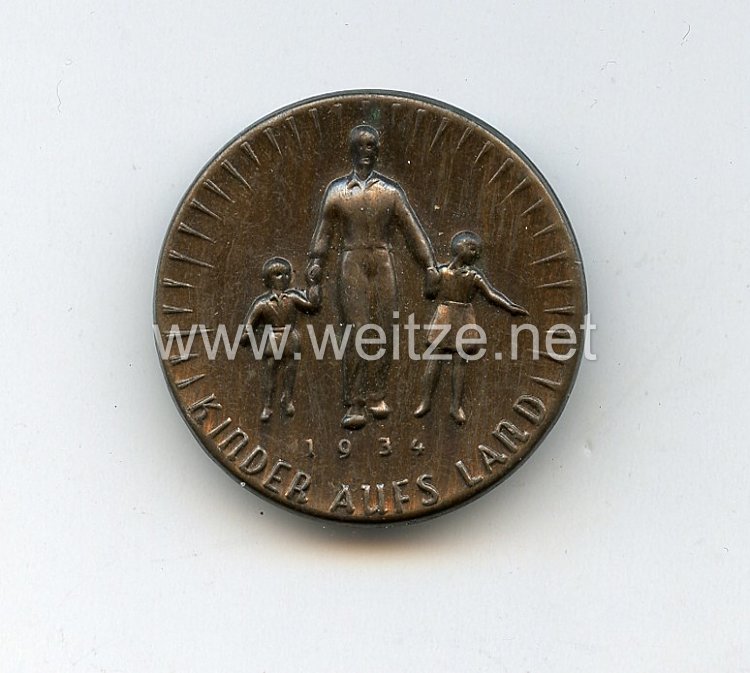
Third Reich - Children to the Countryside 1934

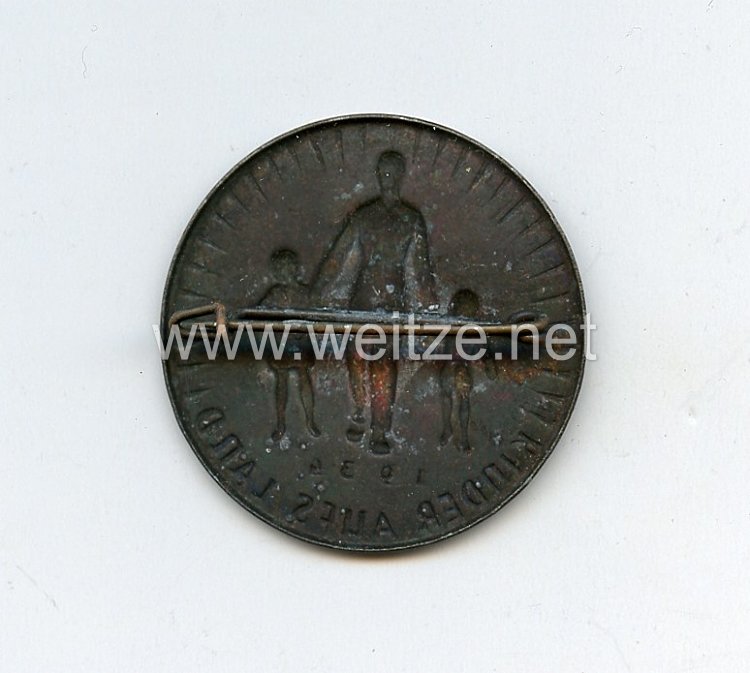
Tinplate badge, pin-back, condition 2.
418283
20,00

Third Reich - Children to the Countryside 1934

The “Kinder aufs Land” (Children to the Countryside) badge from 1934 represents a fascinating chapter in National Socialist social and health policy during the early phase of the Third Reich. This tin badge was issued as part of a broader welfare campaign aimed at sending children from urban areas to the countryside for recreation and recuperation.

Following the Nazi seizure of power in 1933, the regime quickly took control of all aspects of public life, including welfare and youth care. The National Socialist People's Welfare (NSV), founded in 1932 and massively expanded from 1933 onwards, became the central organization for social welfare in the German Reich. The NSV organized numerous aid programs that were used for propaganda purposes to demonstrate the new regime's supposed care for the German people.

The “Kinder aufs Land” campaigns had several objectives. From a health perspective, city children, especially from poorer families, were to be strengthened through stays in the countryside. Living conditions in industrial cities were often cramped, and many children suffered from malnutrition and lack of exercise. A stay in the countryside offered fresh air, better nutrition, and physical activity. Simultaneously, these programs served ideological indoctrination by emphasizing the connection between the German people and their “soil” – a central element of the National Socialists' “Blood and Soil” ideology.

Badges like this were used as donation badges. Citizens who donated to such welfare programs received these pins as a visible sign of their participation. Wearing such badges was not merely an act of supposed charity but also a form of social pressure and conformity. Those not wearing a badge could be perceived as non-solidary or critical of the regime. These fundraising campaigns were regular and covered various themes and occasions throughout the year.

The manufacture from tin plate was typical for the period. Unlike higher-quality badges made from non-ferrous metals or with enamel, these mass-produced items were inexpensive to manufacture. This enabled wide distribution while keeping production costs minimal. The simple construction with a pin back for attaching to clothing was standard for such welfare badges.

The year 1934 was a consolidation phase for the Nazi regime. Following the elimination of the SA leadership in the so-called “Röhm Affair” in June 1934 and Hindenburg's death in August, which paved Hitler's way to uniting the offices of Reich President and Reich Chancellor, the dictatorship solidified. Simultaneously, the regime intensified its propaganda and social work to bind the population more closely to itself.

The NSV grew rapidly during this period. It organized not only children's evacuations but also the Winter Relief Work (WHW), mother recuperation programs, and numerous other initiatives. By 1939, the NSV had become the largest mass organization after the German Labour Front (DAF) with over 17 million members.

From today's perspective, such objects must be viewed critically. While they document social programs that had positive effects for individual children, they were inseparably connected with the inhumane system of National Socialism. The apparent welfare was selective and ultimately served “Volkserziehung” (national education) in accordance with Nazi ideology. Children who did not fit the racist worldview were systematically excluded and later persecuted.

Collectors and historians preserve such badges as historical documents. They are material witnesses to the penetration of everyday life by the Nazi regime and show how propaganda and social control were interwoven. The condition grade “Condition 2” indicates a well-preserved piece with slight signs of use, which is remarkable for objects over 90 years old.