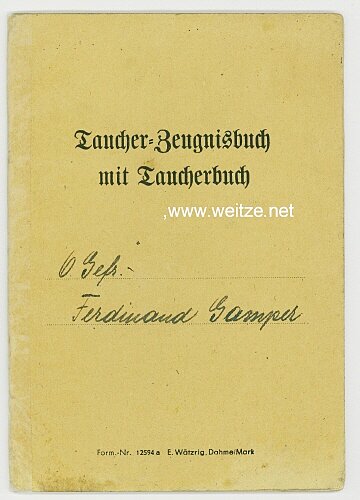
Army - Diver Certificate Book with Diving Log for Engineers

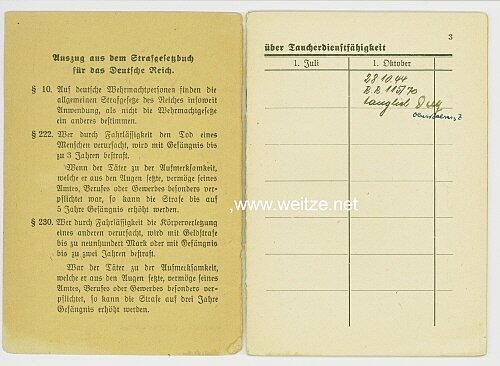
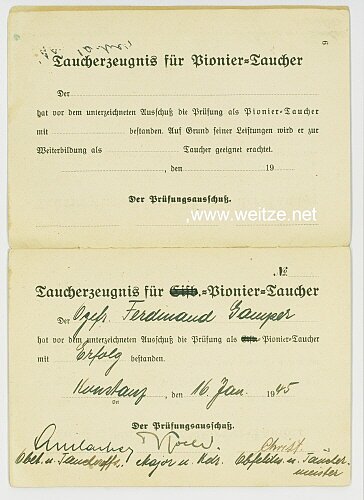
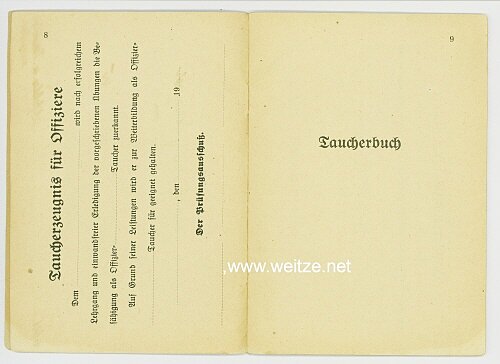
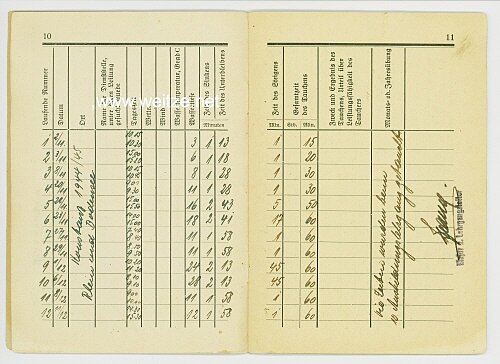
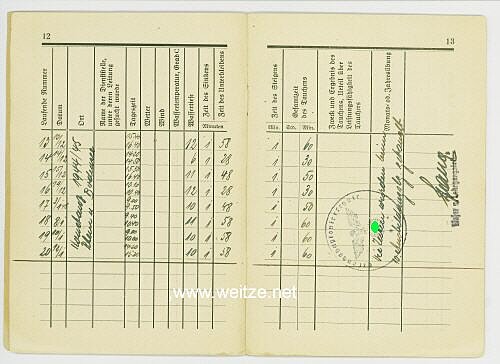
for an Obergefreiter (Senior Lance Corporal) who was examined for fitness on 28.10.1944, he successfully passed the diver certification for Pioneer-Diver, issued in Konstanz on 16.1.1945, the diving log records 20 dives from 2.11.1944 to 12.1.1945 in the Rhine and Bodensee (Lake Constance), stamped by the Eisenbahnpionierschule (Railway Engineer School); used condition.
224483
700,00

Army - Diver Certificate Book with Diving Log for Engineers

The Diver Certification Book for Pioneer Divers of the Wehrmacht represents a fascinating testimony to specialized military training during the final months of World War II. These documents served as essential proof of successful training for soldiers in the highly specialized field of military diving, which played an important role particularly in the Pioneer units of the Wehrmacht.

The Pioneer troops of the Wehrmacht were responsible for a wide variety of technical tasks, including bridge construction, demolitions, mine clearance, and underwater operations. Pioneer divers received specialized training to perform tasks such as repairing and demolishing bridges, salvaging materials, inspecting underwater obstacles, and preparing river crossings. These skills were of strategic importance in a country like Germany with its numerous rivers and waterways.

Training for pioneer divers took place at specialized facilities such as the Railway Pioneer School (Eisenbahnpionierschule), which was responsible not only for training in railway engineering but also for other technical pioneer skills. The fact that training took place in Constance (Konstanz) makes geographic sense, as the city on Lake Constance offered ideal training opportunities for diving operations. Lake Constance with its varying depths and the Rhine with its currents presented different challenges necessary for realistic training of military divers.

The chronological placement of this document – October 1944 to January 1945 – falls within the final phase of World War II, when the German Reich was already under severe pressure. Despite the increasingly desperate military situation, investment continued in training specialized forces. This underscores the importance the Wehrmacht attributed to technical specialist forces even in this late phase. The training of pioneer divers as late as winter 1944/45 indicates the continuing need for such specialists, possibly for defensive operations along German rivers or for sabotage missions.

The dive log itself served as a personal record document in which each individual dive was documented with date, location, depth, duration, and work performed. This careful documentation was important not only for training purposes but also for medical monitoring of divers. The dangers of diving, particularly decompression sickness (then often referred to as “diver's disease”), were well known, and keeping accurate records helped monitor the health and safety of divers.

The recording of a total of 20 dives over a period of approximately ten weeks demonstrates an intensive training program. Dives in the Rhine and Lake Constance offered different training conditions: while Lake Constance provided calmer water and greater depths, the Rhine presented special challenges with its current. The winter months from November to January were particularly demanding, as water temperatures were considerably lower and placed additional stress on the divers.

Wehrmacht diving equipment at this time typically consisted of standard diving dress (helmet diving equipment) or in some cases more modern closed-circuit rebreathers. The equipment was heavy and required considerable physical fitness and technical understanding. The medical fitness examination conducted before training began was therefore of critical importance.

Documents such as this diver certification book are rare historical artifacts today. They offer insight not only into military organization and training but also into the lives of individual soldiers during the final months of the war. The personal character of these documents – with individual entries, stamps, and signatures – makes them valuable sources for military historical research.

The preservation of such documents is important for understanding the everyday reality in the Wehrmacht, beyond the great battles and strategic decisions. They document the technical competence and specialization that still existed even in an army in decline, and remind us of the individual fates of the men who carried out these dangerous tasks. The intensive training schedule, even during the harsh winter months, speaks to both the dedication required of these soldiers and the Wehrmacht's determination to maintain specialized capabilities until the very end of the war.

These certification books also reflect the bureaucratic thoroughness characteristic of German military administration, with detailed record-keeping maintained even as the Reich faced imminent collapse. Such attention to documentation and procedure, even in desperate circumstances, provides valuable insights into military culture and organization during this critical period.