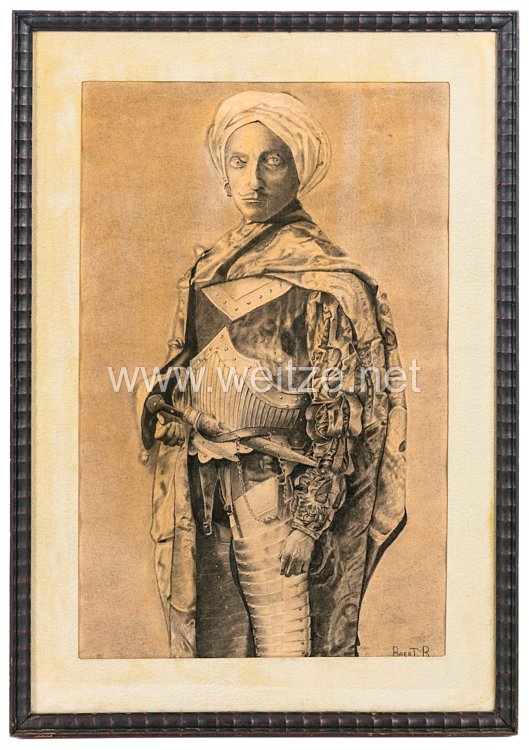
France Portrait of a Mameluke Warrior

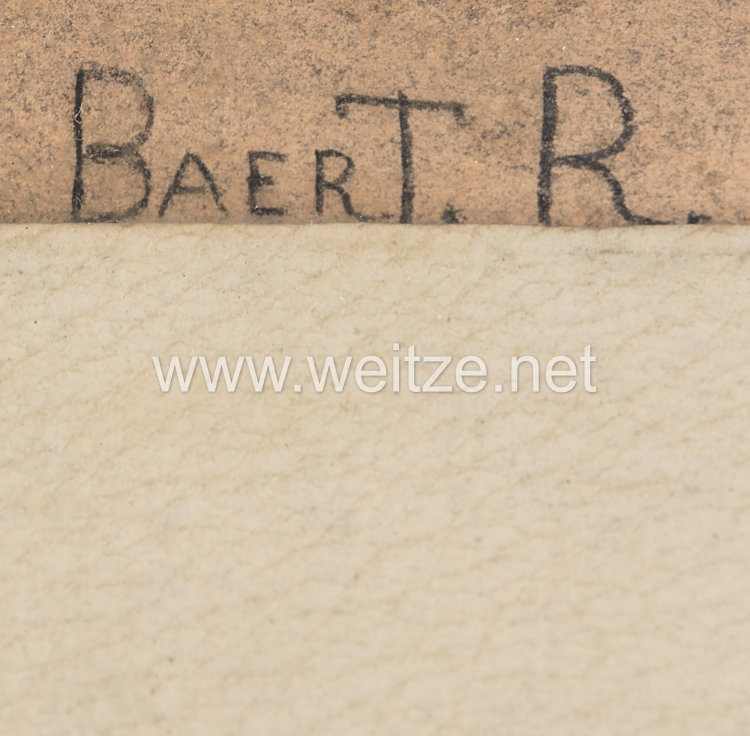
Circa 1860/70. Artist “T.R. Baer”, in wooden frame, 43 x 62 cm, Condition 2.


304183
75,00

France Portrait of a Mameluke Warrior

This portrait of a Mameluke warrior, created around 1860/70 by the artist T.R. Baer, represents a fascinating chapter in military history and 19th-century European Oriental fascination. This work emerged during an era when the romanticized image of the Mamelukes was deeply rooted in European, particularly French, culture.

The Mamelukes were originally military slaves who played a significant role in the Islamic world from the 9th century onward. The term derives from the Arabic “mamluk” (owned, slave). This warrior caste consisted primarily of youth of Turkic and Caucasian origin who were trained as elite soldiers. In Egypt, the Mamelukes established their own sultanate from 1250 to 1517 and retained considerable influence even under Ottoman rule.

The French connection to the Mamelukes began with Napoleon's Egyptian Campaign (1798-1801). On July 21, 1798, Napoleon defeated the Mameluke army under Murad Bey at the Battle of the Pyramids. Despite their legendary bravery and equestrian skills, the Mamelukes were no match for modern French infantry tactics. Napoleon himself, however, admired their courage and martial appearance. He stated appreciatively: “Two Mamelukes could defeat three Frenchmen, 100 Mamelukes were equal to 100 Frenchmen, but 300 Frenchmen regularly defeated 300 Mamelukes.”

Following the Egyptian Expedition, Napoleon integrated Mameluke cavalry into his army. The most famous example was the Mameluke Squadron of the Imperial Guard, founded in 1801 and officially established in 1804 as the “Escadron des Mamelouks de la Garde impériale.” These exotic cavalrymen, in their magnificent Oriental uniforms with baggy trousers, richly decorated dolmans, and turbans, became a symbol of the Napoleonic army. They accompanied Napoleon on his campaigns throughout Europe and fought at Austerlitz (1805), Jena (1806), Wagram (1809), and in the catastrophic Russian Campaign (1812).

The most famous Mameluke in French service was Roustam Raza, Napoleon's personal bodyguard from 1799 to 1814. His presence at the Emperor's side solidified the romantic image of the faithful Oriental warrior in French consciousness.

After Napoleon's fall in 1815, the Mameluke units were disbanded, but their visual legacy persisted. The July Monarchy under Louis-Philippe and the Second Empire under Napoleon III (1852-1870) consciously cultivated the memory of Napoleonic glory. During this period, precisely when our portrait was created around 1860/70, Napoleon veneration experienced a renaissance.

The Orientalism movement of the 19th century further intensified interest in exotic military figures. Artists such as Eugène Delacroix, Jean-Léon Gérôme, and Horace Vernet created numerous depictions of Oriental warriors. Military themes were particularly popular as they combined masculinity, exoticism, and historical grandeur.

Portraits of Mameluke warriors from this era typically show the characteristic weaponry and clothing: the curved saber (Shamshir or Kilij), richly decorated pistols, the dagger (Jambiya), as well as colorful Oriental garments. The depictions often emphasized the martial dignity and exotic foreignness of these warriors, oscillating between historical documentation and romantic idealization.

The artistic value of such portraits lay not only in their aesthetic quality but also in their function as historical memorabilia. In France of the Second Empire, they served to recall the military successes of the Napoleonic era and strengthen national identity. Simultaneously, they satisfied the widespread fascination with the “Oriental,” which in European imagination was considered mysterious, dangerous, and seductive.

The historical significance of the Mamelukes largely ended with the Cairo Massacre of 1811, when Egyptian ruler Muhammad Ali Pasha had the Mameluke elite murdered in a trap to consolidate his power. Nevertheless, their myth lived on in Europe, especially in France, where they remained inseparably connected to the Napoleonic legend.

This portrait of a Mameluke warrior is thus more than merely a military artwork—it is testimony to the complex cultural entanglements between Europe and the Orient, the romanticization of military history, and the enduring fascination with the Napoleonic era in the 19th century.

r