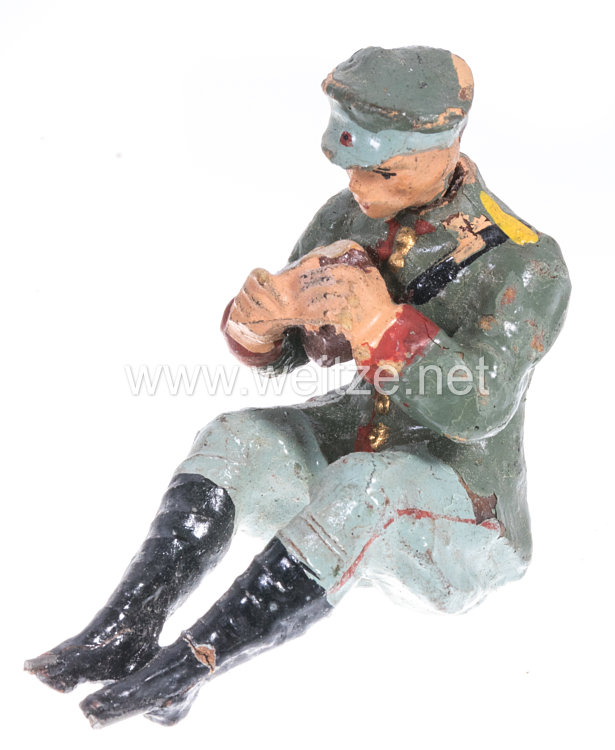
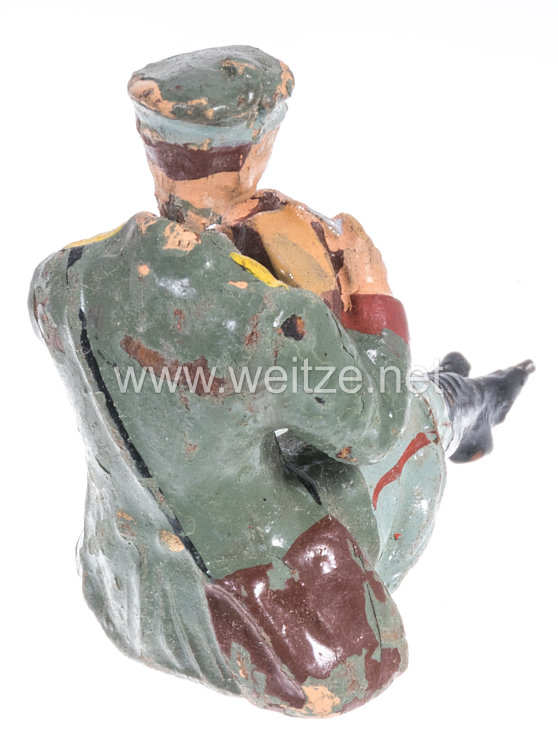
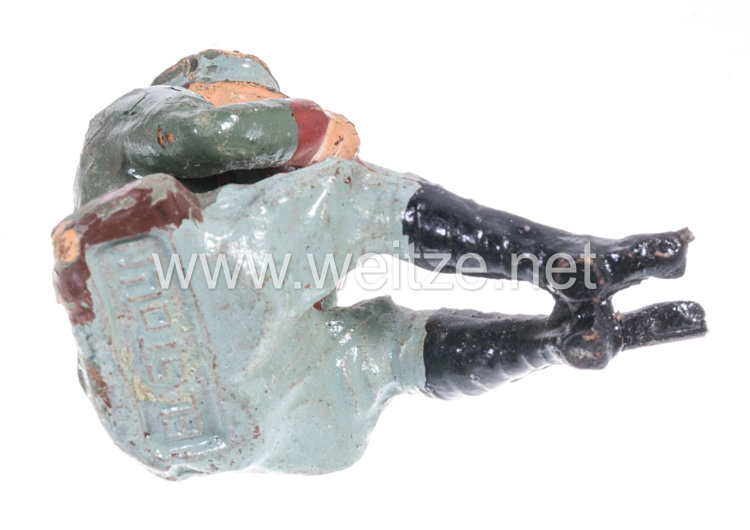
Elastolin - Army Camp Life - Soldier with Visor Cap Seated Cutting Bread

7 cm, condition 2.
358283
20,00

Elastolin - Army Camp Life - Soldier with Visor Cap Seated Cutting Bread

This Elastolin figure depicting a seated soldier of the German Wehrmacht cutting bread represents a remarkable testament to German toy and militaria production of the 1930s and 1940s. This 7 cm figure belongs to the “Heer Lagerleben” (Army Camp Life) series, which portrays the daily life of German soldiers outside of combat situations.

The company O. & M. Hausser in Ludwigsburg began producing Elastolin figures in the 1920s, using an innovative material composed of casein, lime, chalk, and linseed oil, molded over wire frames. This composition allowed for detailed representation while being more robust than conventional papier-mâché figures. The name Elastolin became synonymous with high-quality German mass-produced figures.

The service cap (Schirmmütze) worn by the depicted soldier was the characteristic headgear of the Wehrmacht. The Army Service Dress Regulations of 1935 precisely defined uniform standards. The service cap was worn in camp life and outside of combat, while the steel helmet was mandatory in the field. This everyday scene shows the soldier in a rest situation, typical of the Camp Life series.

Bread cutting as the depicted activity reflects a fundamental aspect of soldier's daily life. Wehrmacht army rations were based on fixed allocations, with bread being a staple food. Kommissbrot, a dark rye mixed bread, was issued in loaves and had to be portioned by soldiers themselves. The ration regulations provided for 700 grams of bread or 500 grams of zwieback daily.

The Elastolin series documented various aspects of military life. While combat scenes and marching troops made up the majority of productions, representations of camp life gained importance from the mid-1930s onwards. These figures showed soldiers eating, grooming, writing, or performing other everyday tasks. They served not only as toys but also as propaganda instruments to idealize soldier's life.

The production of military toy figures experienced an upswing in the Third Reich. The regime promoted the militarization of youth, and toy soldiers were part of this educational strategy. Hausser produced items for the WHW (Winter Relief Organization) among others and received government contracts. The accurate depiction of uniforms and equipment was intended to familiarize children with the Wehrmacht.

The technical production of Elastolin figures was elaborate. First, wire frames were bent to form the skeleton of the figure. The Elastolin mass was then modeled and shaped over this. After drying, painting was done in several layers. The figures were painted by hand, making each one unique. The coloring followed official uniform regulations, with Wehrmacht field gray (Feldgrau) reproduced in various nuances.

The condition grade 2 of this figure indicates very good preservation with only minor signs of use. In the collector's field, condition is classified from 1 (perfect) to 5 (heavily damaged). Figures in this state of preservation are rare today, as Elastolin figures were intensively used as toys and the material was susceptible to damage.

After 1945, the production of military figures was initially banned in the American occupation zone. Hausser switched to civilian themes before resuming soldier figure production in the 1950s, now depicting Bundeswehr and NATO troops. Original Wehrmacht figures from the pre-war and war periods are now sought-after collector's items.

From a military-historical perspective, such figures offer insights into the contemporary representation and perception of the military. They document uniform details, equipment items, and everyday practices. At the same time, they are testimonies to propaganda and the militarization of society in National Socialist Germany.