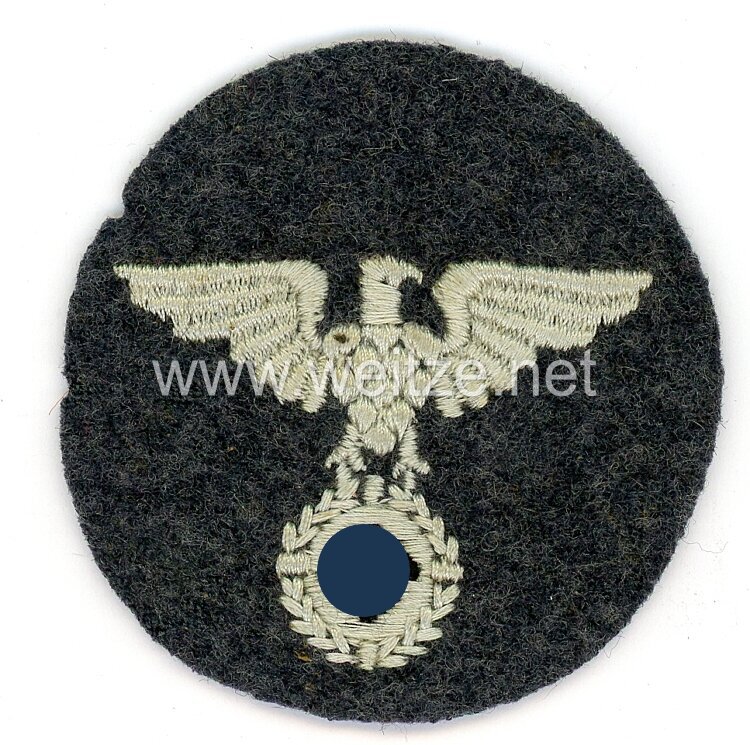
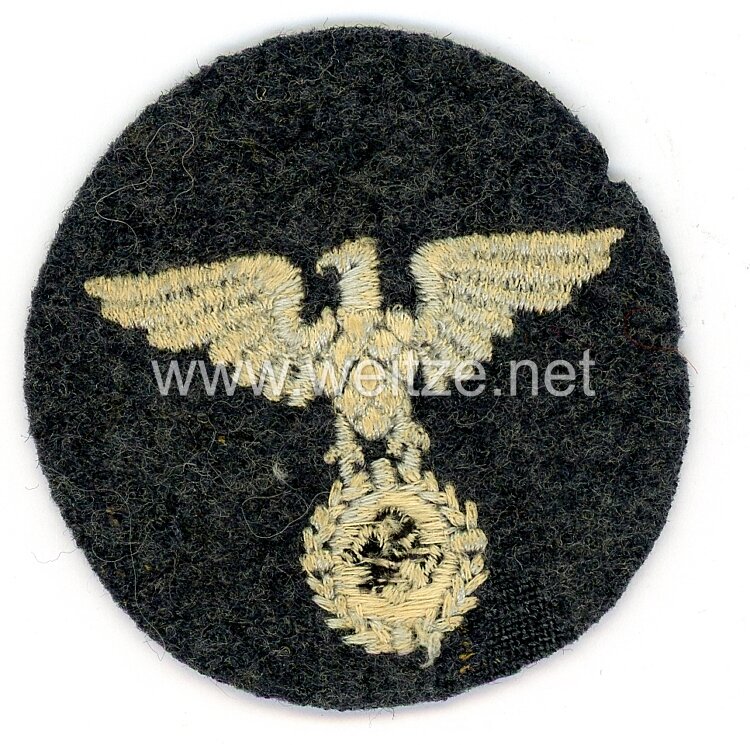
DLV Deutscher Luftsportverband Sleeve Eagle for Enlisted Men
The DLV Arm Eagle for Enlisted Men: Emblem of Civil Aviation Sport in the Third Reich
The Deutscher Luftsportverband (DLV) or German Air Sports Association played a central role in the development of German aviation between 1933 and 1937. The arm badge described here, an eagle for enlisted ranks on Luftwaffe cloth, represents a fascinating chapter in the prehistory of the German Air Force.
The DLV was founded on March 25, 1933, taking over the functions of various previously existing air sports organizations from the Weimar Republic. Under the leadership of Hermann Göring, the association officially served to promote civilian flight sports, but in reality fulfilled a far more significant function: the covert training of pilots and technical personnel for the air force then under construction. This camouflage was necessary because Germany had been prohibited from maintaining a military air force by the Treaty of Versailles of 1919.
The uniforming of the DLV followed precise regulations established in several decrees between 1933 and 1937. The arm badge in the form of an eagle was an essential component of this uniform and identified membership in the association. For enlisted men (Mannschaften), meaning the lower ranks, a special design was prescribed that differed from the badges for leaders and non-commissioned officers.
The badge was typically worn on the left upper sleeve of the DLV uniform. The execution on Luftwaffe cloth (LW-Tuch) is particularly noteworthy, as it documents the close connection between the nominally civilian DLV and the military air force. The gray or gray-blue cloth was characteristic of Luftwaffe uniforms and differed markedly from civilian fabrics.
The eagle as a symbol had a long history in German military tradition. In the DLV version, the eagle with outstretched wings clutched the swastika in its talons – a clear sign of the National Socialist orientation of the organization. The design followed the iconographic guidelines of the regime, though embroidery quality and execution could vary depending on the manufacturer.
Membership in the DLV was strictly hierarchically organized. The enlisted ranks formed the base of the organization and included flight students, technical assistants, and auxiliary personnel. Their training encompassed not only theoretical and practical aeronautics, but also pre-military schooling, field exercises, and ideological instruction. Many DLV members later entered the Luftwaffe directly when it was officially established on March 1, 1935.
The quality and condition of DLV badges vary considerably. A “lightly worn” example in “condition 2” indicates a piece that was used but shows no significant damage. Such badges were generally produced by authorized manufacturers who had to maintain certain quality standards. Attachment was usually by sewing onto the uniform, with lightly worn pieces often showing slight signs of use such as minimal thread loosening or minor fading.
On April 1, 1937, the DLV was officially dissolved and incorporated into the National Socialist Flyers Corps (NSFK). This reorganization reflected the changed situation: the Luftwaffe now existed openly and no longer needed the cover organization in its original form. The NSFK continued to assume tasks in preliminary flight training, but under a different organizational structure and with modified uniforms and badges.
For collectors and historians, DLV badges are of particular interest because they document a relatively short but significant period of German history. The four-year existence of the DLV makes original pieces rare and sought-after today. Authentication requires knowledge of manufacturing techniques, materials, and wearing regulations of the period. The execution on Luftwaffe cloth is particularly important as an authenticity feature, as later reproductions often use different materials.
The arm badge stands as an example of the complex interweaving of civilian sport, military preparation, and political ideology in National Socialist Germany. It recalls a time when official restrictions were circumvented through cover organizations and when systematic rearmament began years before its official announcement.