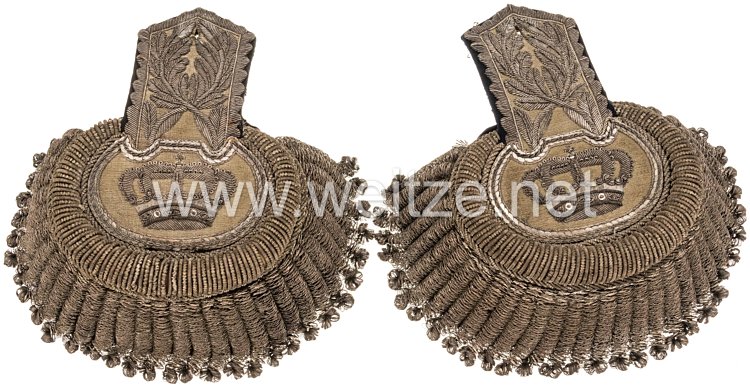
Bavaria Pair of Epaulettes for High-Ranking State Officials

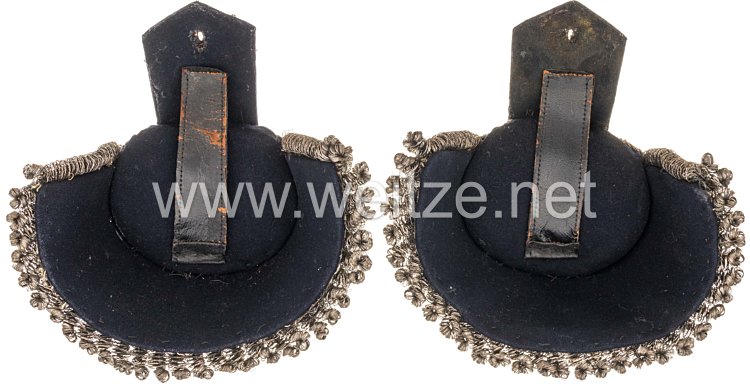
Pair of epaulettes for a Ministerial Director etc. in the style of the Prince Regent’s regency until 1914. Silver embroidery, with crown on silver cloth, rigid bullion wire. Dark blue cloth base. Worn, condition 2.
351983
850,00

Bavaria Pair of Epaulettes for High-Ranking State Officials

These epaulettes for high-ranking Bavarian state officials represent a significant example of civil rank insignia in the late German Empire. These magnificent shoulder pieces were worn by senior officials of the Bavarian state administration, particularly by Ministerialdirigenten (ministerial directors), during the regency of Prince Regent Luitpold of Bavaria (1886-1912) and his successor Prince Regent Ludwig (1912-1913), as well as in the early months of World War I until 1914.

The Prince Regent era marked a distinctive epoch in Bavarian history. Following the incapacitation of King Ludwig II in 1886, his uncle Luitpold assumed the regency, which would span nearly three decades. This period was characterized by administrative stability, cultural flourishing, and a highly developed civil service hierarchy whose members were distinguished by precisely defined rank insignia.

The technical execution of these epaulettes meets the highest standards of the time. The silver embroidery was crafted with elaborate handwork, whereby the rigid bullion - spirally twisted metal threads - was characteristic of higher ranks. Unlike the flexible bullion of lower ranks, the rigid bullion gave the epaulettes more weight and stability. The embroidered crown on silver cloth symbolized the royal authority under which the state officials served.

The dark blue cloth backing was prescribed for civil state officials and thus distinguished them from military epaulettes, which displayed different colors according to branch of service. The blue corresponded to the traditional state color and was specified in various service regulations.

Ministerialdirigenten belonged to the highest civil service ranks below ministers themselves. They headed important departments in the ministries and bore considerable responsibility for the administration of the Kingdom of Bavaria. Their position required the wearing of gala uniforms on certain ceremonial occasions, to which these epaulettes belonged. Such occasions included state receptions, royal audiences, court balls, and other official ceremonies.

The wearing of epaulettes by civil officials had a long tradition in Europe dating back to the late 18th century. In Bavaria, regulations for official uniforms were refined several times, particularly through ordinances from 1806, 1835, and 1886. The present pieces conform to the regulations valid during the Prince Regent era.

The craftsmanship quality of such epaulettes was produced by specialized military embroidery workshops, often based in Munich or other larger Bavarian cities. These workshops employed highly skilled embroiderers and goldsmiths who had undergone years of training. A pair of such epaulettes represented a considerable investment and was often worn and maintained for decades.

The indicated condition 2 points to comprehensible signs of wear expected with worn pieces of this type. This underscores the authenticity of the objects as actually used service insignia rather than mere display pieces.

With the end of the monarchy in 1918 and the proclamation of the Free State of Bavaria, these epaulettes lost their official function. The new republican order dispensed with such monarchical symbols and rank insignia. Many of these valuable pieces were preserved in family ownership or entered collections and museums, where they can today be studied as important testimonies to the administrative and cultural history of the Kingdom of Bavaria.

For collectors and historians, such epaulettes offer valuable insights into the hierarchical structure of Bavarian state administration, the symbolism of monarchical rule, and the high craftsmanship of the era. They document an epoch in which social rank and state function were made visible through precisely defined external signs.

These artifacts remind us of a time when the Bavarian state maintained an elaborate system of visual distinctions, reflecting both the authority of the crown and the importance placed on administrative hierarchy. The combination of precious materials, skilled craftsmanship, and symbolic elements created objects that were simultaneously functional, decorative, and emblematic of state power.

r