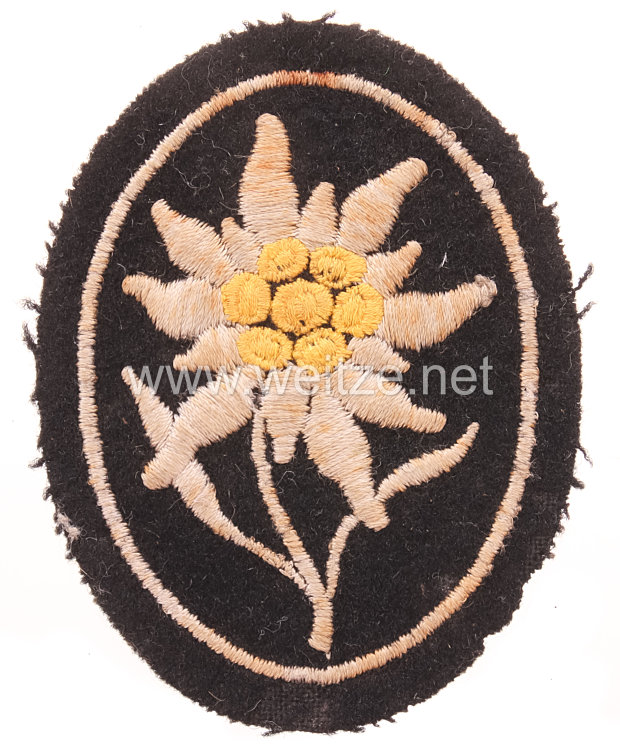
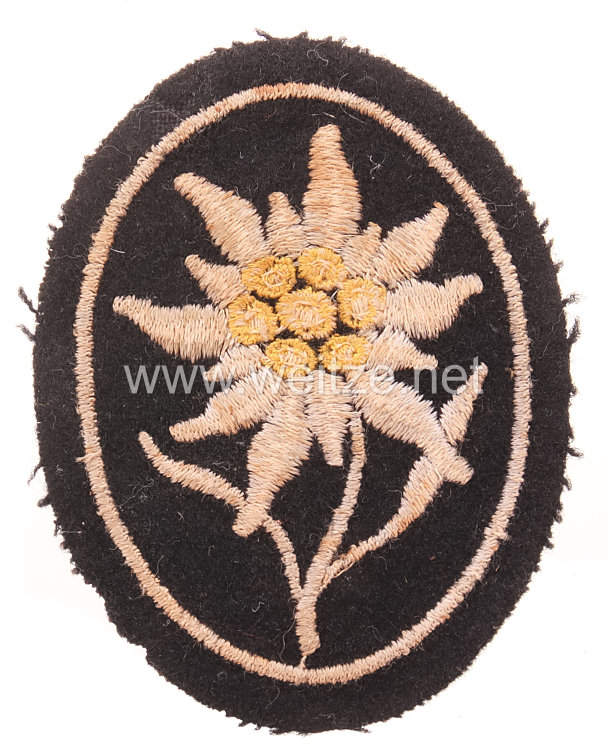
Waffen-SS Sleeve Insignia for Mountain Troops
The Waffen-SS sleeve insignia for mountain troops (Gebirgsjäger) represents a significant example of the military insignia system of the Third Reich. These special sleeve badges were introduced to identify membership in the Waffen-SS mountain troops and to highlight the alpine specialization of these units.
The Waffen-SS Gebirgsjäger emerged in the context of the expansion of SS units during World War II. The most well-known formation was the 6th SS Mountain Division “Nord”, established in 1941, followed by the 7th SS Volunteer Mountain Division “Prinz Eugen” in 1942. These divisions were specially trained for deployment in difficult terrain such as the Norwegian fjords, the Alps, and the Balkans.
The present specimen displays the typical RZM machine-embroidered execution. The Reichszeugmeisterei (RZM) was the central procurement office of the NSDAP and its organizations, which from 1929 oversaw the standardization and quality control of uniforms and insignia. Machine-embroidered badges represented a more cost-effective alternative to hand-embroidered variants and were produced in large quantities, particularly during the war years when demand for military equipment increased dramatically.
The Edelweiss, typically depicted on these sleeve badges, had a long tradition as a symbol of mountain troops. Already in the Imperial Army and later in the Reichswehr, the Edelweiss was used as an identifying symbol of alpine units. The Waffen-SS adopted this symbolism to establish continuity with German military tradition and to emphasize the elite status of their mountain troops.
The wearing of these sleeve badges was regulated by various uniform regulations. They were typically worn on the right upper arm of the field tunic or mountain combat uniform. The position and method of attachment followed precise military specifications laid down in the Waffen-SS clothing regulations.
The manufacture of such badges was carried out by various licensed manufacturers who were inspected and approved by the RZM. These manufacturers received specific RZM numbers, which were often applied to the reverse of the badges. The machine-embroidered execution is characterized by a distinctive uniformity of stitching and standardized coloring, typically in white or light gray on a dark background.
The stated condition 2 in collector categorization indicates a worn piece showing clear signs of use but still well recognizable and largely complete. Such worn specimens are particularly interesting historically as they represent authentic testimony to actual military deployment. Signs of use may include fading, minor damage to the embroidery, or remnants of the original attachment.
The SS mountain divisions were deployed on various theaters of war. The “Nord” Division fought mainly in Finland and northern Norway, while the “Prinz Eugen” Division was predominantly deployed in the Balkans against partisans. Additional mountain units such as the 13th Waffen Mountain Division of the SS “Handschar” and the 21st Waffen Mountain Division of the SS “Skanderbeg” were established later, with these increasingly composed of foreign volunteers and recruits.
From today's perspective, such military relics are important historical documents that contribute to the study of uniform history, military history, and material culture. They enable historians and museums to study the development of military symbolism, manufacturing techniques, and organizational structures. At the same time, they require sensitive and contextualized treatment due to the criminal nature of the Nazi regime and the Waffen-SS, which was classified as a criminal organization by the Nuremberg Tribunal.
The scholarly engagement with such objects serves to understand this dark period of German history and contributes to historical education without glorifying or relativizing the regime's actions.