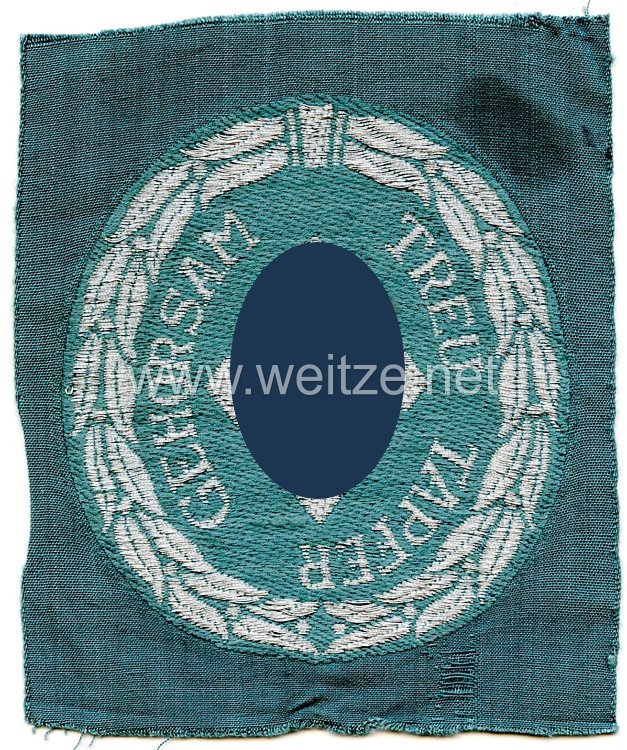
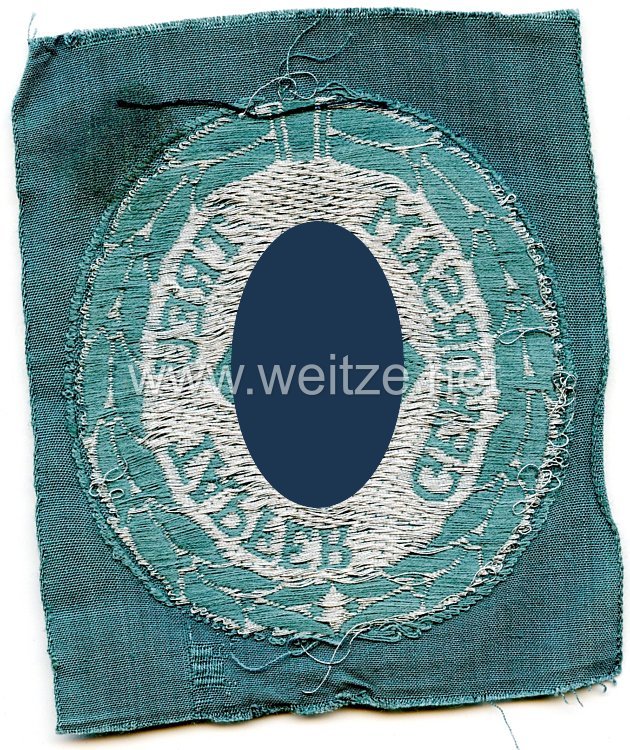
SD/Schutzmannschaften Sleeve Insignia for Leaders of the Ordnungspolizei

Bevo metal-thread woven construction on field-gray wool. Unissued condition, grade 2.
The Schutzmannschaft (= Schuma) was an auxiliary police unit composed of local personnel from the occupied territories of Eastern Europe.
440582
210,00

SD/Schutzmannschaften Sleeve Insignia for Leaders of the Ordnungspolizei

The sleeve insignia for leaders of the Schutzmannschaft represents a significant, albeit problematic, testimony to German occupation policy during World War II. This badge, manufactured using the Bevo metal thread weaving technique on field-gray backing, was part of the uniform of leadership personnel within the so-called Schutzmannschaft (abbreviated: Schuma), an auxiliary police organization recruited from local volunteers in the occupied Eastern territories.

The Schutzmannschaften emerged from 1941 onward in the context of the German conquest of large parts of Eastern Europe during Operation Barbarossa. Given the enormous territorial extent of the occupied areas and chronic personnel shortages, German occupation authorities found themselves compelled to rely on local auxiliary forces. These units were formally subordinated to the German Ordnungspolizei (Order Police/Orpo) and were intended to perform various police duties in the occupied Eastern territories.

The organizational structure of the Schutzmannschaften was complex and encompassed various categories: the Schutzmannschaft Einzeldienst (Individual Service) for stationary police duty, the Schutzmannschaft Bataillone (Battalions) for mobile operations, and the Schutzmannschaft der Feuerwehr (Fire Brigade) for fire protection duties. The total strength of these formations is estimated at approximately 300,000 to 350,000 men, though figures vary depending on sources.

Recruitment took place from various population groups in the occupied territories, including Ukrainians, Belarusians, Balts, Russians, and members of other nationalities. Motives for service were diverse: economic necessity, anti-communist convictions, hopes for future national independence, or simply the need for survival under extreme wartime conditions. The German occupation authorities skillfully exploited national and ethnic tensions to recruit personnel.

The sleeve insignia described here, manufactured using Bevo weaving technique, represents the high-quality production method developed by the company Bandfabrik Ewald Vorsteher from Wuppertal-Barmen. This technique made it possible to weave complex patterns and symbols directly into the fabric, often using metal threads for lustrous effects. The use of field-gray backing shows the alignment with the color scheme of the German Wehrmacht and police forces.

The uniforming and rank insignia of the Schutzmannschaften partially followed German models but also exhibited their own characteristics. Leaders and non-commissioned officers wore special sleeve badges that indicated their status within the hierarchy. These insignia were intended to demonstrate both the authority of the wearers vis-à-vis the local population and their integration into the German occupation system.

The duties of the Schutzmannschaften were wide-ranging and included regular police work such as patrol duty, traffic control, and crime fighting. However, these units were also deployed for far darker purposes. Numerous Schutzmannschaft battalions were involved in war crimes, anti-partisan operations, “reprisal measures” against the civilian population, and the murder of the Jewish population. This entanglement in National Socialist crimes makes these uniform items historically burdened objects.

The legal status of the Schutzmannschaften was ambivalent. Although formally subordinated to the German Order Police and wearing German uniform items, they were often treated as second-class auxiliaries. Their armament, equipment, and pay were generally inferior to those of their German superiors. After the war, many former members of the Schutzmannschaften were prosecuted as collaborators in their home countries, while others emigrated to Western nations.

From a historical perspective, such sleeve insignia document the complex reality of German occupation rule in the East. They show how the Nazi regime systematically incorporated local population groups into its policies of domination and extermination. For military-historical research, these objects are important sources for understanding occupation policy, collaboration, and the structure of German police and security organs.

The preservation of such historical artifacts in collections and museums serves scholarly investigation and historical education, always with awareness of the serious crimes in which many wearers of such insignia were implicated.

r