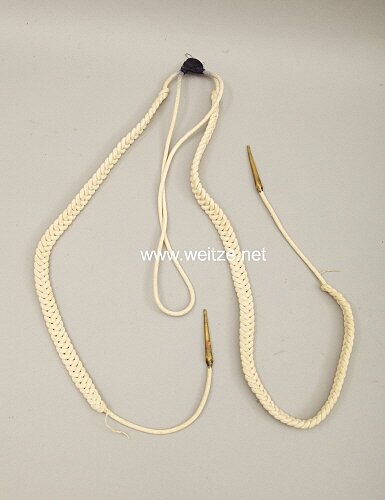
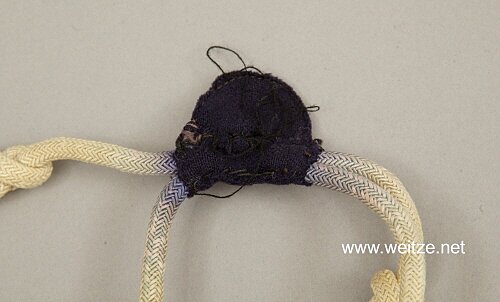
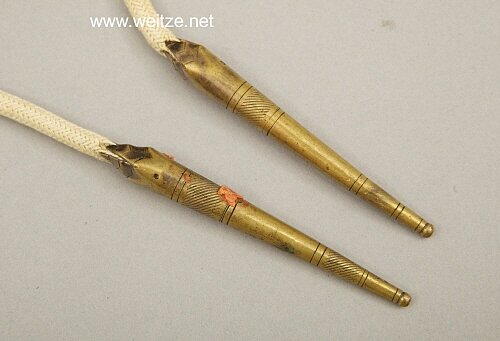
Russia World War I: Officer's Aiguillette

Circa 1915, matte finish. Worn, condition 2.
175182
220,00

Russia World War I: Officer's Aiguillette

The officer's sword knot of the Russian Army during World War I represents a significant element of Imperial Russia's military uniform tradition. This matte version from around 1915 embodies both the traditional splendor and the increasing practicality of Russian military dress during the war years.

The sword knot, known in Russian as “темляк” (temlyak), had its origins in practical military necessity. Originally, it served to secure sabers, swords, or other edged weapons to the wrist, preventing their loss in combat. Throughout the 19th century, the sword knot increasingly evolved into a rank insignia and decorative element of the officer's uniform.

In the Imperial Russian Army, sword knots were strictly regulated according to rank and branch of service. Officer versions differed significantly from those of non-commissioned officers and enlisted men through material, workmanship, and coloring. Officer sword knots were typically crafted from high-quality metal threads, often silver or gilt material, while lower ranks wore versions made of wool or cotton.

The matte finish of this sword knot from 1915 is particularly noteworthy. It reflects an important change in military practice during World War I. While shiny, polished metal sword knots were common in peacetime and the early months of the war, the reality of modern warfare led to more practical solutions. Shiny metal parts could reflect sunlight and reveal the position of officers, making them preferred targets for enemy snipers.

Russian military leadership responded to this danger with various measures. From 1915 onward, field gray and matte uniform elements were increasingly introduced, which were less conspicuous. The matte finish of sword knots was part of this development toward a more practical field uniform. Nevertheless, they retained their function as rank insignia, which was of great importance for the strictly hierarchical Russian Army.

The years 1914 to 1917 were a time of enormous challenges for the Russian Army. The Eastern Front stretched thousands of kilometers, from the Baltic Sea to the Black Sea. The Russian Army, though numerically impressive, suffered from chronic supply problems, outdated equipment, and often inadequate training. Officers played a crucial role in this context as leaders and links between common soldiers and higher command levels.

The Russian officer corps of World War I was a heterogeneous group. It included established noble families whose sons traditionally pursued military careers, but also increasingly officers from the rising bourgeoisie and even promoted non-commissioned officers who were appointed officers based on their performance. The sword knot was for all these groups a visible sign of their status and responsibility.

The use on sabers or swords remained common even in World War I, although edged weapons were increasingly losing importance. The saber, however, was more than just a weapon for Russian officers; it was a symbol of their honor and rank. The sword knot, which was attached to the sword's hilt and could be looped around the wrist, was an integral part of this tradition.

After the February Revolution of 1917 and especially after the October Revolution, these traditional rank insignia gradually disappeared. The new Red Army initially abolished all rank insignia to create an egalitarian military organization. Only later, in the 1930s, did the Soviet Union reintroduce formal rank structures and corresponding insignia.

Today, sword knots of the Imperial Russian Army are sought-after collectibles. They document not only the craftsmanship quality of military equipment production of that era, but also the complex history of Tsarist Russia in its final years. The matte version from 1915 demonstrates the transition from traditional, representative uniforming toward more war-suitable, practical equipment.

The preservation of such objects is of great historical significance, as they represent material testimonies of a vanished military culture and provide insight into the world of Russian officers during one of the most formative conflicts of the 20th century.

r