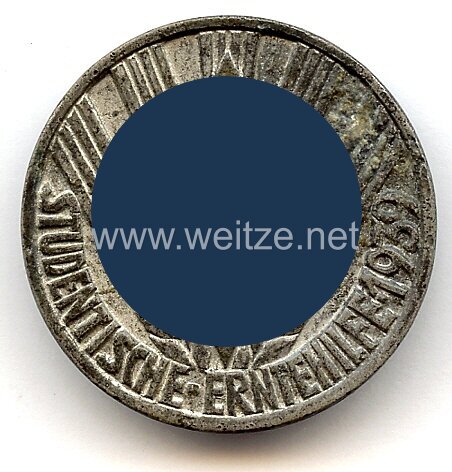
Reichsstudentenfuehrung - Commemorative Badge “Studentische Erntehilfe 1939”

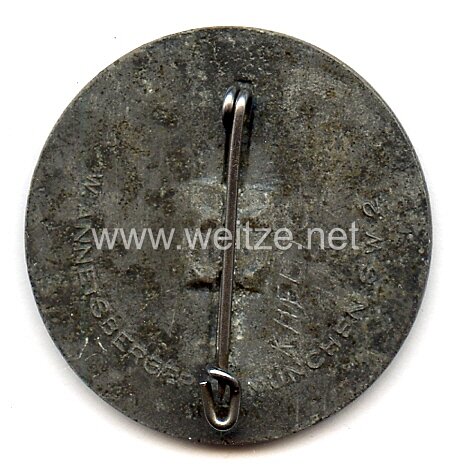
Zinc construction, with pin, maker: W.Annetsberger München SW2, condition 2-.
279982
220,00

Reichsstudentenfuehrung - Commemorative Badge “Studentische Erntehilfe 1939”

The Commemorative Badge “Student Harvest Aid 1939” of the Reich Student Leadership (Reichsstudentenführung) represents a remarkable testament to the Nazi mobilization of German students immediately before the outbreak of World War II. This zinc-manufactured badge, produced by the firm W. Annetsberger in Munich SW2, documents the systematic integration of academic circles into the war preparations of the Nazi regime.

The Reichsstudentenführung (RStF) was established in 1936 as the central leadership organization of German students and placed under the Reich Ministry of Education. Under the direction of Gustav Adolf Scheel from 1936 onwards, the organization developed into an important instrument of Nazi penetration of universities. The Reich Student Leadership controlled all student activities and ensured the ideological alignment of academic youth.

In the summer of 1939, the German Reich faced enormous logistical challenges. Accelerated rearmament and impending military operations required maximum mobilization of all societal resources. At the same time, agricultural production had to be maintained, even though numerous workers had already been conscripted into the Wehrmacht. The Student Harvest Aid formed part of comprehensive labor deployment programs designed to fill these gaps.

Harvest aid campaigns were by no means new in Nazi Germany. Since 1933, students had been regularly obligated to perform land service and agricultural deployments. These measures served multiple purposes: they were meant to harness students' practical labor for the regime's Blood and Soil ideology, while also educating academic youth in the National Socialist spirit and providing physical training. However, the 1939 deployment gained special significance due to the immediately impending outbreak of war.

The badge itself was presumably awarded to participating students after completion of the harvest deployment. Such commemorative badges were a widespread means in the Third Reich to document participation in specific actions or events while simultaneously fostering loyalty to the regime. The manufacture from zinc was typical for the period from the late 1930s onwards, when more valuable metals were increasingly reserved for armaments production.

The firm W. Annetsberger in Munich belonged to the numerous manufacturers of badges, medals, and awards in the Third Reich. Munich, as the “Capital of the Movement,” housed a multitude of such enterprises that produced for party organizations, state agencies, and military institutions. The marking with manufacturer name and location was customary for NS badges and served quality control as well as the economic organization of insignia production.

The historical context of 1939 is crucial for understanding this badge. On September 1, 1939, World War II began with the German invasion of Poland. The harvest aid campaign took place during the summer months, when military preparations were already in full swing. The student body was thus directly integrated into the war economy even before the first shots were fired.

Participation in such campaigns was effectively mandatory for students. The Reich Student Leadership exerted considerable pressure, and refusal could have negative consequences for one's academic career. This demonstrates the totalitarian penetration of all spheres of life in Nazi Germany, where even the traditionally relatively autonomous universities were completely coordinated.

After the outbreak of war, student labor deployments intensified further. Many male students were soon conscripted into the Wehrmacht, while remaining students were increasingly deployed for war-essential work. The universities themselves became heavily militarized, and academic life was subject to strict war economy priorities.

From today's perspective, this badge documents the systematic instrumentalization of academic youth for the goals of the Nazi regime. It stands as an example of the comprehensive mobilization of German society and the preparation for the war of aggression. Such objects are important historical sources for understanding the functioning of Nazi rule and the integration of various social groups into the system.

Research into such commemorative badges contributes to understanding the everyday history of the Third Reich and shows how through seemingly harmless symbols and awards, loyalty was generated and participation in Nazi governance was documented and rewarded.