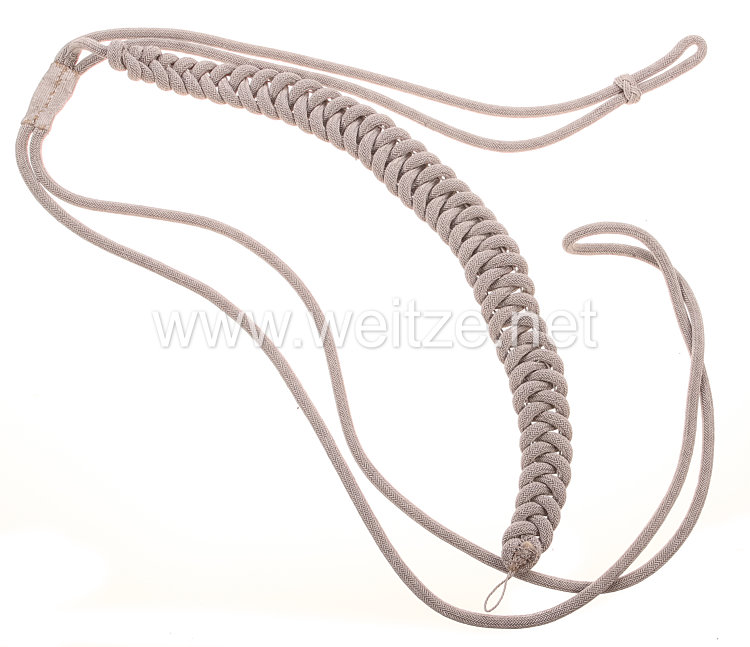
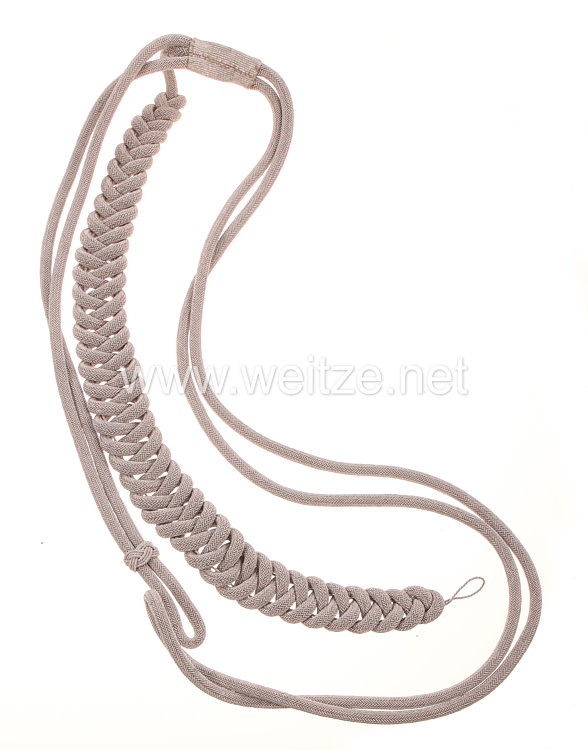
Luftwaffe / Police / State Forestry Service Parade Aiguillette for Officers
The officers' parade lanyard of the German Luftwaffe, Police, and State Forestry Service represents a significant example of ceremonial uniform components of the German Reich during the National Socialist period. This particular form of military and paramilitary distinction combines tradition with the specific organizational structure of the Third Reich.
The lanyard itself has a long military tradition dating back to the 19th century. Originally known as an aiguillette, it initially served practical purposes as a fastening device for sabers or pistols. Over time, it evolved into a purely decorative element that indicated rank and affiliation with certain units or grades.
The present example in silver braid indicates the officer quality of the wearer. The use of silver was prescribed for officers of the Wehrmacht and various state organizations, while non-commissioned officers and enlisted men, when entitled, wore lanyards in other materials. The silver version was made from fine metal threads braided around a textile core, ensuring the characteristic luster and durability of the piece.
Particularly noteworthy is the shared use of this parade lanyard by three different organizations: the Luftwaffe, the Police, and the State Forestry Service. This practice reflects the complex organizational structure of the National Socialist state, in which military and civilian administrations became increasingly intertwined.
The Luftwaffe, officially founded in 1935 under the command of Hermann Göring, quickly developed its own extensive uniform system. The parade lanyard was worn on special occasions, at parades, and ceremonial events. Various service regulations precisely governed when and by whom this distinction was to be worn.
The Police of the Third Reich was also centralized and militarized by Göring. The adoption of military traditions and uniform components was part of this development. Police officers wore the parade lanyard at official occasions, illustrating the increasing fusion of police and military structures.
The State Forestry Service held a special position in National Socialist Germany. Göring, himself a passionate hunter and as Reich Master of the Hunt and Reich Master of Forestry the supreme authority, promoted the paramilitary organization of this agency. Forestry officials wore uniforms modeled on military examples, including the parade lanyard for senior officials.
The technical execution of the lanyard followed strict specifications. It typically consisted of several braided cords formed into a loop and fitted with characteristic metal tips. The manner of wearing was precisely prescribed: the lanyard was attached at the right shoulder and ran across the chest, where it was hooked onto a uniform button.
After the end of the war in 1945, all military insignia and rank badges of the Wehrmacht and other NS organizations were banned by the Allies. Many of these objects were destroyed or taken by soldiers as souvenirs. Preserved examples like the one described are today important historical testimonies to the material and uniform history of this era.
In the modern Bundeswehr and other German security organizations, lanyards are also used, but under completely different auspices and with conscious differentiation from the NS period. The tradition of the aiguillette was democratically reinterpreted and integrated into the ceremonial of the Federal Republic.
For collectors and historians, such objects provide important insights into the uniform history and social organization of the Third Reich. The condition of such a piece is crucial for its historical and material value. Classification into different condition grades enables objective evaluation.
The study of these ceremonial objects contributes to our understanding of how totalitarian regimes used symbolism and uniform regulations to create hierarchies and reinforce organizational structures. The elaborate nature of such items reflects the importance placed on visual representation and military tradition in the Nazi state apparatus.