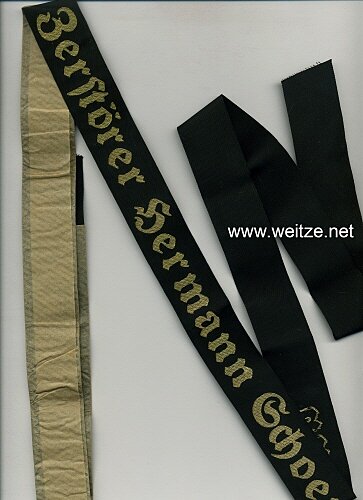
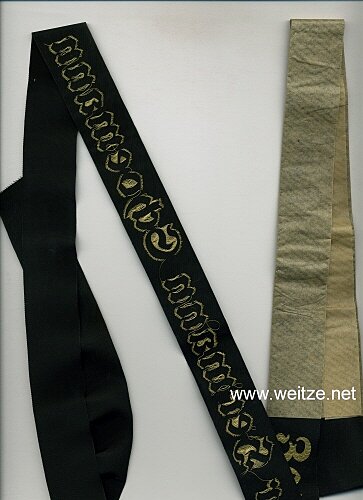
Kriegsmarine Cap Tally "Destroyer Hermann Schoemann"

Metal thread woven construction, mint condition in original paper packaging. Condition 1
202182
190,00

Kriegsmarine Cap Tally "Destroyer Hermann Schoemann"

The cap tally of the destroyer Hermann Schoemann represents a significant artifact from the era of the German Kriegsmarine during World War II. This metal-thread woven example in mint condition with original paper packaging documents the maritime tradition of crew equipment in the National Socialist Navy between 1935 and 1945.

Z 9 Hermann Schoemann was a Type 1934A destroyer, named after Korvettenkapitän Hermann Schoemann (1896-1918), who fell in World War I as commander of torpedo boat S 33. The ship was launched on April 1, 1939, at Deschimag AG Weser in Bremen and commissioned on September 9, 1939, immediately after the outbreak of war. With a displacement of 2,411 tons, a length of 119 meters, and a top speed of 38 knots, she belonged to the modern combat units of the German fleet.

Cap tallies were a traditional identification feature of the German Navy, with roots in the Imperial Navy. According to the Kriegsmarine dress regulations, enlisted men and non-commissioned officers without sword knot wore a black ribbon with gold inscription on their peaked cap. The inscription consisted of the ship's name in Latin letters, framed by national symbols. This tradition served not only for identification but also to foster esprit de corps and connection to the respective vessel.

The metal-thread woven execution was technically demanding to produce. Fine metal threads, typically made of aluminum or silvered copper, were woven into the black base fabric. This manufacturing was carried out in specialized textile factories that produced for the Navy. The quality of execution varied depending on the manufacturer and production period, with early war years often showing better material quality than later productions under raw material shortages.

The operational history of the Hermann Schoemann was intense and characteristic of German destroyers in the North Atlantic and Norwegian waters. The ship participated in 1940 in Operation Weserübung, the occupation of Norway, and was assigned to the Narvik Group. In the following years, the destroyer operated mainly in Norwegian waters, escorted convoys, and participated in several operations against Allied convoys.

On May 2, 1942, the Hermann Schoemann met her end during an engagement as part of Operation Rösselsprung against the Allied convoy PQ 15. After severe damage from British warships, the destroyer was scuttled by her own crew to prevent capture. Of the 340 crew members, 60 men lost their lives.

The preservation of this cap tally in mint condition with original paper packaging is remarkable. This indicates that it was either a never-issued example from naval stocks or a carefully preserved spare ribbon. The original paper packaging was typical for the storage and issue of such equipment items in naval inventories and significantly increases the historical documentation value.

From a military-historical perspective, such cap tallies document several aspects: they evidence the maritime tradition of naming after fallen naval officers, the material culture of the Wehrmacht, the textile processing techniques of the era, and the organizational structure of the Kriegsmarine. At the same time, they are personal mementos often preserved by veterans.

The collectibility of such objects derives from several factors: the historical significance of the respective ship, the state of preservation, authenticity, and provenance. Cap tallies from ships with short operational periods or dramatic histories, such as the Hermann Schoemann, are particularly sought after, as they exist in smaller numbers than those from longer-lived units.

In modern military-historical research, such objects are valued as primary sources for uniform studies, heraldry, and maritime history. They complement written sources and photographs and enable a more comprehensive understanding of the daily life of naval personnel. Museums and archives preserve such pieces as part of maritime cultural heritage.

The study of Kriegsmarine cap tallies also provides insights into the industrial production during wartime, the distribution systems of military equipment, and the symbolic importance placed on unit identification in the German armed forces. These objects thus serve multiple functions in historical research and preservation.

r