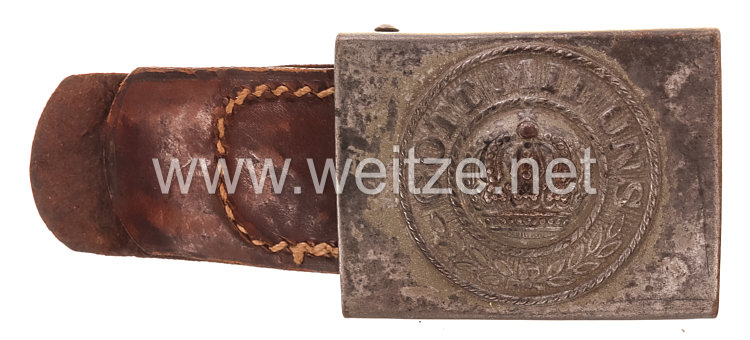
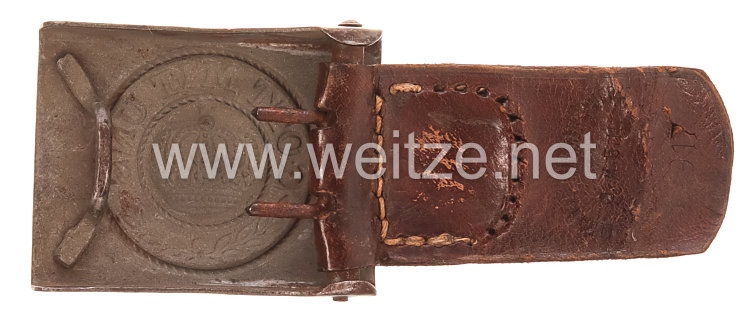
World War I Prussian Belt Buckle from 1914 for Enlisted Men
The Prussian belt buckle for enlisted men from World War I represents a significant piece of equipment from the Imperial German Army. This particular specimen, manufactured from stamped steel in field-grey finish, bears the date 1917 on its leather tab and represents the simplified production methods introduced from 1914 onwards for mass manufacture of military equipment.
With the outbreak of World War I in August 1914, the German military administration had to fundamentally restructure its equipment production. The traditional, elaborately manufactured belt buckles made of brass with the characteristic motto “Gott mit uns” (God with us) were too expensive and time-consuming for mass production. The Army Administration therefore ordered the development of simplified models that could be manufactured more quickly and cost-effectively.
The belt buckle described here, made of stamped steel, corresponds to this wartime production. Unlike the early brass versions, which were cast and polished, these models were manufactured by stamping from sheet steel. The field-grey paint or browning served not only as rust protection but also met the tactical need for camouflage. The shiny brass buckles of the pre-war period had quickly been recognized as impractical in trench warfare, as they created light reflections and betrayed the soldiers' positions.
The leather tab with the date 1917 is particularly revealing. In this year, the German Empire was in its third year of war, and the material burden was becoming increasingly noticeable. Leather production was already subject to strict rationing, and the quality of materials had noticeably declined. Nevertheless, marking with year dates was a common practice of the Prussian Army Administration, which enabled traceability and control of manufactured equipment.
The belt buckle was an indispensable component of the field uniform of every German soldier. It served to fasten the belt, to which various pieces of equipment such as ammunition pouches, side arms, bread bags, and canteens were attached. The functional importance of this inconspicuous item can hardly be overestimated – without a functioning belt buckle, a soldier could not properly carry his basic equipment.
The differences between various production phases are of great interest to military historians. While peacetime versions until 1914 were made of brass and often richly decorated, the wartime models show increasing simplification. From 1915 onwards, iron sheets were increasingly used, which were painted or browned. The inscription “Gott mit uns” was retained but was now stamped rather than cast.
Prussia, as the largest federal state of the German Empire, provided the main portion of German armed forces. The Prussian military administration led the standardization of equipment, even though other German states such as Bavaria, Saxony, and Württemberg sometimes used their own variants. However, the Prussian model became the de facto standard for the entire German Army.
The manufacture of such belt buckles took place in numerous factories throughout the Reich. Traditional metalware factories in Solingen, Remscheid, and other industrial centers were enlisted for production. As the war progressed, smaller businesses and even non-specialized factories had to be involved in armaments production, which sometimes led to quality fluctuations.
From today's perspective, these belt buckles are important historical artifacts that provide insight into the material culture of World War I. They document not only military equipment but also the economic and industrial challenges that the German Empire faced during the war. The conversion from elaborate peacetime production to simplified wartime manufacture reflects the increasing totalization of war, in which all social and economic resources were subordinated to warfare.
Collectors and museums preserve such objects as witnesses to a significant historical epoch. Each belt buckle with its specific year date and manufacturer's mark tells a story about production, logistics, and the lives of soldiers at the front. The year 1917 marks a particularly critical phase of the war, in which the Central Powers, despite military successes in the East, increasingly suffered under the pressure of the Allied blockade and the material superiority of their opponents.
These artifacts serve as tangible connections to the experiences of millions of soldiers who served in the Great War. The wear patterns, the oxidation of the steel, and the condition of the leather all tell stories of service, hardship, and survival. For researchers and enthusiasts of military history, such items provide invaluable primary source material for understanding the practical realities of military service during one of history's most devastating conflicts.