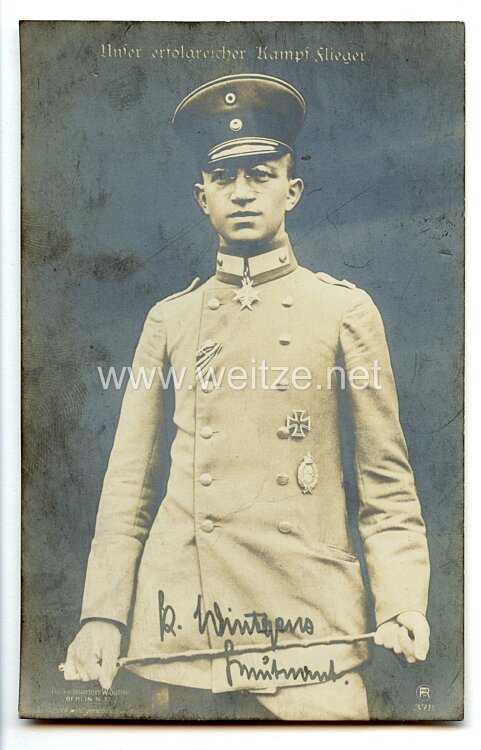
WWI Aviation - Photo Postcard - German Flying Ace "Lieutenant Wintgens"

on Sanke card No. 378, unused, condition 2/2-.
271382
25,00

WWI Aviation - Photo Postcard - German Flying Ace "Lieutenant Wintgens"

This historical Sanke postcard No. 378 featuring the portrait of Lieutenant Kurt Wintgens represents a fascinating testament to German aviation propaganda during World War I. The card comes from the famous “Deutsche Fliegerhelden” (German Flying Heroes) series, published by Berlin photographer and publisher Gustav Sanke, and ranks among the most sought-after collectibles in military aviation history.

Kurt Wintgens (1894-1916) was one of the first German fighter pilots and achieved historical significance as likely the first pilot to shoot down an enemy aircraft in organized aerial combat. On July 1, 1915, he successfully downed a French Morane-Saulnier over Lunéville in France, although this victory was initially not officially recognized because it occurred behind enemy lines without German witnesses. Wintgens achieved a total of 19 confirmed aerial victories before falling in combat on September 25, 1916.

The Sanke postcards emerged during a time when aerial warfare was still in its infancy but already captured public imagination. Publisher Gustav Sanke recognized early the commercial and propagandistic potential of the new flying aces. Beginning in 1914, his Berlin studio systematically produced portrait postcards of the most famous German aviators. These cards were printed in large editions and served both home front propaganda and the growing personality cult surrounding the “Knights of the Air.”

The Sanke series comprised several hundred different motifs and documented nearly all significant German fighter pilots of the war, including Manfred von Richthofen, Oswald Boelcke, Max Immelmann, and many others. The numbering of the cards followed no chronological order but was assigned sequentially as new aviators were added or distinguished themselves through special achievements. Card No. 378 featuring Wintgens belongs to the middle series.

The typical design of a Sanke card showed the aviator's portrait in uniform, often with decorations, printed on high-quality cardboard. The reverse side followed standard postcard format and allowed mailing through field post or civilian postal systems. Many cards were acquired as collectibles and never mailed, explaining why unmailed examples are particularly valued by collectors today.

The condition rating 2/2- according to the standard collector's grading scale indicates a well-preserved specimen with minor signs of use. For historical postcards, preservation condition is crucial for collector and historical value. Unmailed cards in good condition are sought-after objects for collectors of military memorabilia and aviation history.

The Sanke cards fulfilled multiple functions: They served military propaganda by emphasizing the bravery and heroism of German aviators. They satisfied public interest in the new “aces of the air” and contributed to the heroicization of the air force. For the soldiers themselves, they were mementos and expressions of camaraderie. Today they are important historical documents providing insight into propaganda methods and societal perception of aerial warfare in World War I.

Kurt Wintgens' significance for German fighter aviation cannot be overestimated. As one of the pioneers of aerial combat, he contributed to the development of tactics and inspired subsequent generations of fighter pilots. His early death at only 22 years old made him a symbol of the dangers and transience of glory in aerial warfare.

This photographic postcard is thus not merely a collector's item but an authentic testimony to early military aviation and the way World War I was medially conveyed and glorified. It represents an era in which technological progress and traditional notions of chivalric combat formed a unique, albeit deceptive, connection.

r