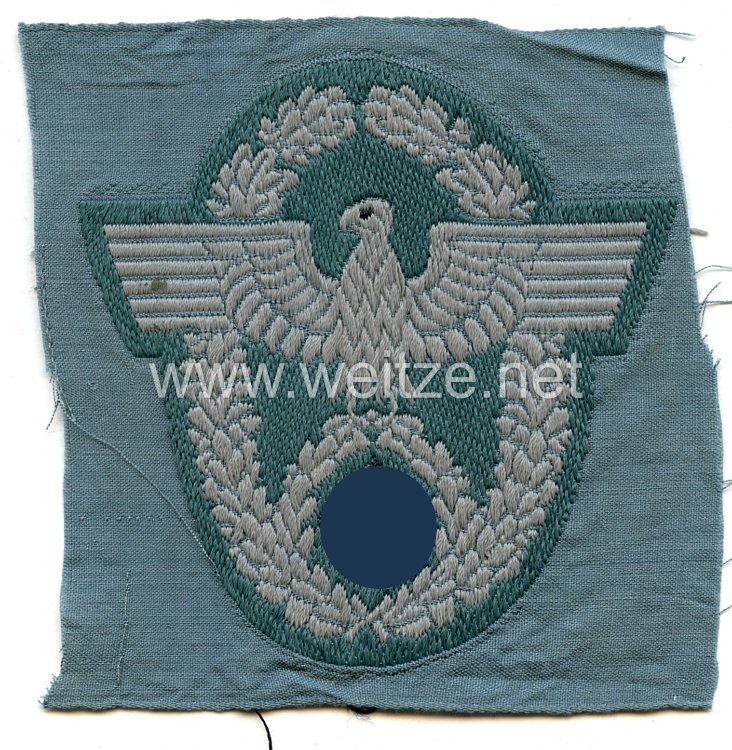
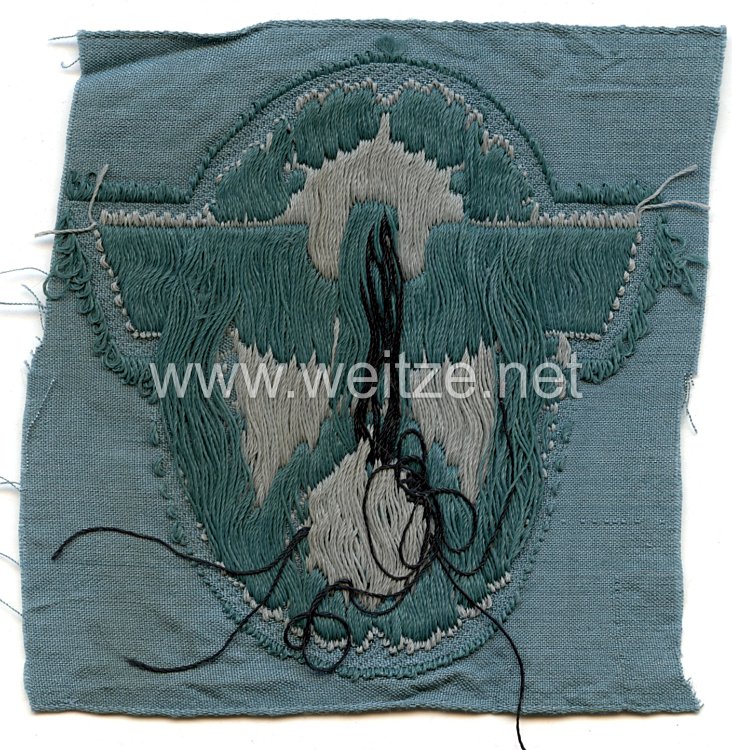
Police Sleeve Eagle for Enlisted Personnel Polizei-Felddivision
The Police Arm Eagle for Enlisted Men of the Police Field Division represents a significant piece of German police and military history during World War II. This example in Bevo weaving technique on field-gray background embodies the complex organizational structure of the German Ordnungspolizei and its military deployment between 1942 and 1943.
The Police Field Divisions were formed as military formations from members of the Ordnungspolizei. The first of these divisions was created in October 1939, with additional ones following during the war years. These units were organizationally subordinate to the Main Office of the Ordnungspolizei under SS-Obergruppenführer Kurt Daluege, but were tactically placed under Wehrmacht command and deployed on various fronts.
The present specimen shows the characteristic Police Eagle in the version prescribed for enlisted ranks. The Bevo weaving technique, named after the Barmer Bandweberei Ewald Vorsteher, enabled detailed and durable production of national emblems. This technique was particularly suitable for military insignia, as it allowed machine-woven emblems of high quality and detail fidelity.
The field-gray coloring corresponds to the uniform regulations for Police Field Divisions, which closely followed Wehrmacht uniforming. Unlike the green peacetime uniform of the Ordnungspolizei, members of the Field Divisions wore field-gray uniforms to emphasize their military function and visually align them with regular Wehrmacht units.
The arm eagle was worn on the right upper arm and differed in form from the Wehrmacht eagle. The Police Eagle faced left (heraldically right) and held the swastika in its talons. This design had been characteristic of the German police since the 1930s and was retained even in militarized police units.
The dating around 1942/43 is of particular historical significance. During this phase of the war, the Police Field Divisions were increasingly deployed on the Eastern Front, particularly in security operations and in combat against partisans. The 1st Police Division, for example, fought with Army Group North, while other police formations were deployed in the rear army area.
The fact that this specimen is unissued makes it a rare testimony. Most of these insignia were issued and worn, leading to wear. Unissued pieces either remained in depots or were never issued due to size changes, transfers, or the war's end.
The field-gray cloth backing served not only for attachment but also for protecting the uniform. The insignia was sewn on, with the backing distributing mechanical stress and preventing tearing. This construction was typical for Wehrmacht and police insignia of that era.
The production of such insignia was subject to strict quality controls and standardization. The Reichszeugmeisterei and the Main Office of the Ordnungspolizei supervised production to ensure uniformity and quality. Various manufacturers produced according to the same specifications, which could lead to certain variations in execution.
After the war's end, many of these insignia were destroyed or removed, as wearing National Socialist symbols was prohibited. This makes preserved specimens important historical documents for researching the uniform and organizational history of this era.
Today, such objects are found in museum collections and among militaria collectors. They serve historical research and documentation of the complex structures of the NS state, in which the boundaries between police and military increasingly blurred. The scholarly examination of such objects contributes to understanding the militarization of state organs.