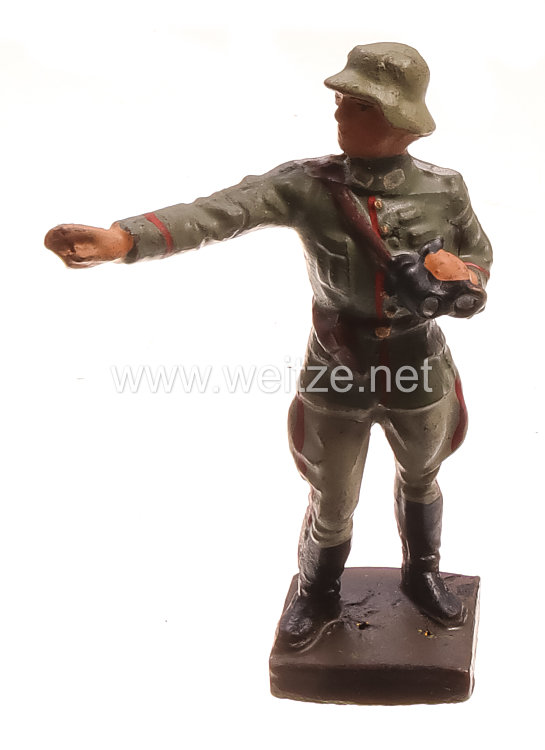
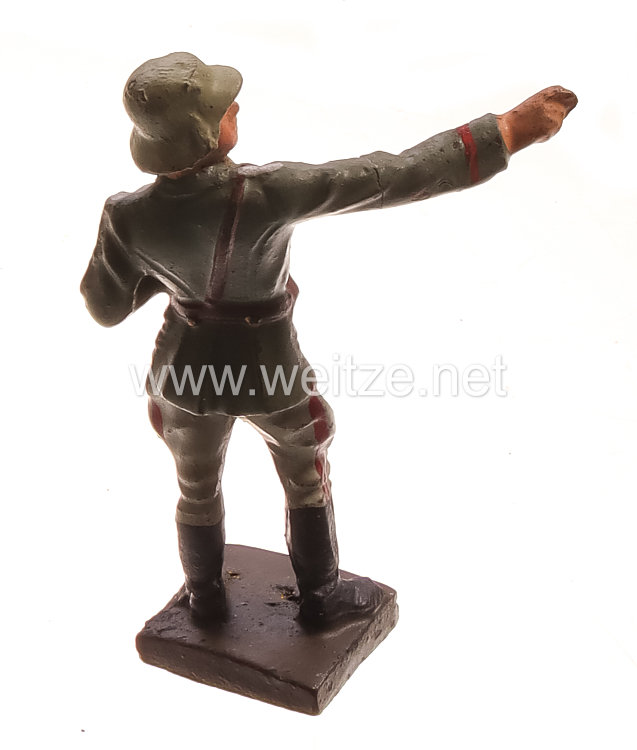
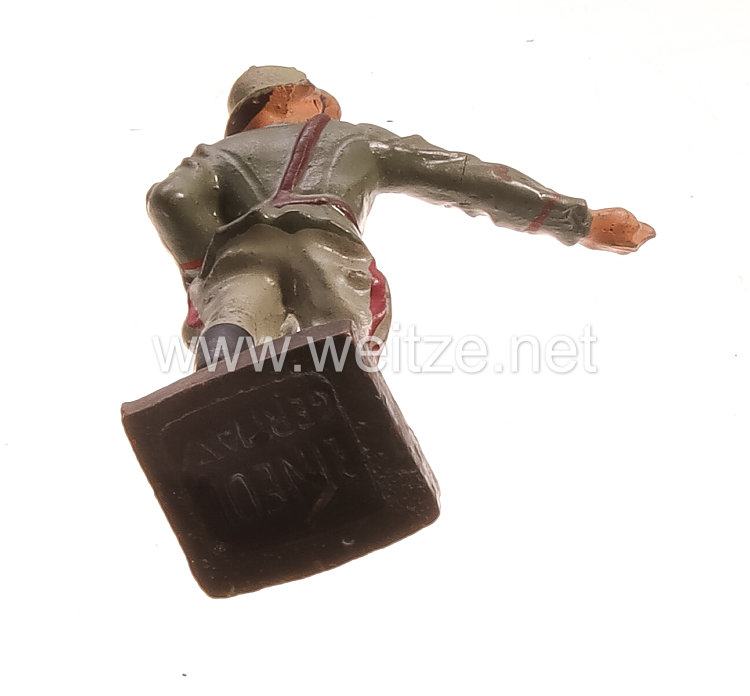
Lineol - Army Officer Pointing with Binoculars
The Lineol figure of an Army officer with binoculars represents a significant example of German toy and collector figure production from the 1930s and 1940s. At a height of 7.5 cm, this figure belongs to the standardized size of Lineol military figures that the company produced during its heyday.
The Lineol company was founded in 1906 by Oskar Wiederholt in Brandenburg an der Havel. The name “Lineol” was composed of the words “Line” (Linie) and “Oil” (Öl), referring to the materials used and the linear manufacturing method. The company developed into one of Germany's leading manufacturers of composition figures, made from a material consisting of wood flour, glue, casein, and other binding agents. This composition allowed for detailed forms and was more cost-effective than traditional lead figures.
The depicted figure shows a Wehrmacht Army officer in a characteristic pose with an outstretched arm, pointing in a specific direction with binoculars. This pose embodies the military leadership function and was a typical motif in the representation of commanders. Binoculars were an indispensable piece of equipment for officers of all branches and served for terrain reconnaissance and enemy observation.
In the Wehrmacht, officers carried various standardized binocular types, including the well-known 6x30 and 7x50 models, manufactured by renowned optical companies such as Carl Zeiss Jena, Leitz, or Hensoldt. Observation and reconnaissance were among the fundamental leadership tasks detailed in the Army Service Regulations (Heeresdienstvorschrift).
Lineol figures were distinguished by remarkable attention to detail. Uniforms were designed according to official regulations, with rank insignia, branch colors, and equipment items reproduced with great care. Painting was done by hand, making each figure an individual piece. The field gray color, the characteristic uniform color of the Wehrmacht from 1935 onwards, was reproduced as authentically as possible.
In the 1930s, Lineol reached its production peak. The company employed over 400 workers at times and exported its products worldwide. The figures were used not only as toys but also for educational purposes and as collector's items. Military units sometimes used larger figure collections for tactical war games and training purposes.
Production during the Nazi period was heavily influenced by the political situation. Lineol increasingly manufactured military figures depicting the contemporary Wehrmacht. After the outbreak of World War II, production became war-essential and was subject to state directives. Raw material shortages led to quality deterioration, and from 1943 onwards, civilian production largely ceased.
After the war ended in 1945, the Brandenburg plant was dismantled. A new beginning took place in 1947 in Giengen an der Brenz in the American occupation zone. However, the Allies initially prohibited the production of military figures. In the post-war period, Lineol increasingly produced civilian figures, animals, and later plastic figures, but could not return to its former significance. Production finally ended in 1983.
Today, Lineol figures are sought-after collector's items. The condition 2 indicated for this figure corresponds to a good to very good state of preservation with only minor signs of use in the standard collector's grading system. The grading scale typically ranges from 1 (mint condition) to 6 (heavily damaged). Figures in good condition with complete paint and no breaks command considerable prices on the collector's market.
The historical classification of such objects requires a differentiated perspective. On one hand, they document the craftsmanship quality of German toy production and the everyday culture of their time. On the other hand, they are testimonies of an era marked by militarism and the crimes of the Nazi regime. For collectors and historians, they therefore possess both cultural and contemporary historical value as material evidence of a complex historical period.