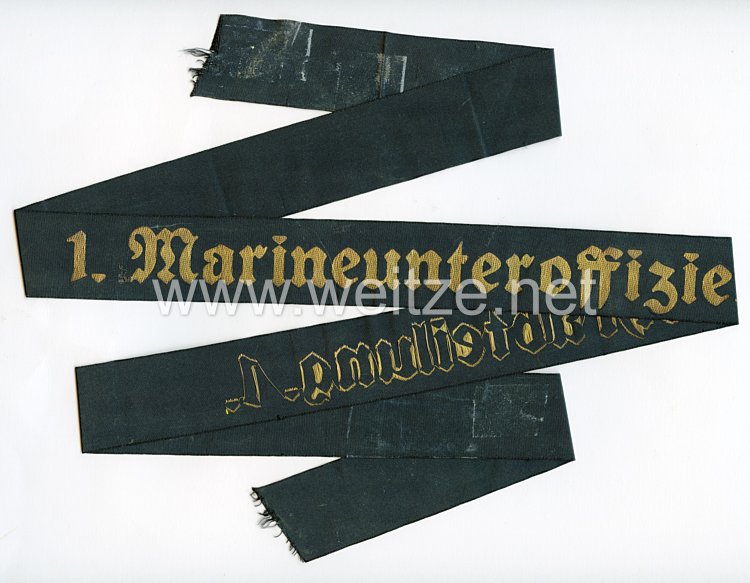
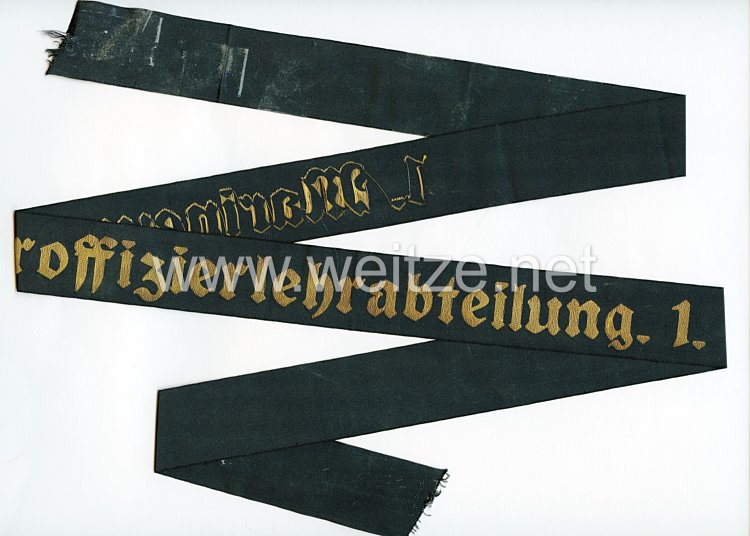
Kriegsmarine Cap Tally "1. Marineunteroffizierlehrabteilung 1."
The cap ribbon of the 1st Naval NCO Training Department represents a characteristic piece of equipment from the German Kriegsmarine during World War II. This metal-thread woven version exemplifies the high level of craftsmanship employed in the production of naval uniform accessories.
The Marine NCO Training Departments (Marineunteroffizierlehrabteilungen) were central training facilities of the Kriegsmarine responsible for the education and advanced training of non-commissioned officers. These institutions played a crucial role in the Navy's training system, as NCOs formed the backbone of any military organization. They were responsible for the practical training of crews and constituted the vital link between officers and ordinary sailors.
The designation “1st Marine NCO Training Department 1” indicates one of the first and possibly most significant of these training establishments. Within the Kriegsmarine system, various training departments were established at different locations to meet the increasing demand for qualified NCOs during the rearmament phase and later during the war.
The cap ribbon (Mützenband) itself was a traditional element of naval uniforms dating back to the 19th century. Originally, these ribbons served to identify the ship or unit to which a sailor belonged. This tradition was adopted by the Imperial Navy and continued by the Kriegsmarine. The ribbons were worn around the peaked cap and served as an important identifying feature.
The metal-thread woven execution was technically sophisticated and required specialized manufacturing processes. Metal threads, usually made from silver-plated or tin-plated copper wire, were woven together with textile threads to create a durable and visually appealing ribbon. This technique provided the characteristic shine and durability of cap ribbons. The lettering was typically executed in gold or silver on a black or dark blue background.
The length of approximately 115 cm corresponds to the standardized dimensions for Kriegsmarine cap ribbons. This length was necessary to wrap the ribbon around the cap and provide the characteristic hanging ends at the back, which had to conform to regulation length specifications.
The mentioned adhesive traces are not unusual on historical cap ribbons and can have various causes. Often, ribbons were attached to caps using adhesive, particularly for parade or dress wear, to prevent slipping. After the war, many of these ribbons were kept as memorabilia, sometimes glued into albums or mounted on display boards, which could also lead to such traces.
Training in the Marine NCO Training Departments encompassed theoretical and practical elements. NCO candidates were instructed in navigation, weapons technology, military leadership, naval service, and various technical subjects. Training duration varied depending on specialization but typically lasted several months. Upon successful completion, graduates were distributed to ships and units of the Kriegsmarine as Mates (Maate), Senior Mates (Obermaate), or in other NCO ranks.
These training departments were usually stationed on land and located at various naval bases throughout the German Reich. The facilities included classrooms, workshops, training grounds, and often their own accommodation buildings for course participants.
Wearing the cap ribbon of a training facility was time-limited to the duration of training. After transfer to a ship or land unit, NCOs received the corresponding new cap ribbon of their assigned unit. Nevertheless, many naval personnel kept their training cap ribbons as personal mementos.
Today, such cap ribbons are important military historical documents that provide insight into the organizational structure and training system of the Kriegsmarine. They are sought after by collectors of naval equipment and militaria and serve historical research as source material for reconstructing unit histories and uniform studies.
The preservation condition and authenticity of such items are crucial factors for collectors and historians alike. Original pieces like this metal-thread woven cap ribbon offer tangible connections to the daily life and organizational structure of the wartime German Navy, making them valuable artifacts for understanding this period of naval history.