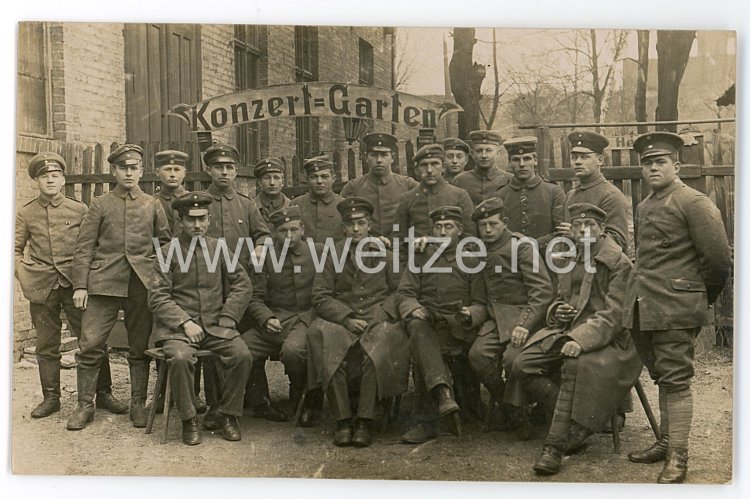
German Army Group Photograph, Soldiers in Front of the Konzert-Garten
Historical Context: German Army Group Photograph of Soldiers in front of a Concert Garden
This postcard-sized photograph showing soldiers of the German Army (Deutsches Heer) in front of a concert garden represents an important aspect of military everyday life in the German Empire and Weimar Republic. Such images document not only military presence but also the social integration of armed forces into civilian life of the period.
Military Photography as Historical Medium
Photography established itself from the mid-19th century onwards as a significant medium for documenting military life. With the introduction of the postcard around 1870 and its mass distribution from the 1890s, a new format for private and military communication emerged. Soldiers frequently had their photographs taken to send these images as mementos to family members and friends or to keep as personal souvenirs.
The standard postcard size (approximately 9 x 14 cm) made such photographs affordable and easily mailable. Professional photographers established their studios in garrison towns, while mobile photographers also visited military installations to carry out commissioned work.
The Concert Garden as Social Space
Concert gardens were popular entertainment venues in the German Empire and Weimar Republic, combining music, gastronomy, and social life. These establishments served as important spaces for leisure activities for all social classes, including the military. Military bands regularly performed in such gardens and contributed significantly to the musical entertainment of the population.
The presence of soldiers in civilian entertainment facilities reflected the close interweaving of military and society in the German Empire. The military enjoyed high social prestige, and soldiers in uniform were omnipresent in public spaces. Concert gardens offered opportunities for recreation, maintaining comradely relationships, and contact with the civilian population.
Military Everyday Life and Leisure
The life of German Army soldiers was not exclusively shaped by drill and service. Especially in peacetime, regulated leisure activities were part of military daily life. The military service regulations (Heeresdienstvorschrift) provided that soldiers received leave after duty and on weekends, provided there were no special obligations.
Group excursions to entertainment facilities such as concert gardens were often encouraged by superiors, as they strengthened troop cohesion and contributed to morale. Such joint undertakings were photographically recorded and served as memories of time spent together in service.
Uniforms and Military Identity
Soldiers typically had themselves photographed in their uniforms, which were not merely functional clothing but also expressions of rank, affiliation to a particular branch of service, and military identity. The various regiments of the German Army wore different uniform variants with specific insignia, buttons, and collar patches, which increase the military-historical value of such photographs.
The uniform conferred social prestige upon its wearer and was worn with pride even outside of service. Appearing together in uniform reinforced the sense of camaraderie and belonging to a military community.
Condition and Historical Value
The described “used condition” is typical for historical photographs that were actually utilized – whether through mailing, frequent viewing, or decades of storage. Signs of use such as creases, discoloration, or inscriptions on the reverse often enhance the authentic character of such documents.
Such photographs are today important historical sources for military, social, and everyday history. They document not only military structures but also the life-world of soldiers, their social relationships, and the interactions between military and civil society.
Collector and Research Value
For collectors of military-historical objects and for researchers, such group photographs offer valuable insights into uniform history, military everyday culture, and the social-historical aspects of German military affairs. The location in front of a concert garden potentially enables regional attributions and contributes to research into local military history.
These photographs connect personal memory with collective history and remain as material witnesses of a past era of enduring historical interest.