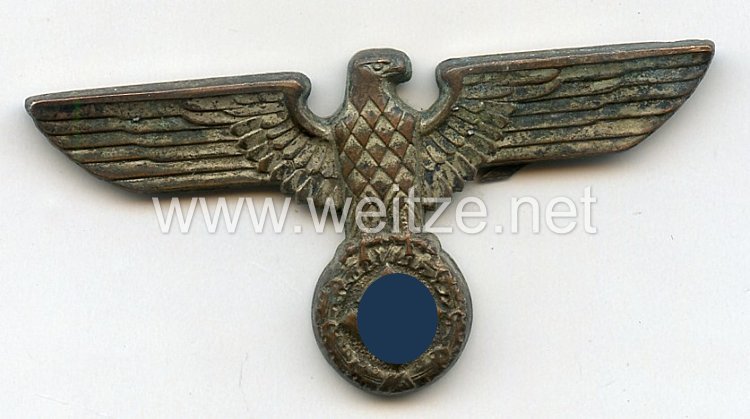
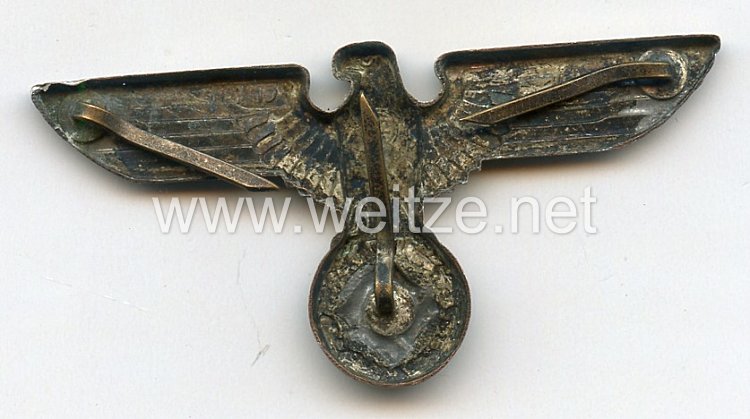
SA Cap Eagle for Peaked Cap
The SA Cap Eagle for the Peaked Cap represents a significant insignia of the National Socialist organizational structure, worn by members of the Sturmabteilung (SA). This example represents the second model, introduced after 1939, which displays important differences from earlier versions.
The Sturmabteilung was founded in 1921 as a paramilitary combat organization of the NSDAP and played a central role in the National Socialists' rise to power. After the Röhm Affair of 1934, the SA lost its political supremacy to the SS but remained an important organization within the Nazi state with millions of members.
SA uniforming followed strict regulations established in the SA Service Regulations and various orders from the Supreme SA Leadership (OSAF). The eagle on the peaked cap was a mandatory insignia symbolizing political alignment and allegiance to the National Socialist state.
The second model of the SA cap eagle differs from the first model through several characteristic features. While the first model was used until approximately 1939, the second model shows simplifications in design, partly attributable to the increasing war economy and associated material conservation. The eagle representation became more stylized, and the manufacturing method was rationalized.
The manufacture from Cupal, a copper-aluminum alloy, was typical for this period. Cupal offered the advantage of being lighter than pure copper and easy to process. The silver plating gave the insignia its characteristic metallic luster and corresponded to regulations for SA rank insignia. The silver finish was standard for most SA ranks.
The RZM marking is of particular importance for authenticating and dating such insignia. The Reichszeugmeisterei (RZM) was established in 1929 as the central procurement office of the NSDAP and was responsible from 1935 onwards for quality control and approval of all party insignia, uniform parts, and equipment items. Each approved manufacturer received their own RZM number, which had to be affixed to products. This was intended to ensure quality standards and prevent production of unauthorized insignia.
The RZM marking enables historians and collectors today to attribute insignia to specific manufacturers and production periods. The system was highly organized and reflects the bureaucratic penetration of all areas of life in the Nazi state.
The peaked cap itself was a characteristic component of the SA uniform. It was worn on various occasions and differed from the field-gray service cap used for more formal events. The eagle was attached centrally above the cap visor and, together with the swastika cockade, was an indispensable identifier.
After 1939, with the outbreak of World War II, the SA's role changed considerably. Many SA men were conscripted into the Wehrmacht, and the organization increasingly focused on home front tasks such as pre-military training, air raid protection, and other auxiliary services. Nevertheless, the SA persisted until the end of the war and retained its characteristic uniforming.
The production of SA insignia and uniform parts became increasingly difficult during the war as materials were rationed and industry was converted to war production. Nevertheless, insignia continued to be manufactured, often resorting to less expensive materials and simplified production methods.
From today's perspective, such objects are important historical witnesses to a dark epoch of German history. They document the organizational structure, symbolism, and material culture of National Socialism. For scholarly research and museum presentation, they are indispensable for authentically representing the history of this period and understanding the mechanisms of totalitarian rule.