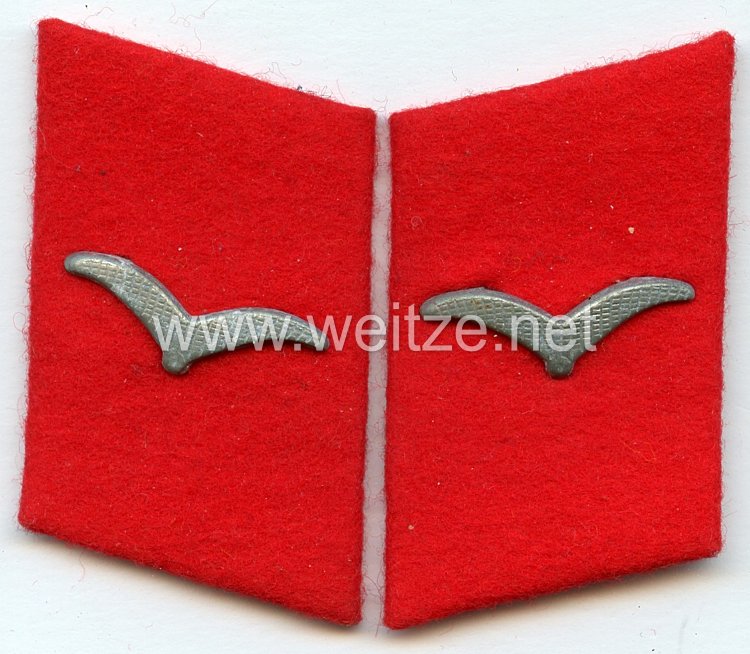
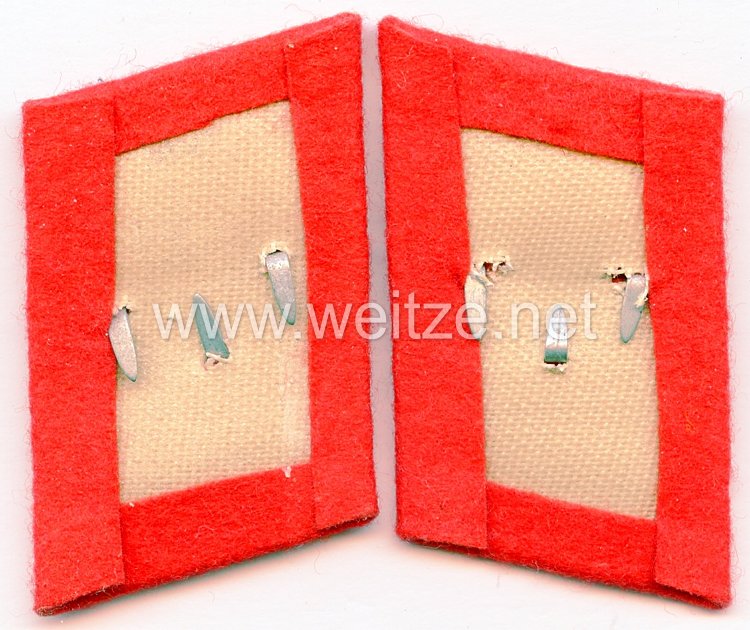
Luftwaffe Pair of Collar Tabs for a Flak Gunner

, Condition 2
399180
90,00

Luftwaffe Pair of Collar Tabs for a Flak Gunner

Luftwaffe collar tabs for a Flak gunner represent a characteristic example of military rank insignia from the Third Reich. These insignia were worn on uniform collars and served for immediate identification of branch of service and rank within the German Air Force between 1935 and 1945.

The Luftwaffe was officially founded on February 26, 1935, after the National Socialist regime openly disregarded the restrictions of the Treaty of Versailles. With its establishment came a complex system of rank insignia and uniform regulations, detailed in Luftwaffe Service Regulation L.Dv. 410/1. Collar tabs formed an essential component of the uniforming system.

The Flak (abbreviation for Flugabwehrkanone, anti-aircraft gun) represented a significant portion of the Luftwaffe. The Flak artillery was responsible not only for air defense of Reich territory but was also deployed in ground combat, particularly on the Eastern Front. Gunners of the Flak belonged to the basic enlisted ranks and formed the backbone of this branch of service.

Collar tabs for Flak enlisted personnel were diamond-shaped and featured the branch color red, characteristic of Flak artillery. This branch color was used on both collar tabs and shoulder straps, enabling quick assignment to the respective service branch. The red shade distinguished itself clearly from other branch colors such as yellow (signals), white (infantry), or pink (armored troops).

The manufacture of collar tabs followed strict specifications. They typically consisted of a base plate made of cloth or felt in air force blue (later also field gray), onto which the red branch color was applied. The workmanship varied depending on manufacturer and production period. Early examples from the 1930s often showed higher quality craftsmanship with hand-embroidered details, while wartime production became increasingly simplified.

For a simple Kanonier (gunner), the collar tabs bore no additional rank insignia. Unlike non-commissioned officers and officers, whose collar tabs displayed braids, stars, or other rank indicators, enlisted collar tabs showed only the branch color. This simple design corresponded to the hierarchical structure of the Wehrmacht and enabled immediate distinction between different rank groups.

The manner of wearing was precisely regulated in uniform regulations. The paired collar tabs were attached to both sides of the uniform collar of the flight blouse or tunic. The points of the diamond-shaped tabs pointed up and down, with the longer axis running vertically. Attachment was usually by sewing, less commonly by pinning for versions with wire loops.

The training of a Flak gunner was comprehensive and demanding. It encompassed not only the operation of various Flak guns (from light 2cm Flak to heavy 12.8cm weapons) but also theoretical knowledge in ballistics, target recognition, and fire control procedures. Flak units played a decisive role in the air defense of the Reich, especially during Allied bomber offensives from 1942 onward.

During the course of the war, the Flak grew into a massive organization. Hundreds of thousands of soldiers, including increasingly Luftwaffenhelfer (youth auxiliaries from age 15) and Flakhelferinnen (female auxiliaries), served with the Flak artillery. High casualties and constant personnel requirements led to accelerated training and frequent transfers.

The preservation of such collar tab pairs is today of military-historical interest. They document the uniform history of the Luftwaffe and serve as material witnesses to a dark epoch of German history. Collectors and museums preserve these objects as study and educational material, whereby the historical context and critical examination of the Nazi past must always remain in the foreground.

r