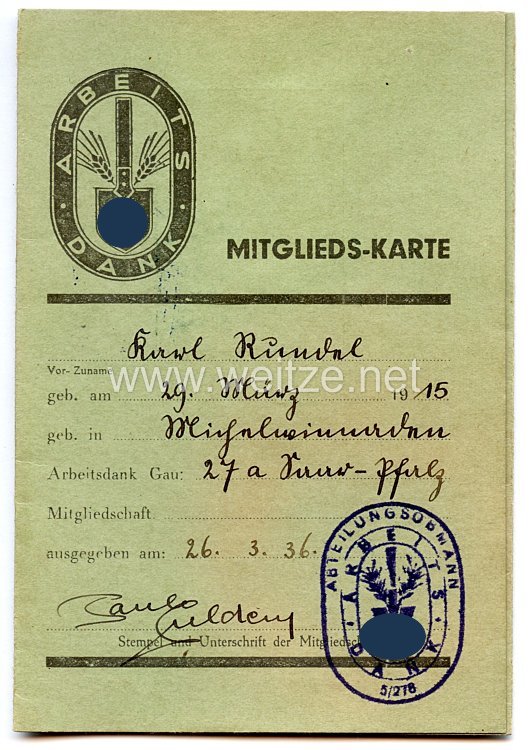
Arbeitsdank Gau 27a (Saar-Pfalz) - Membership Card

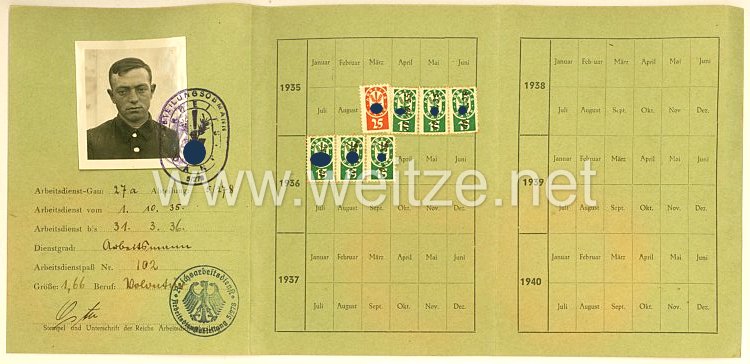
for a Arbeitsmann in RAD-Abteilung 5/278, in labor service from October 1, 1935 to March 31, 1936, with attractive uniform photograph and contribution stamps; used condition.
339780
60,00

Arbeitsdank Gau 27a (Saar-Pfalz) - Membership Card

This Arbeitsdank membership card from Gau 27a (Saar-Pfalz) represents a significant historical document from the early phase of the Reich Labour Service (Reichsarbeitsdienst, RAD). The card documents the membership of a labour serviceman in RAD Unit 5/278 during his service period from October 1, 1935, to March 31, 1936, a formative period in the organization of the National Socialist labour service.

The Reich Labour Service evolved from the tradition of voluntary labour services during the Weimar Republic. After the Nazi seizure of power in 1933, the labour service became increasingly centralized and militarized. The compulsory labour service was introduced through the law of June 26, 1935, which obligated all young Germans between 18 and 25 years to serve for six months. This document dates precisely from this transitional period when mandatory service was first being implemented.

Gau Saar-Pfalz (Gau 27a) was a regional administrative unit of the RAD, encompassing the Saar region and the Palatinate. This region held special significance, as the Saarland had only returned to the German Reich on March 1, 1935, following a plebiscite. The integration of the Saar population into National Socialist organizations like the RAD therefore carried particular political and symbolic weight.

RAD Unit 5/278 was one of numerous local units organized in a military hierarchy. Each unit typically comprised several hundred labour service conscripts and was responsible for concrete work projects such as land reclamation, road construction, drainage works, or forestry projects. The numbering 5/278 indicates affiliation with Group 5 of Unit 278, though the exact organizational structure underwent multiple reforms.

The Arbeitsdank system was a social insurance institution of the RAD that provided certain support services to labour servicemen and their families. The contribution stamps affixed to the membership card document regular payments into this system. These stamps were pasted in monthly and served both to finance benefits and for bureaucratic control. The Arbeitsdank system offered support in cases of illness, accident, or death, and was intended to provide social security for those serving in the labour service.

The uniform photograph on the card shows the bearer in the characteristic RAD uniform. The labour service uniform typically consisted of brown service clothing with belt, shoulder straps, and the distinctive field cap or side cap. The spade was regarded as the symbolic “weapon” of the labour service and played a central role in roll calls and ceremonies. The uniforming emphasized the paramilitary character of the organization and was intended to foster discipline and community spirit.

The service period from October 1935 to March 1936 encompassed the typical six months of compulsory service. This time was strictly regulated and followed a military daily routine with morning roll call, physical training, work assignments, and political instruction. The winter months presented particular challenges, as work was often carried out under difficult weather conditions.

Documents like this membership card are today important sources for historical research. They enable the reconstruction of individual biographies and provide insight into the everyday functioning of National Socialist mass organizations. The used condition of the card suggests that it was actually carried throughout the entire service period and regularly used, which underscores its authenticity as a contemporary document.

The systematic registration and documentation of all labour servicemen served the National Socialist administration for control and mobilization of the population. At the same time, these documents were important for those affected, as they served as proof of completed mandatory service, which was a prerequisite for access to many professions and further educational institutions.

Today, such artifacts serve as tangible reminders of the comprehensive nature of National Socialist control over German society and the methods used to indoctrinate and discipline young Germans during the Third Reich period.

r