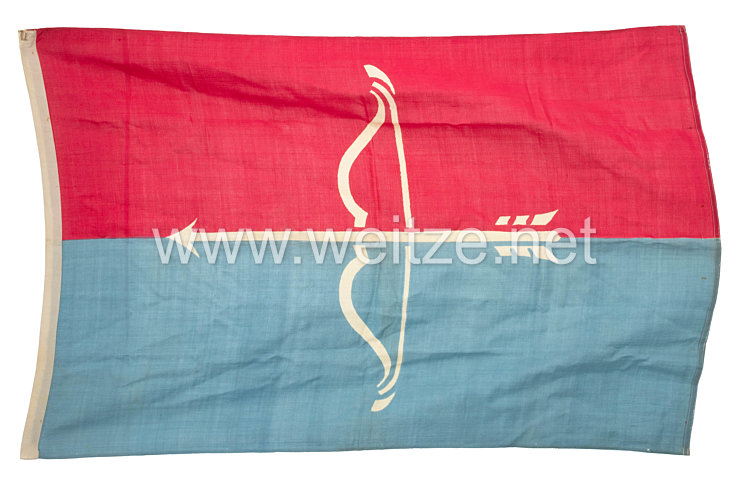
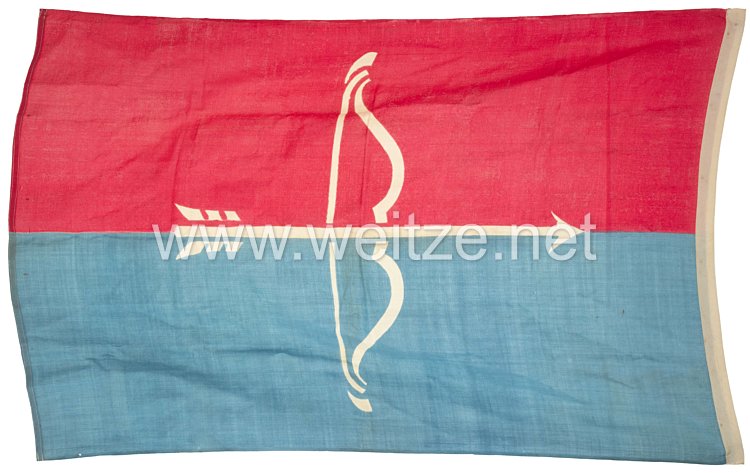
Wehrmacht Fahne eines Turkestanischen Feld-Bataillons der 162. Turkistanischen Infanterie-Division
um 1943. Farbig bedrucktes Flaggentuch mit der Darstellung Pfeil und Bogen auf rot/hellblauem Hintergrund, Maße 75 x 120 cm. Seitlich mit Einfassung zum befestigen an einem Fahnenstock. Leichte Gebrauchs- und Altersspuren, Zustand 2.
Am 15. November 1941 erließ Eduard Wagner, Generalquartiermeister im Oberkommando des Heeres einen Befehl "Über die Aufstellung einer militärischen Einheit aus Kriegsgefangenen aus Turkestan und kaukasischen Nationalitäten". Gemäß dieser Anordnung wurde innerhalb der deutschen 444. Sicherungs-Division ein turkestanisches Regiment unter dem Kommando des Oberleutnants Taube geschaffen. Im Mai 1942 stellte man die erste „Turkistanische Legion“ auf; sie bestand zunächst nur aus einem einzigen Bataillon. Bis Ende des Jahres 1943 entstanden insgesamt 16 Bataillone mit einer Gesamtstärke von etwa 16.000 Soldaten. Die Truppen wurden in die 162. Infanterie-Division integriert. Mitte Juni 1943 wurde Ernst-August Köstring zum Inspekteur der Turkistanischen Legion ernannt und am 1. Januar 1944 dann zum General der Ostlegionen im Oberkommando des Heeres befördert. Um eine mögliche Gefangennahme durch die „Rote Armee“ auszuschließen, verlegte man die Turkistanische Legion nach Frankreich bzw. nach Norditalien. 1945 wurde der größte Teil der Legion von der britischen Armee gefangen genommen. Gemäß der auf der Konferenz von Jalta geschlossenen Vereinbarung wurden die Mitglieder der Legion in die Sowjetunion zurückgeführt, wo sie das gleiche Schicksal erlitten wie die anderen so genannten „Ostvölker“, die die Seiten gewechselt hatten.
Am 15. November 1941 erließ Eduard Wagner, Generalquartiermeister im Oberkommando des Heeres einen Befehl "Über die Aufstellung einer militärischen Einheit aus Kriegsgefangenen aus Turkestan und kaukasischen Nationalitäten". Gemäß dieser Anordnung wurde innerhalb der deutschen 444. Sicherungs-Division ein turkestanisches Regiment unter dem Kommando des Oberleutnants Taube geschaffen. Im Mai 1942 stellte man die erste „Turkistanische Legion“ auf; sie bestand zunächst nur aus einem einzigen Bataillon. Bis Ende des Jahres 1943 entstanden insgesamt 16 Bataillone mit einer Gesamtstärke von etwa 16.000 Soldaten. Die Truppen wurden in die 162. Infanterie-Division integriert. Mitte Juni 1943 wurde Ernst-August Köstring zum Inspekteur der Turkistanischen Legion ernannt und am 1. Januar 1944 dann zum General der Ostlegionen im Oberkommando des Heeres befördert. Um eine mögliche Gefangennahme durch die „Rote Armee“ auszuschließen, verlegte man die Turkistanische Legion nach Frankreich bzw. nach Norditalien. 1945 wurde der größte Teil der Legion von der britischen Armee gefangen genommen. Gemäß der auf der Konferenz von Jalta geschlossenen Vereinbarung wurden die Mitglieder der Legion in die Sowjetunion zurückgeführt, wo sie das gleiche Schicksal erlitten wie die anderen so genannten „Ostvölker“, die die Seiten gewechselt hatten.