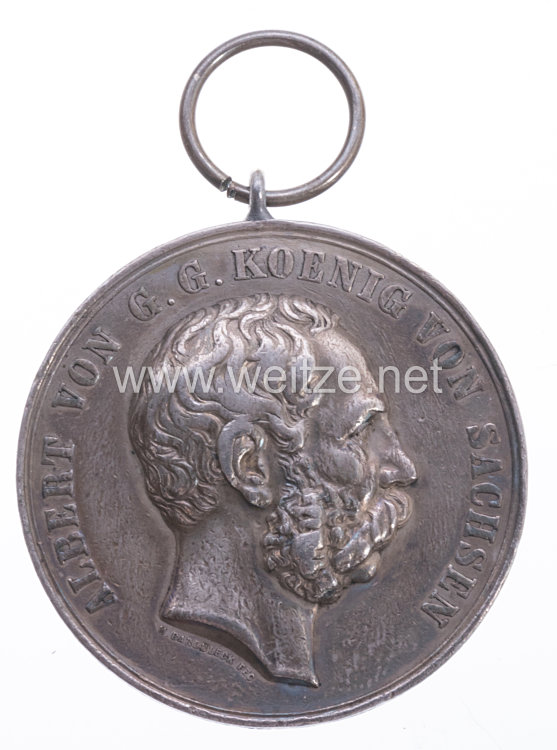
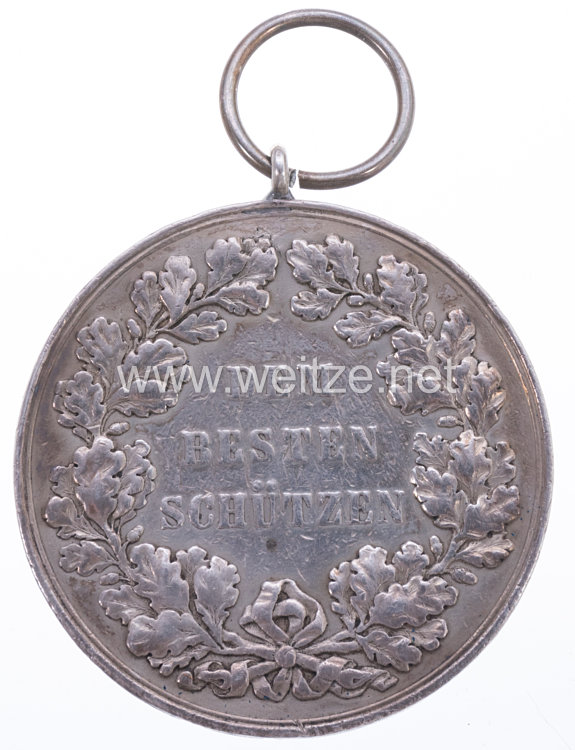
Saxony Portable Shooting Prize Medal 2nd Class His Majesty King Albert, 1874-1877
The Saxon Portable Marksmanship Award Medal, Second Class from the reign of King Albert of Saxony (1873-1902) represents a remarkable testament to the military training culture in the German Empire. This decoration, awarded between 1874 and 1877, embodies the high importance that the Kingdom of Saxony placed on the shooting proficiency of its soldiers.
Historical Context and Origins
Following the founding of the German Empire in 1871 and the experiences of the Franco-Prussian War, German military authorities recognized the crucial importance of well-trained marksmen for modern warfare. King Albert, who had himself served as an army commander during the 1870/71 campaign, actively promoted shooting training in the Saxon army. The introduction of marksmanship award medals occurred as part of comprehensive reforms to improve military effectiveness.
The Kingdom of Saxony maintained a significant military force as the second-largest contingent in the German army after Prussia. The Saxon army was known for its excellent training and discipline. The systematic promotion of marksmanship through awards such as this medal contributed substantially to the combat effectiveness of the troops.
Technical Characteristics and Design
The present medal, made of silver with a diameter of 41 mm and weighing 35 grams, corresponds to the typical specifications of Saxon military decorations from this period. The Second Class designation indicated a middle performance level in the graduated award system. Typically, three to four classes existed, with the First Class representing the highest distinction.
The medals usually bore the portrait of King Albert with the corresponding inscription on the obverse, while the reverse displayed insignia of marksmanship such as crossed rifles, targets, or laurel wreaths. The execution in silver for the Second Class corresponded to the hierarchical graduation of awards, with higher classes often receiving gilt examples.
Award Criteria and Wearing
The marksmanship award medals were presented annually at shooting exercises and competitions of the Saxon regiments. Soldiers had to achieve defined scores in target shooting at various distances. The evaluation criteria were strictly regulated and included both accuracy and speed in loading and firing.
As a portable decoration, the medal could be worn on the uniform, distinguishing it from purely commemorative pieces. It was typically attached to a ribbon in the Saxon state colors (white-green) on the left breast side of the uniform. The authorization to wear it represented public recognition of marksmanship achievement and fostered ambition among soldiers.
Significance in the Military Training System
The system of marksmanship award medals was part of a comprehensive motivational system in the Imperial Army. In addition to personal honor, financial premiums were often associated with the awards. This promoted not only individual performance readiness but also esprit de corps and competitive culture within units.
The years 1874-1877 mark an intensive phase of modernization in the Saxon army. During this period, the Model 1871 rifle (Mauser) was introduced, a single-shot breech-loader that enabled significantly higher rates of fire than earlier muzzle-loaders. Shooting training had to be adapted accordingly.
Historical Classification and Significance
The Saxon military placed particular emphasis on marksmanship as a fundamental military skill. The experiences of the wars of German unification had demonstrated that well-trained shooters could be decisive in battle. The systematic awarding of medals for shooting proficiency created a culture of excellence and continuous improvement.
The medal also reflects the administrative efficiency of the Saxon military bureaucracy. Detailed records were kept of shooting results, and the award process followed strict regulations. This systematization was characteristic of the professionalization of European armies in the late 19th century.
Collector Value and Historical Context
Today, Saxon marksmanship award medals are sought-after collector's items that provide insight into the military everyday culture of the 19th century. The condition grade 2 (very good) makes the present example particularly valuable. The medals document not only military traditions but also the craftsmanship quality of Saxon minting facilities.
The temporal limitation to 1874-1877 makes these medals relatively rare objects, as they were issued only during a brief period of King Albert's long reign. Later years brought modified designs or changed award criteria.
Conclusion
The Saxon Marksmanship Award Medal, Second Class, of King Albert embodies the professionalization of military training in the German Empire. It stands exemplary for the importance attributed to shooting proficiency as a fundamental military skill and for the systematic promotion of soldierly performance through a sophisticated award system. As a historical document, it offers valuable insights into the military culture of the Kingdom of Saxony in the late 19th century.