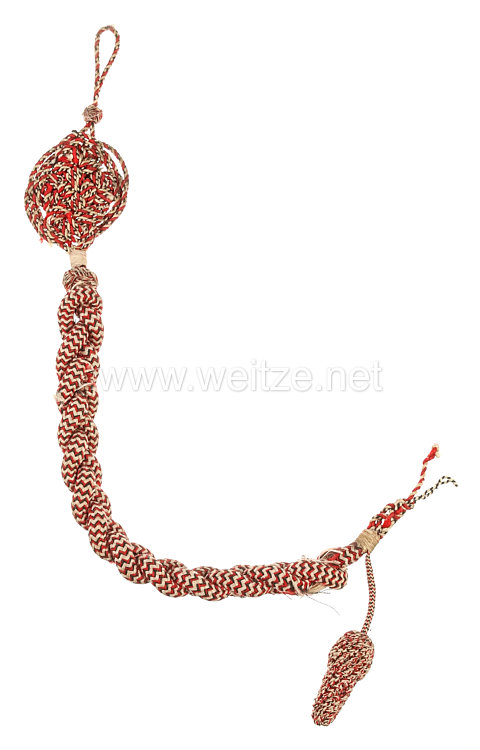
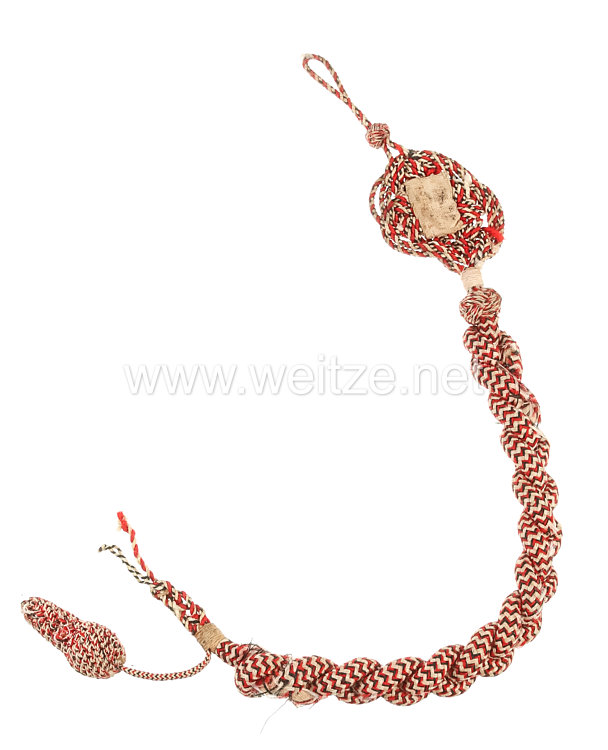
Prussian Schützenschnur 1st Class for Infantry
The Prussian Marksmanship Lanyard (Schützenschnur) represents one of the most distinctive military award systems of the German Empire, existing between 1895 and 1918. This special form of proficiency badge was introduced to visibly honor outstanding shooting performance by soldiers while simultaneously encouraging ambition to improve marksmanship skills.
The present First Class Marksmanship Lanyard for Infantry from around 1900 represents the first and basic performance level of this multi-tiered award system. The introduction of marksmanship lanyards occurred through the Supreme Cabinet Order of July 12, 1895 under Kaiser Wilhelm II, who placed great emphasis on military training and particularly on the shooting proficiency of his troops. The system was part of comprehensive reforms to modernize the Prussian Army in an age of increasing importance of precise individual fire.
The wearing system of marksmanship lanyards was hierarchically graduated and comprised a total of twelve grades. The first grade, like the present example, consisted of a braided cord with a single pendant acorn. The cord was worn as a shoulder cord on the right shoulder of the uniform and ran diagonally across the chest. With each additional performance level achieved, the badge was expanded by additional acorns or other elements, with the highest grades also featuring shields and special decorations.
The authorization to wear the first grade had to be earned through concrete shooting performance on the firing range. The requirements were laid down in detailed shooting regulations and included various exercises at different distances. For infantrymen, this meant achieving certain point scores when shooting with the standard rifle, in this era the Gewehr 88 or later the Gewehr 98. The examinations took place annually, and the authorization to wear had to be regularly confirmed through renewed performance verification.
The coloring of the marksmanship lanyards was branch-specific. The infantry, to which this example belongs, wore cords in the characteristic branch colors. The braided execution testifies to the craftsmanship quality of these awards, which despite their mass distribution were manufactured with care. The acorn at the end of the cord was a traditional element of Prussian military decorations and symbolized strength and permanence.
The wearing system was precisely regulated: the marksmanship lanyard was led from the right shoulder strap, passing under the right arm to the left breast pocket, where the acorn was attached. For parade uniforms and on special occasions, wearing was mandatory if authorization existed. This made the marksmanship lanyard an immediately recognizable sign of military competence.
The social significance of this decoration should not be underestimated. In the strongly militaristic society of the Empire, wearing a marksmanship lanyard meant recognition and prestige, not only within the troops but also in civilian life. Reservists and veterans wore their marksmanship lanyards with pride even after active service at military events and veterans' meetings.
The material quality and workmanship of marksmanship lanyards varied depending on manufacturer and time of production. Examples from around 1900, like the present one, typically still show the high craftsmanship quality of the pre-war period. The cord was manufactured from robust materials to withstand the demands of military daily life.
With the end of World War I and the dissolution of the imperial army in 1918, the official use of Prussian marksmanship lanyards also ended. The Reichswehr introduced its own, simplified system of shooting badges. Nevertheless, the imperial marksmanship lanyards remained popular collector's items and memorabilia representing the military tradition of Prussia.
Today, original marksmanship lanyards are sought-after objects for militaria collectors and important testimonies to the military history of the German Empire. They document not only the award system but also the importance attached to military training and performance in this era. Examples in good condition, especially from the early period around 1900, are particularly remarkable due to their age and historical value.