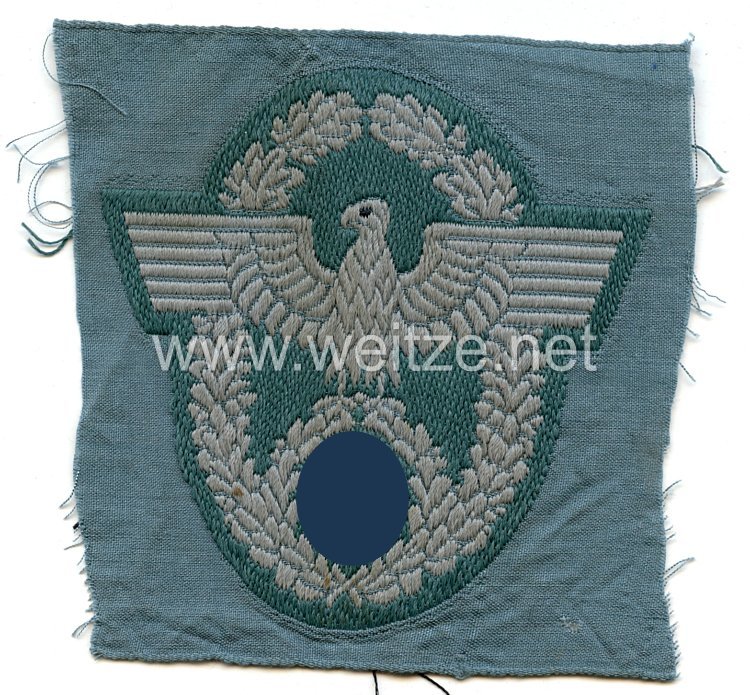
Police Sleeve Eagle for Enlisted Men Polizei-Felddivision

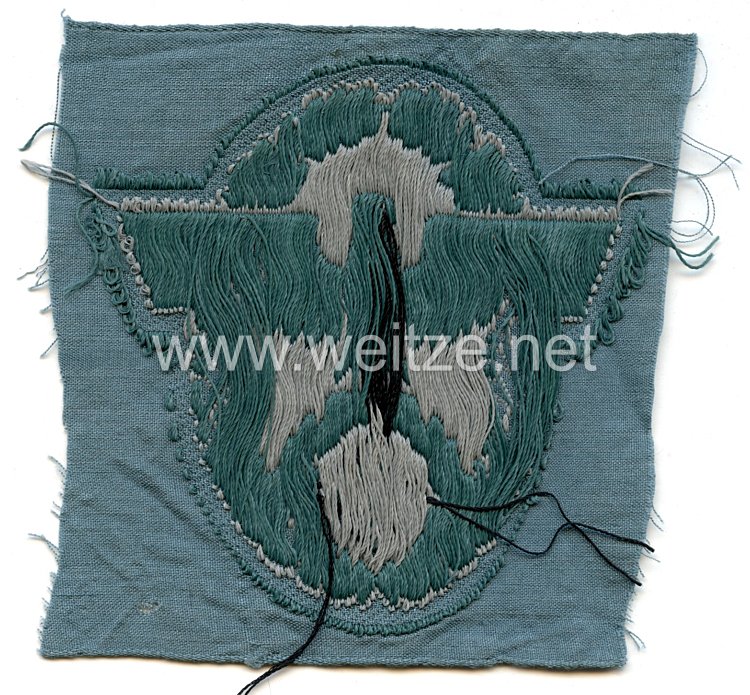
Bevo-woven version on field-gray, on field-gray wool backing, circa 1942/43. Unissued, Condition 2.
434379
150,00

Police Sleeve Eagle for Enlisted Men Polizei-Felddivision

The Police Arm Eagle for Enlisted Men of the Police Field Division represents a significant example of the uniform insignia worn by German police units during World War II. This particular specimen dates from around 1942/43 and represents the uniform equipment of enlisted ranks within the militarized police formations.

The Police Field Division (Polizei-Felddivision) was a military formation created from members of the German Order Police (Ordnungspolizei). The first Police Field Division was established in October 1939 and consisted primarily of police personnel mobilized for front-line service. These units differed from regular Wehrmacht formations through their administrative subordination to the Reichsführer-SS and Chief of the German Police, although they were tactically subordinated to the Wehrmacht.

The present insignia is manufactured using BeVo weaving technique, a high-quality weaving process developed by the company Bandfabrik Ewald Vorsteher (BeVo) in Wuppertal. This technique enabled the mechanical production of detailed uniform insignia with high precision and durability. BeVo insignia were very common throughout the war and were considered standard for many military and paramilitary organizations.

The field-gray execution corresponds to the typical field uniform coloring of German armed forces. The eagle was woven on field-gray fabric and applied to a field-gray cloth backing, allowing integration into the field uniform. This coloring differed significantly from the green police uniforms of the pre-war period and signaled the military deployment character of these formations.

The Police Eagle itself differed iconographically from the Wehrmacht eagle. While the Wehrmacht eagle looked to the right and held a swastika in an oak wreath, the Police eagle was depicted frontally or slightly to the left. This distinction was prescribed by regulations and enabled clear identification of different organizational affiliations.

The temporal classification around 1942/43 falls within a phase of intense warfare on the Eastern Front. The Police Divisions were deployed particularly in the occupied territories of the Soviet Union, where they undertook both regular combat tasks and security operations. By 1943, several Police Divisions had already been established, which suffered significant losses and had to be repeatedly reinforced.

The insignia was worn on the left upper arm of the field tunic, as prescribed by uniform regulations for Wehrmacht and police formations. The position of the arm eagle was precisely defined: approximately 15 cm below the shoulder seam, with the eagle oriented forward. This standardization ensured a uniform appearance within the troops.

The unworn condition of this specimen makes it a valuable historical document. Many uniform insignia of this period were used intensively and show corresponding signs of wear. Unworn pieces were often part of depot stocks, replacement equipment, or were never attached to uniforms for other reasons.

The production of such insignia was subject to increasing material restrictions during the war. While early war years still permitted high-quality executions, simplified versions or substitute materials often had to be used later. The present piece from 1942/43 dates from a phase when high-quality BeVo production was still possible.

The Police Field Divisions played a complex and problematic role in World War II. While formally organized as military combat formations, they were also involved in war crimes and security operations that massively affected the lives of civilian populations in occupied territories. The historical assessment of these units must take this dimension into account.

For collectors and historians, such uniform insignia represent important material sources that provide information about organizational structures, uniform regulations, and the material culture of war. Precise documentation of manufacturing technique, materials, and design enables authentication and temporal classification of such objects.

r