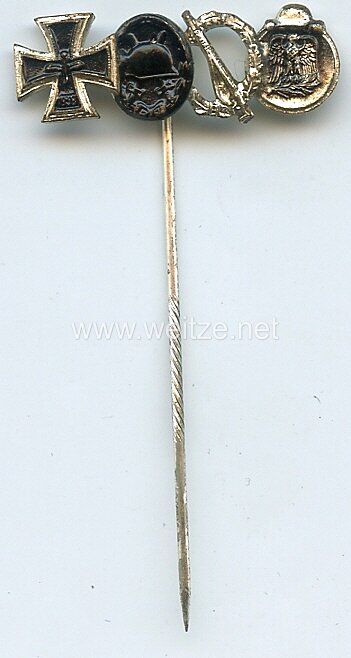
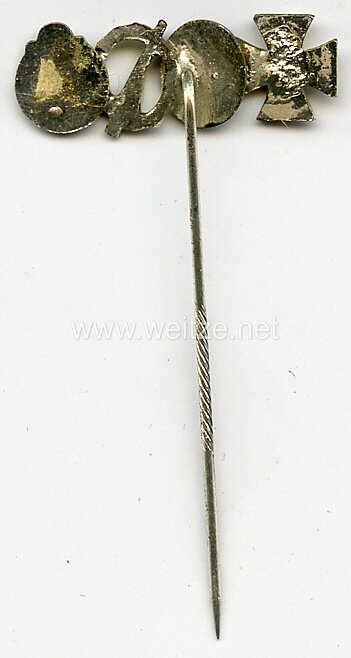
Miniature Medal Bar 1957 of a World War II Veteran - 4 Decorations
This miniature medal bar from 1957 represents a significant aspect of German military history and post-war commemorative culture. This ribbon bar combines four decorations from World War II in reduced form and documents the service of a veteran during the devastating conflict from 1939 to 1945.
Following the establishment of the Federal Republic of Germany in 1949, questions arose regarding the treatment of military decorations from the Nazi era. The Law on Titles, Orders and Honorary Signs of July 26, 1957 finally created a legal basis for wearing certain decorations in modified form. These so-called 1957 Orders Law versions removed all National Socialist symbols, particularly the swastika, and replaced them with neutral elements such as oak leaves.
The four decorations represented on this bar tell a specific story of military service. The Iron Cross 1939 2nd Class was one of the most widely distributed German military decorations. Emperor Wilhelm III originally instituted the Iron Cross in 1813, and Adolf Hitler renewed it on September 1, 1939, the day of the invasion of Poland. The second class was worn on a ribbon and awarded for bravery in the face of the enemy. By the end of the war, approximately 2.3 million Iron Crosses 2nd Class had been awarded.
The Wound Badge 1939 in Black was instituted on September 1, 1939 by Hitler and awarded in three grades: black for one or two wounds, silver for three or four wounds, and gold for five or more wounds. The black grade on this bar documents that the wearer was wounded in combat at least once. The badge connected to the tradition of the Wound Badge awarded during World War I.
The Infantry Assault Badge was instituted on December 20, 1939 and recognized the special achievements of the infantry in combat. It was awarded after three successful combat days on the front line or after being wounded during an infantry assault. The badge depicted a rifle with fixed bayonet, framed by an oak leaf wreath. This decoration emphasizes the veteran's direct frontline service as an infantryman.
The Eastern Front Medal, colloquially also called the “Frozen Meat Medal,” was instituted on May 26, 1942. It recognized service during the first winter on the Eastern Front in 1941/42, when the Wehrmacht fought under extreme conditions at temperatures down to -50 degrees Celsius. The medal was awarded to all members of the Wehrmacht and its allies who served at least 14 days on the Eastern Front between November 15, 1941 and April 15, 1942, or were wounded. With approximately three million awards, it was one of the most frequently conferred German military decorations.
The combination of these four decorations paints the picture of a soldier who fought as an infantryman on the Eastern Front, was wounded there, and distinguished himself through particular bravery. The presence of the Eastern Front Medal indicates service during the catastrophic first winter battle before Moscow, one of the bloodiest sections of the war.
Miniature bars were traditionally worn with civilian clothing or on social occasions when wearing regular-sized orders appeared inappropriate. The 9-mm width corresponds to the standard for miniature versions of German orders. The attachment to a long pin enabled mounting on jacket lapels.
The production of these post-war versions from 1957 was carried out by specialized order manufacturers, which often had existed before and during the war. The quality of the executions varied considerably, from simple pressings to elaborately crafted pieces.
This miniature bar documents not only individual war service but also the complex approach of post-war German society to military traditions. The Orders Law of 1957 attempted a compromise between recognizing the personal sacrifices of veterans and the necessary distancing from the National Socialist past.
For collectors and historians, such pieces represent important material witnesses to a complex historical period. They reflect both the individual experiences of millions of soldiers and the social processes of coming to terms with history in post-war Germany. The modifications mandated by the 1957 law make these pieces easily distinguishable from original wartime awards, providing physical evidence of Germany's efforts to honor veterans while rejecting Nazi ideology.