Brunswick Commemorative Glass for the 50th Anniversary of the Reign of Duke Wilhelm
This commemorative glass celebrating the 50th jubilee of Duke Wilhelm of Brunswick's reign on April 25, 1881, represents a remarkable testament to 19th-century German commemorative culture and the close connection between princely rule and bourgeois veneration in the German Empire.
Duke Wilhelm of Brunswick (1806-1884) ascended to the throne of the Duchy of Brunswick on April 25, 1831, after his brother Charles II was driven out due to his tyrannical rule. His reign was characterized by moderate, constitutional policies and the modernization of the duchy. Wilhelm led the duchy through the turbulent times of the 1848 Revolution, Prussian-Austrian tensions, and ultimately to integration into the German Empire in 1871.
The year 1881 marked the golden jubilee of the Duke's reign – an extraordinary milestone achieved by only a few German princes. Such jubilees in the 19th century were occasions for extensive celebrations designed to strengthen the bond between ruler and subjects. They served dynastic legitimation and demonstrated political stability during a time of rapid social change.
The tradition of commemorative glasses or jubilee glasses had a long history in German-speaking regions. Since the 17th century, artistic glasses were produced for special occasions – coronations, weddings, military victories, or reign jubilees. These served both as drinking vessels at festive banquets and as permanent keepsakes for bourgeois households.
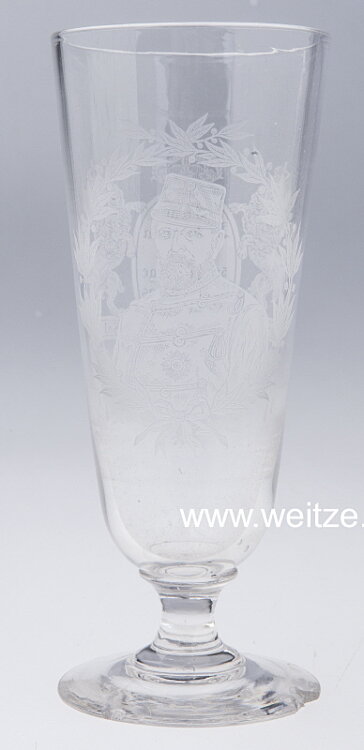
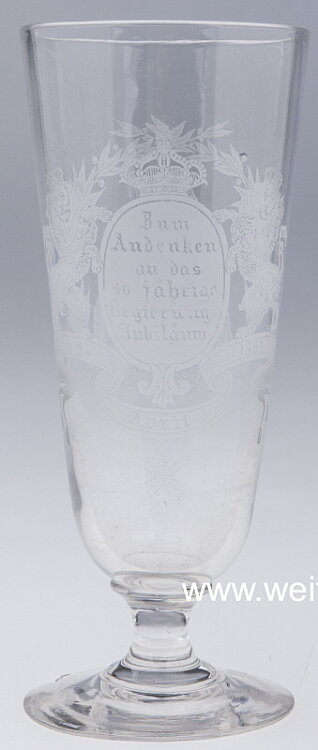
This glass displays typical iconographic elements of the period: The portrait of the Duke in a laurel wreath references the ancient tradition of honoring meritorious rulers. The laurel wreath had symbolized victory, glory, and dignity since Roman antiquity. The two lions holding the cartouche with the jubilee inscription derive from the Brunswick coat of arms – the leaping lion had been the heraldic symbol of the Welf duchy since the Middle Ages.
The inscription “Zum Andenken an das 50 jährige Regierungsjubiläum 25. April 1881” (In Memory of the 50-Year Reign Jubilee April 25, 1881) corresponds to the period-typical formulation of such commemorative objects. It makes clear that the glass was intended not primarily for use but for permanent remembrance – a characteristic of 19th-century bourgeois memorial culture.
At 18 cm in height, the glass belongs to the medium-sized examples of its kind. Such glasses were produced in varying qualities – from simple, press-molded variants for a broad public to elaborately cut and enameled pieces for wealthier purchasers. The artistic execution with portrait and heraldic elements suggests a middle to upper quality level.
Production likely occurred in one of the Brunswick or Thuringian glassworks known in the 19th century for their commemorative and utilitarian glasses. Particularly the region around Lauscha in Thuringia had established itself as a center of glass production. The decoration was applied either through enamel painting, engraving, or etching techniques.
In the context of military-historical significance, it should be noted that Duke Wilhelm, as sovereign, was simultaneously commander-in-chief of Brunswick troops. The Duchy of Brunswick maintained its own military units that fought in the German War of 1866 and the Franco-Prussian War of 1870/71. Veneration of the sovereign always included recognition of his military role, even though Wilhelm himself did not pursue an active field commander career.
Such jubilee glasses were often used or displayed at official receptions, military banquets, and veterans' meetings. They served to demonstrate loyalty to the ruling house and were part of the visual culture that permeated military and civilian life in the Empire.
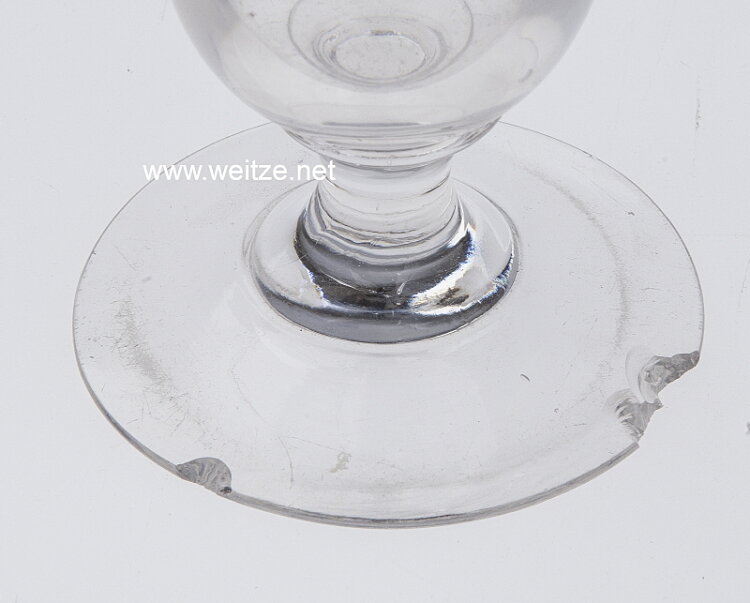
The noted damaged foot testifies to the object's eventful history over more than 140 years. Many such glasses survived the political upheavals of the 20th century – the end of monarchy in 1918, the Nazi era, and World War II – only fragmentarily. That this specimen remained largely intact makes it a valuable historical document.
Today, such commemorative glasses are important sources for researching memorial culture, everyday history, and the visual representation of rule in the 19th century. They document how monarchical legitimation was anchored through material culture in the bourgeois milieu and how dynastic jubilees contributed to integrating subjects into the political system.