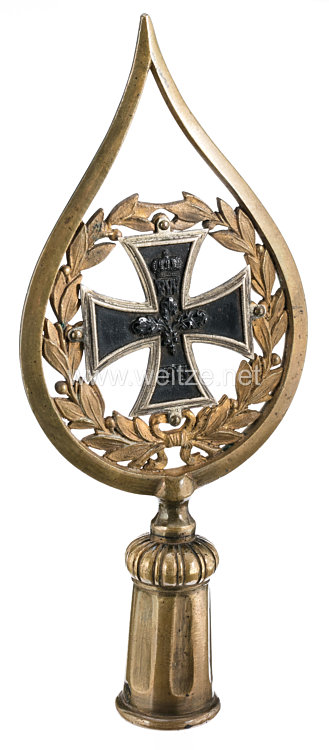
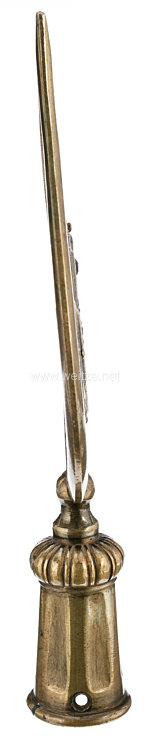
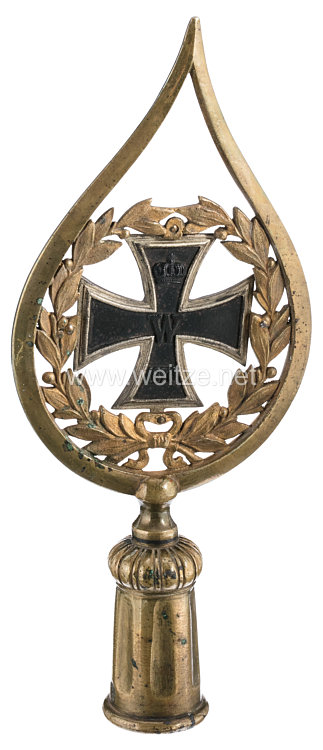
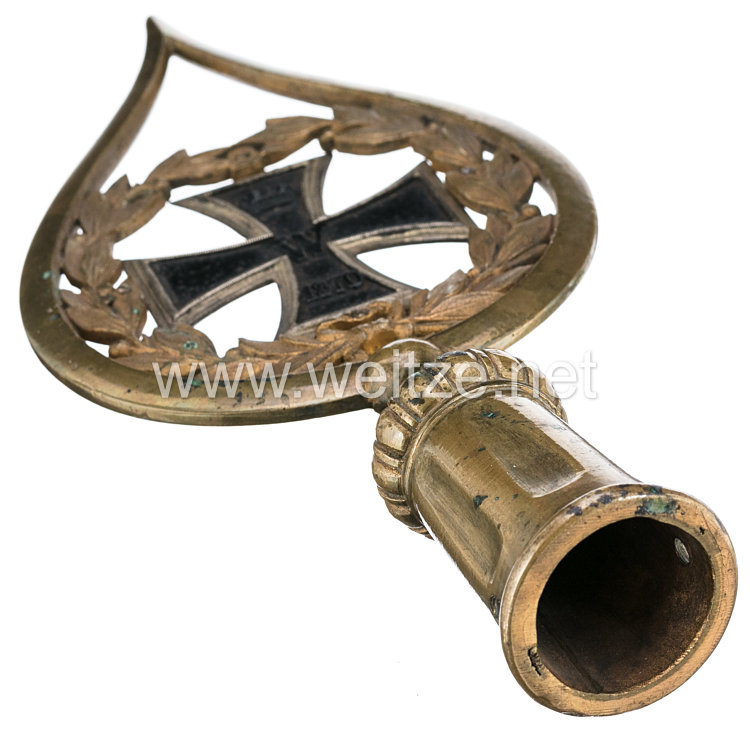
Prussian Battalion Flag Finial with Grand Cross of the Iron Cross 1870

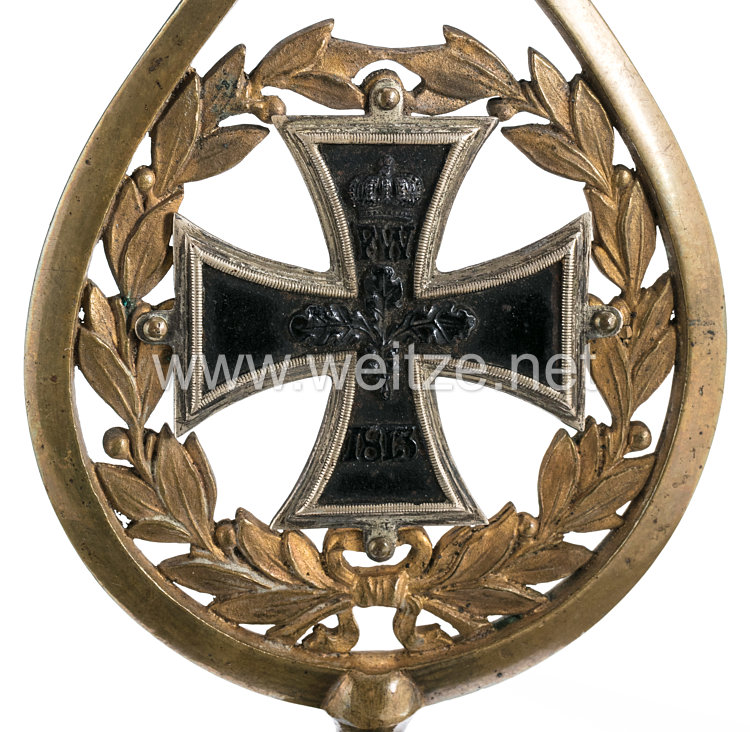
The flag finial made of fire-gilded brass bronze, at the center a laurel wreath with riveted Grand Cross in silver frame, blackened iron core. Overall height 24 cm. Used piece with typical age-related wear, in beautiful untouched original condition.
After the campaign of 1870/71, the Kaiser awarded all Prussian battalion flags that had been “under enemy fire” the new flag finials with the Iron Cross as a distinction. The cross set into the flag finial is identical to the Grand Crosses of the Iron Cross 1870 awarded during the campaign. Very rare and a highly desirable piece for any Iron Cross collector.
Compare Dr. F. Wernitz/V. Simons “Das Eiserne Kreuz 1813 1870 1914 Geschichte und Bedeutung eines Auszeichnung” page 156 ff.
278278

Prussian Battalion Flag Finial with Grand Cross of the Iron Cross 1870

The Prussian Battalion Flag Finial with the Grand Cross of the Iron Cross 1870 represents one of the highest honors that could be bestowed upon a military unit in the German Empire. This decoration for regimental colors is rooted in Prussian military tradition and marks a significant moment in German imperial history.

Following the victorious Franco-Prussian War of 1870/71 and the proclamation of the German Empire in January 1871, Emperor Wilhelm I decreed on June 16, 1871, during the triumphal entry of victorious troops into Berlin, that all battalion colors that had participated in combat would receive new finials bearing the Iron Cross as a battle honor. This award continued the Prussian tradition established after the Wars of Liberation (1813-1815), when Friedrich Wilhelm III awarded Iron Cross finials to flags that had fought against Napoleon.

The finial itself is a masterpiece of military craftsmanship. It consists of a fire-gilded brass-bronze frame with a total height of approximately 24 centimeters. At the center is a laurel wreath containing the riveted Grand Cross of the Iron Cross. This cross features a silver frame and a blackened iron core that is magnetic. The Grand Cross set into the finial is identical in design to the personal Grand Crosses of the Iron Cross 1870 awarded to nine recipients during the war: Helmuth Graf von Moltke, August Karl von Goeben, Prince Friedrich Karl of Prussia, Crown Prince Albert of Saxony, August Karl von Werder, Edwin von Manteuffel, Crown Prince Friedrich Wilhelm of Prussia (March 22, 1871), King Wilhelm I of Prussia (June 16, 1871), and Grand Duke Friedrich Franz II of Mecklenburg-Schwerin (December 4, 1871).

The award criteria were strictly defined. The finials were exclusively awarded to Prussian battalion colors that had stood “under enemy fire” during the Franco-Prussian War of 1870/71. Initially, 99 Prussian battalion flags and 15 cavalry standards received the new finials with the Grand Cross following the campaign. An additional seven Prussian flags were honored later. Units whose flags had been left behind during deployment according to regulations received the honor on April 11, 1872. One notable exception was the flag of the II Battalion of the 8th Pomeranian Infantry Regiment No. 61, which did not receive this distinction because it had been captured by the enemy in the Battle of Lisaine near Dijon. Flags that did not receive the Iron Cross finial were awarded the ribbon of the War Commemorative Medal 1870/71 instead. Subsequently, 110 flags of non-Prussian German federal state units that had also stood in combat received the Iron Cross.

Two main types of Iron Cross flag finials existed: the 1813 pattern with the Iron Cross surrounded by two laurel branches in a slender finial (for units that fought in the Wars of Liberation), and the 1870 pattern with the Grand Cross surrounded by a laurel wreath in a broader finial. Battalions that had earned both distinctions retained the 1813 finial and received special double flag ribbons. Standard battalion finials without the Iron Cross featured the crowned royal cipher “WR” (Wilhelm Rex) and measured approximately 22 centimeters in height.

Many finials remained in service on battalion colors through World War I. After the German Empire's defeat in 1918 and Kaiser Wilhelm II's abdication, many Prussian regimental colors with their decorations were stored, hidden by veterans' organizations to prevent confiscation, or transferred to museums and archives. The Weimar Republic introduced new republican flags. Numerous Prussian colors and their finials were lost during World War II; the Red Army confiscated many military trophies in 1945, including flags with their ribbons and finials, which were taken to Moscow. Today these finials are highly prized collectors' items and important militaria representing Prussian-German military tradition.