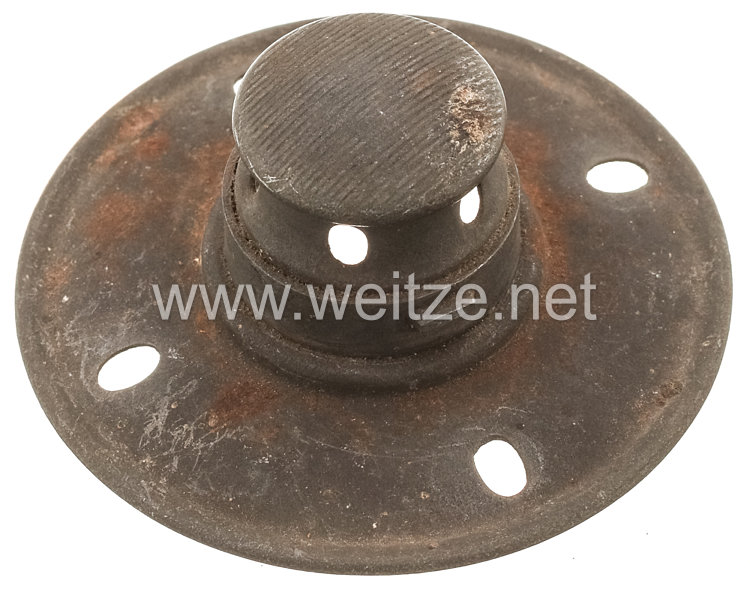
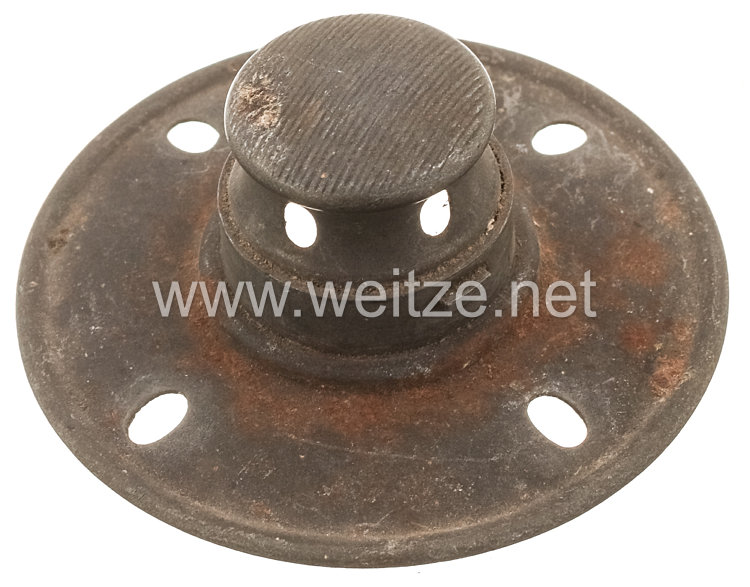
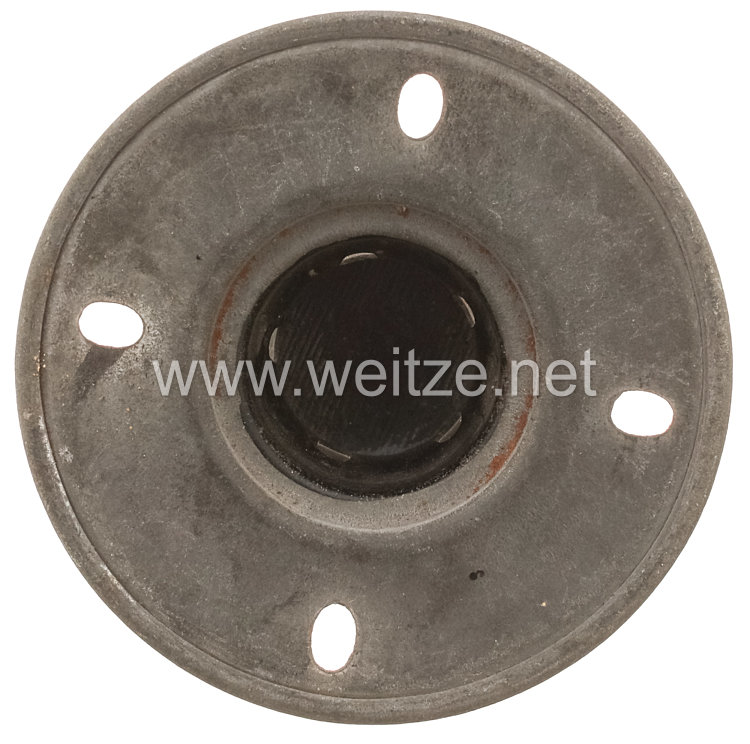
Prussia WWI Field Gray Plate for Pickelhaube for Enlisted Men Infantry or Artillery
The field-gray plate for the Pickelhaube of the Prussian infantry and artillery from World War I represents a significant transformation in military equipment forced by the realities of modern warfare. This specific specimen, manufactured from iron and painted field-gray, dates to around 1915 and demonstrates the pragmatic adaptation of German forces to the conditions of trench warfare.
The Pickelhaube, originally introduced in 1842 under King Friedrich Wilhelm IV of Prussia, was for over seven decades the characteristic identifying feature of the Prussian and later German army. The helmet with its distinctive spike became a symbol of military power and Prussian discipline. At the outbreak of World War I in August 1914, German soldiers still wore the traditional leather Pickelhauben with shining brass fittings – equipment designed for parades and 19th-century warfare.
The reality of war on the Western Front, however, quickly changed the requirements for military equipment. Trench warfare with its dugouts, modern artillery, and snipers made every shining or conspicuous element a deadly danger. The polished brass fittings of the early Pickelhauben reflected sunlight and made soldiers easy targets. As early as autumn 1914, front-line units began covering their helmets with mud or cloth to avoid the telltale reflections.
In response to this necessity, the Prussian War Ministry ordered the production of Pickelhauben from alternative materials and in subdued colors from 1915 onwards. Leather became scarce and was needed for other war-essential purposes. Sheet iron became the preferred material as it was inexpensive, available, and sufficiently malleable. The characteristic field-gray paint matched the new uniform color introduced in 1910, which had replaced the colorful uniforms of the 19th century.
The plate, the flat disk element on the front of the Pickelhaube, traditionally bore the national emblem – for Prussia, the star with the motto “Gott mit uns” (God with us) for enlisted men, or various state coats of arms for other German states. On this field-gray iron specimen, the plate was also painted in the camouflage color, often using stencils to paint or emboss the insignia rather than using shining metal fittings.
The notation “without spike” is characteristic of many surviving specimens. The helmet spike could be unscrewed and was often lost in combat or deliberately removed, as it was impractical in trenches and added unnecessary height. From 1916 onwards, Pickelhauben were increasingly produced with removable or lower spikes, and eventually a fabric cover was introduced that concealed the entire spike.
The distinction between infantry and artillery for enlisted men's Pickelhauben was made primarily through details of the fittings and partly through the shape of the spike. While infantrymen wore a straight spike, artillerymen traditionally had a ball-shaped spike. However, with the simplified wartime models made of iron, these distinctions often became less pronounced.
The year 1915 marks a transitional period in German helmet production. While the Pickelhaube was still being produced and worn, experiments with new helmet designs were already underway. The catastrophic head injuries from shell fragments and shrapnel led to the development of the Stahlhelm (steel helmet), which was tested from late 1915 and distributed to troops on a large scale from early 1916. The famous M1916 steel helmet would completely replace the Pickelhaube in front-line service, although the latter was still used until the end of the war by occupation troops, in rear areas, and for ceremonial purposes.
The condition rating “2” indicates a well-preserved specimen showing typical signs of use but structurally intact. Such field-gray iron Pickelhauben are today less common than pre-war leather versions, as they were often disposed of or melted down after the war as makeshift wartime equipment.
This object impressively documents the transition from traditional to modern warfare, from representational to functional military equipment. It stands symbolically for the end of a military era in which tradition and appearance still played important roles, and the beginning of a new age in which camouflage, protection, and functionality dominated the design of military equipment.