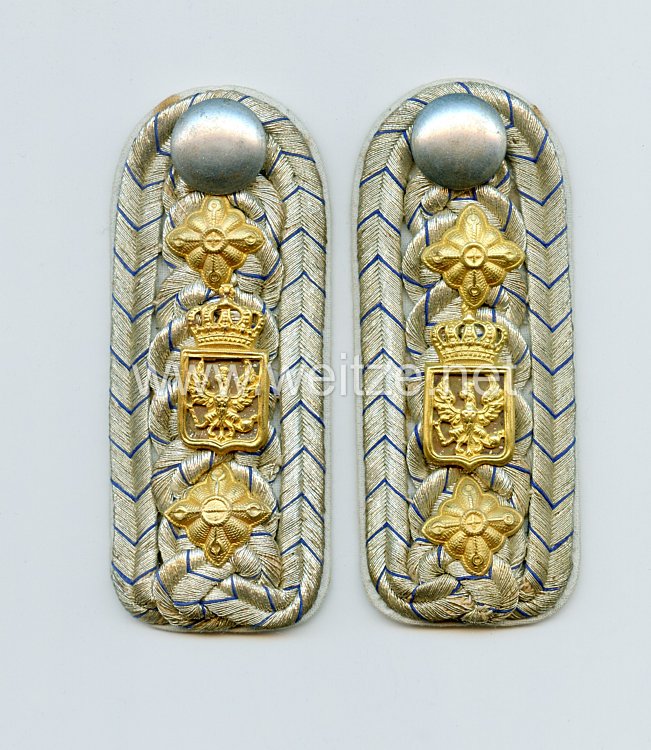
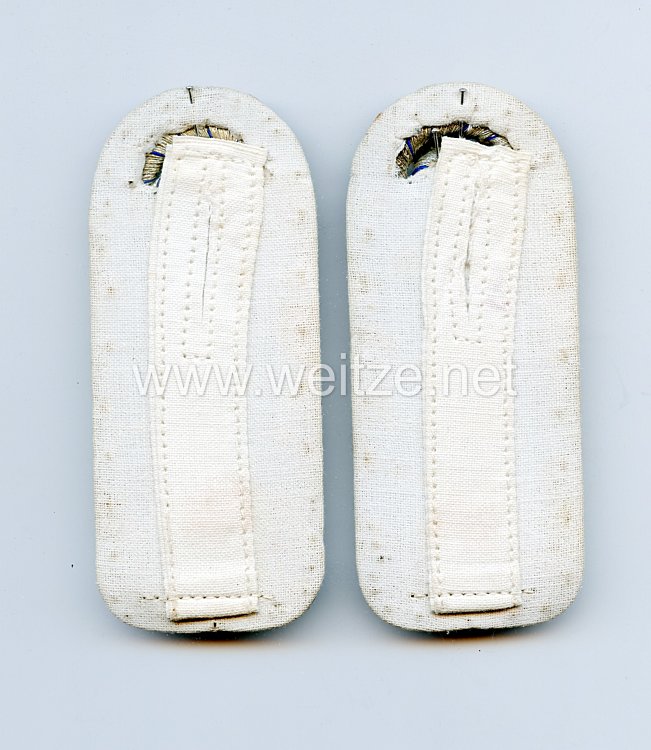
Prussia World War I Treasury/Finance Department Pair of Shoulder Boards for a Financial Councilor (Rechnungsrat)

Circa 1917. Condition 2.
414578
180,00

Prussia World War I Treasury/Finance Department Pair of Shoulder Boards for a Financial Councilor (Rechnungsrat)

The shoulder boards of a Rechnungsrat (Accounting Councillor) in the Prussian military finance administration during World War I represent a fascinating aspect of the administrative structure of the German Empire's military. These rank insignia illustrate the complex organization of the Prussian military establishment, which consisted not only of combat troops but also of an extensive administrative apparatus.

The Prussian Kassenwesen (finance administration) formed the financial backbone of the armed forces. Rechnungsräte belonged to the category of military civil servants and were responsible for the administration, control, and accounting of military finances. Their position was of considerable importance, particularly during World War I, when logistical and financial requirements increased exponentially. The proper management of pay disbursements, ration allowances, equipment costs, and other military expenditures required specialized personnel with particular expertise.

The Schulterstücke (shoulder boards or epaulettes) served in the Prussian Army to identify rank and affiliation with specific branches or administrative departments. For military civil servants of the finance administration, these rank insignia were designed in specific forms. Typically, the shoulder boards of a Rechnungsrat displayed characteristic coloring that indicated the administrative career path. The base color was usually dark green, the traditional color of military administration.

The dating “circa 1917” is of particular significance. In this year, the German Empire was in the third year of World War I. The Hindenburg-Ludendorff Supreme Army Command had assumed military leadership, and the Reich's resources were being utilized to their maximum capacity. The administrative structures had to keep pace with the enormous expansion of the armed forces. The number of military civil servants, including Rechnungsräte, grew correspondingly to meet the tremendous bureaucratic demands.

A Rechnungsrat typically held a middle to senior rank within the military administration. The title “Rat” (Councillor) indicates a position of considerable responsibility and experience. These civil servants often worked in the intendancies of army corps, divisional administrations, or central administrative offices in Berlin. Their duties included the examination of accounts, supervision of treasuries, preparation of financial reports, and advising command posts on financial matters.

The shoulder boards were worn on the uniform, typically on the Waffenrock (dress tunic) or field blouse. Manufacturing occurred in various quality grades. High-quality specimens displayed fine handwork with metal threads, while later wartime productions were simplified for economic reasons. The pair described here from around 1917 falls into a phase when material shortages were already noticeable, but quality was not yet as severely affected as in the final months of 1918.

The Royal Prussian Army Administration was strictly regulated. Uniform regulations were specified in detailed uniforming directives that were regularly updated. These regulations precisely determined which rank insignia were to be worn by which personnel. Separate regulations existed for military civil servants that differed from those for officers and enlisted men.

After the end of World War I and the collapse of the monarchy in November 1918, these shoulder boards lost their official function. The Reichswehr of the Weimar Republic introduced a new uniform system. Nevertheless, many former military civil servants kept their uniform items as mementos of their service. Today, such objects are important historical witnesses that provide insight into the administrative structures and uniform practices of the Imperial era.

The condition rating of “2” indicates a well-preserved specimen, which is remarkable for a textile item over one hundred years old. This enables historians and collectors to study details of manufacturing techniques, materials, and design. Such objects contribute significantly to understanding the material culture of World War I and complement written sources through their physical presence.

r